
Editor's note:At Apple's new product launch conference held at 1 a.m. on September 8, Beijing time, it did not provide iPhone 7 and iPhone 7 Plus that exceeded people's expectations. After all, this is not the first time that Apple has failed to make a major breakthrough in the iPhone series.
The following article written at the 2016 Apple Worldwide Developers Conference (WWDC 2016) (first published on Business Review Network, please do not reprint) discusses the topic of why Apple’s innovation capabilities have become weak. Although it will take time to prove whether its conclusion is correct or not, the analysis and summary of corporate innovation capabilities in this article are worthy of our deep thought.
………………
Apple's Worldwide Developers Conference (WWDC 2016) ended in San Francisco. The content of this conference was mediocre, and Wall Street gave a clear signal - there were no bright spots and exciting places, let alone the existence of innovation. Immediately, the closing price of Apple's stock market fell by 1.5%, and the trading volume was far less than normal levels. Wall Street's elite voted for Apple's conference with their feet.
It may not be possible to tell Apple's decline from just one stock price fluctuation, so let's take a look at Apple's other data this year: the latest report from global market research firm TrendFroce shows that Apple's shipments dropped from 75 million units to 42 million units in the first quarter of 2016, with a quarterly decline of 43.8%, the largest single-quarter decline in history; IDC also released its latest report at the beginning of the month, saying that iPhone shipments in 2016 will decline by 2%. Market performance directly affects Apple's stock price, which has fallen 21% compared to its 2015 high.
In fact, I am not looking forward to the release of iPhone 7 or iCar, because as early as the end of 2012, I had already seen Apple’s inevitable decline.
Why is Apple bound to decline in the Cook era?
Apple’s current prosperity is due to the solid foundation that Jobs laid for Apple. How long can the dividends he left last?
In 2012, I predicted Apple's decline in class. This month in my open innovation class, one of my students (who is also an Apple supplier) told me that through cooperation with Apple and various Apple data, he became more and more convinced of my original prediction.
In fact, not only can I see it, but you can also see Apple's future using my simple analysis system for companies; even my ten-year-old daughter - with her pure heart of a child - can get a similar answer: I no longer like Apple, as if they update just for the sake of updating.
Drucker told us that the two most important basic functions of an enterprise are innovation and marketing. In this article, let us first take a look at the changes in Apple products in the Steve Jobs era and the Cook era from an innovation perspective.
Without Zen innovation, what is left of Apple?
Jobs did almost no market research, but he could always perceive and grasp consumer needs very accurately, and he could always lead new fields and guide consumer trends. On the surface, Jobs rarely caters to consumers, but he always allows competitors to imitate, and he always brings constant surprises to consumers - they are surprised to find that Jobs has created products for them time and time again that they have already sketched in their minds but do not yet understand.
Jobs created perfect innovation. Every product in the Steve Jobs era was so simple, full of beauty, and infinitely creative. I think that's a wonderful innovation, and products from the Steve Jobs era were full of differentiation. But all this disappeared in the Cook era. Cook violated all the principles of "making Apple wonderful" that Jobs adhered to, began to cater to consumers, began to pay attention to competitors, and became more and more like competitors.
iPhone 5S and iPhone 6 have exceeded the size that Jobs considered the largest and most beautiful. They are getting closer to the mainstream of the mobile phone market and are becoming more and more similar to Samsung's products. Although the sales data of these two products are very good, if you take a closer look, what have they lost? It's the characteristics. They have lost the characteristics of Apple in the Steve Jobs era.
Let’s take a look at the iPhone 5C, a series of colorful, cheap products with cheap plastic casings. Completely forgetting the mental positioning that Jobs has spent many years creating! Anyone who understands marketing strategy should see how obvious this move is and how it has failed countless times in marketing history! Sure enough, although 9 million units were sold within a week of its launch, data at the end of 2014 showed that the sales situation of this mobile phone was not optimistic, with an inventory of more than 3 million units. The iPhone 5C was the first mobile phone released by Apple with 6 different colors; the iPhone 6 was later launched. Due to different screen sizes and capacities, there were five different products for consumers to choose from. In the Steve Jobs era, there were only two products for each product to choose from!
Do consumers really want so many choices? Will this confuse consumers and make them confused about who Apple phones are for? In 1997, when Jobs returned to Apple after being exiled for 11 years, when he saw a bloated, mediocre company and cumbersome product line, he cursed the classic saying "it's all stinky shit" because these products had no personality and no characteristics.
The most important Zen concept in Jobs’ innovation is simplicity and beauty, but looking at the protruding camera on the back of Apple’s phone, it’s really impossible to associate it with simplicity. Why was simplicity lost? I see that the underlying reason behind this is that Cook can no longer see the direction of innovation and can only throw out a bunch of products and let consumers choose. What I see is that Apple is losing its strategic direction, its market positioning, its product positioning, and its sense of direction.
Three realms of innovation
Where does a company’s sense of direction come from? Enterprises are like people. Only when you stand high enough can you see the road in the distance clearly; the soul of a company is exactly the mind and character of the entrepreneur. I take the direction that entrepreneurs focus onIt is classified into the material level, the mental level and the character level; accordingly, in terms of innovation management, there are material innovation (only focusing on innovation at the material level), character innovation and mental innovation. In my opinion, the sense of direction of an enterprise should come from a broad heart and a noble soul. Only by having a broad heart can you stand high, see far and see the direction clearly. This is precisely reaching the level of mind.
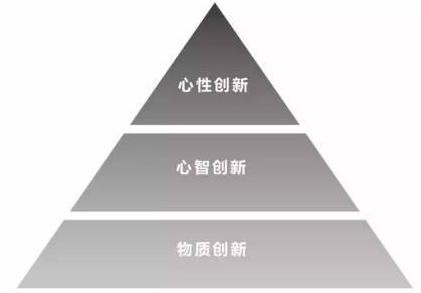
In my view, there are very few people who can achieve mental innovation, and Steve Jobs is one of them. What is innovation at the level of mind and nature? For innovation, what is most needed is a sense of direction, the ability to be aware of customer needs, and even the potential needs of customers - this requires us to have a lot of inspiration. When it comes to the word inspiration, what do you think of spirit and sense? In my opinion, inspiration is the feeling after being able to communicate with the soul. So, how can we have the ability to communicate with the soul?
Judging from Jobs’ experience, meditation undoubtedly had a great benefit on his innovation. In Jobs’ words: When your mind can be completely silent, your vision will expand, and you will see things that you could not see before. This is innovation, and it is also the highest state that I think innovation can achieve.
Rebuilding Apple? I see no hope
Does Cook have a chance to reorganize Apple? To be honest, I don't see hope for the time being. Steve Jobs created a great company with a great heart, but like many CEOs who seek to establish themselves as CEOs, they often make mistakes. He chose a completely different entrepreneur who could complement him as COO, and did not prepare a successor with the same heart for Apple.
Cook does not have Jobs's pursuit of spirituality, his meditation, and the awareness that comes with it, so it is natural that he does not have Jobs's insight into the market and customers. But these are not qualities that all successful entrepreneurs have, and they are not the reasons why I am not optimistic about Cook.
Many successful entrepreneurs may not be able to reach the spiritual level of Steve Jobs, but it does not prevent them from walking on the road to success, and it does not prevent them from still being classified as entrepreneurs at the spiritual level! In my opinion, as a disciple of Zen Buddhism, Jobs already possesses the basic qualities of a Zen practitioner. Zen Buddhism belongs to Mahayana Buddhism. The core point of Mahayana Buddhism is to be altruistic and compassionate. Judging from outside reports on Apple, it may be difficult for us to ask Cook to be as Zen-like as Steve Jobs. However, if you can truly consider your customers wholeheartedly, be customer-centric, and be completely altruistic, you can still mobilize your deepest inspiration and understand customer needs. This is precisely what disappoints me the most about Cook.
In September 2012, when the first mobile phone after Cook took over was launched, a seemingly small thing allowed me to see Cook's future decline. That is, the iPhone 5 has changed from a large interface to a small interface. Not only does the product package not come with a converter, but the retail price of this accessory is ridiculously high. Many fruit fans like me and many five-star hotels have to throw away their original peripheral devices with large interfaces. This is not only an indifference to consumer needs, but also treating consumer needs as a "cash cow" to expand profits. Coupled with the outrageous Apple Maps, the paint will start to peel off immediately.Back cover. I immediately decided not to upgrade with Apple.
Obviously, today's Apple no longer puts customer needs first as Jobs did, focusing on creating perfect products and fully controlling the best quality - all of this is no longer so important. What Cook focuses on is operations and costs, and his relationship with Wall Street. He seems to have forgotten the core point of the Steve Jobs era: all corporate profits come from customers. It can be seen that what really makes Cook have no future is not Zen but from the height of the soul. From the height of philosophy, if he loses altruism, he loses the awareness of becoming one with customers, and he loses height; when he loses height, he loses his sense of direction; when there is no direction, he loses simplicity; when he loses simplicity, he loses beauty. The safest way is to provide a variety of choices, and a bloated and mediocre company emerged.
When the soul of managers drops from the mental level to a lower level, companies will focus too much on profits, employees will lose their passion, talents will inevitably be lost, inspiration will disappear, and ultimately, companies will no longer innovate. An enterprise without innovation has no future at all and will inevitably go downhill. At that point, all that’s left is marketing and falling into constant price cuts.
Compared with Jobs, Cook is far from the level of character of Jobs.
The future of the enterprise will not only be altruistic, but also altruistic
To observe whether a company can develop sustainably, just look at one thing: whether it is still wholeheartedly altruistic. And this altruism not only benefits customers, but also benefits all aspects. One of my students was a supplier to Apple. She said that altruism is no longer seen at Apple. Under Cook's management, Apple has completely changed its original focus on technology and quality. Now they are more focused on profits and how to get more costs from upstream and downstream. When Cook is not good for consumers, he has no way to truly benefit upstream and downstream companies.
Jobs’ beautiful soul lasted for five years. From the time he left us in 2011 until 2015, Apple’s stock price continued to rise under his lingering influence, but now it has dropped by more than 20%. With the passing of Jobs, Apple's most important soul (the level of psyche) has also gradually passed away. The rest are only measures at the mental level or the material level. If it falls to this level, the company will inevitably fall into the red sea of price war, and its future can be imagined.
Where is Apple’s way out?
It is to allow Steve Jobs’ soul to be maintained at Apple for a long time. This is not a crazy statement, so successful entrepreneurs should, like Steve Jobs, have an altruistic heart to make the world a better place, and then search for spirituality, find a guru who can guide practice, and start practicing meditation. When a company grows to a certain level, it begins to enter a mid-life crisis or even decline in old age. The only thing that prevents this from happening is the most classic words said by Steve Jobs - stay true to your original aspirations. The original intention is a beautiful thing. The original intention is to "Stay hungry, Stay foolish", allowing you to see the world and the needs of customers clearly with your child-like eyes.
Apple’s decline may be an opportunity for Chinese entrepreneurs.
We see a group of growing companies, such as Huawei, Xiaomi, OPPO, and vivo. If they can understand the core of Steve Jobs’ marketing innovation and realize theIf Si's Zen reaches the level of mind, then there will definitely be great potential.
Perhaps this is the best opportunity in the land of China, which has ancient oriental culture and the roots of Zen Buddhism.
(The author Zhao Yue is a professor at the Business School of the Hong Kong University of Science and Technology. This article is copyrighted by Business Review Network http://www.ebusinessreview.cn or provided with authorization from content partners. If you have not obtained authorization from Business Review Network, please do not reprint.)
