North Korea conducted its fifth and largest nuclear test on September 9, which sounded the alarm for everyone.
Thomas Karako, director of the Missile Defense Program at the U.S. Center for Strategic and International Studies (CSIS), said in an interview with Business Insider: "The tone of researchers on North Korea and South Korea has changed. This is no longer a joke. We cannot still regard North Korea as a second-rate missile power. It is not safe to ignore them." ”
The following figure compares the range and strike capabilities of North Korea's various ballistic missiles:
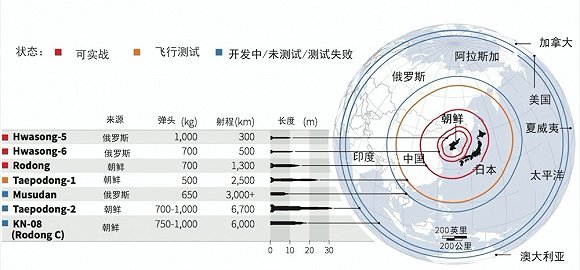
(Note: "Hwasong"; "Rodong"; "Taepodong"; "Musudan")
Calarco said: "North Korea's missile capabilities are making progress on multiple fronts, and the United States and its regional allies must respond." ”North Korea has test-fired more than 15 ballistic missiles this year and launched 30 rockets of various types.
“The accelerated frequency of North Korea’s missile tests not only proves their existing short- and medium-range missile launch capabilities,” he said, “it also reflects their ambition to develop missile launch systems with longer range and greater maneuverability.” ”
Earlier this year, the United States and South Korea agreed to deploy the THAAD defense system in South Korea to enhance defense capabilities. Seoul plans to work with the United States to implement the THAAD system by the end of 2017. At the same time, South Korea's Defense Ministry stated that North Korea is ready to conduct a new nuclear test at any time.
South Korean Defense Ministry spokesperson Moon Sung-jin said in a press briefing: "The assessment of the U.S. and South Korean intelligence agencies is that North Korea has been preparing to conduct a new nuclear test at the Punggye-ri nuclear test site." ”After North Korea conducted its latest nuclear test, the United Nations Security Council has begun to discuss corresponding resolutions.
(Translation: Wang Yinuo)