
After using the iPhone 7 for a week, I decided to change some of the statements in the hands-on article at the press conference.
I try to summarize the deviations in my judgment at different points in time: perceptual factors such as surprise and visual impact always inevitably appear in active, assembly-line short-term tests, and when a tool frequently and passively appears in various scenes in life, its evaluation criteria should be more on whether it can meet or even exceed your expectations.
Ai Faner (WeChat ID: ifanr) believes that the latter is the original intention of the review. So we'll talk more about things you can't see.
What’s special about the glossy black version is not just its “deceiving” appearance
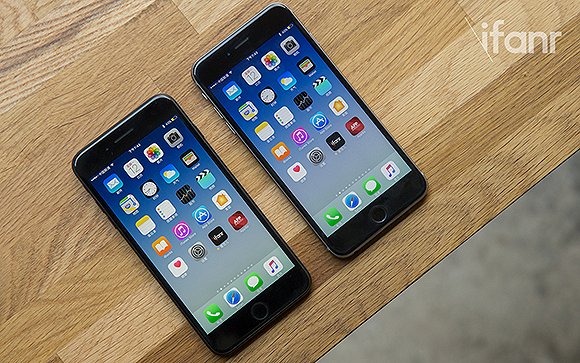
iPhone 7 breaks the "rule" of appearance upgrades every two years for the first time. Viewed from the front, you might not be able to tell the difference between iPhone 7 and iPhone 6s. To a large extent, some regrets that you don't want to admit come from here.
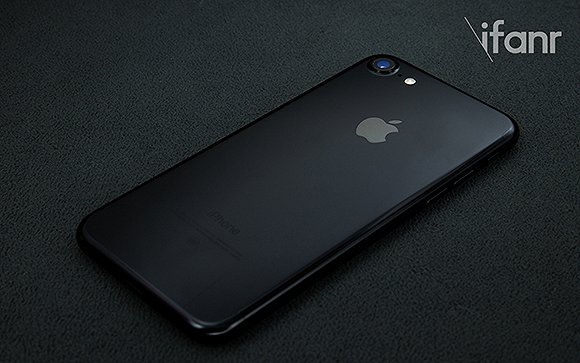
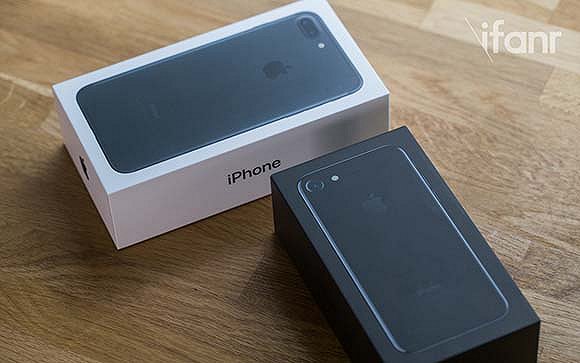
Jet Black (glossy black version) is similar yet unique. For the first time, Apple uses an adjective to describe the color of the iPhone, rather than corresponding to a real image like space gray and rose gold.
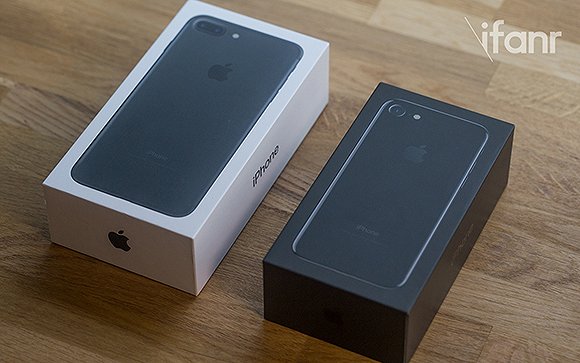
The biggest feature of the glossy black iPhone is the craftsmanship on the back. It has a deep luster like a piano and is crystal clear like glass ceramics, making it difficult to distinguish the boundary between the body and the screen. If I don’t tell you that this is aluminum alloy, I’m afraid most people will mistake it for glass.
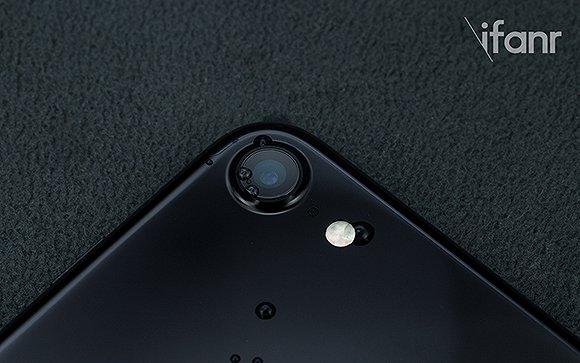
Behind the "deception" is actually another bold attempt by Apple to manufacture mobile phone casings.
Apple chief designer Jonathan Ivy revealed part of the manufacturing process in a video, which can be summarized as "CNC-grinding-anodizing-polishing-coating." It should be noted that this is slightly different from the technology used by mobile phone manufacturers in the manufacturing process of back cases.
The abrasives used for polishing are very interesting. After research, Ai Faner (WeChat ID: ifanr) found out that the clumps of fluffy objects in the video are probably wool, and there may be some very small abrasive particles attached to them.
On the glossy black version of iPhone 7, it is difficult to see the plastic antenna lines clearly. In addition to the fact that the color of the plastic itself is similar to that of the metal anode (colored), it is also because the two materials have almost the same glossiness, which is the level of plastic polishing.A manifestation.
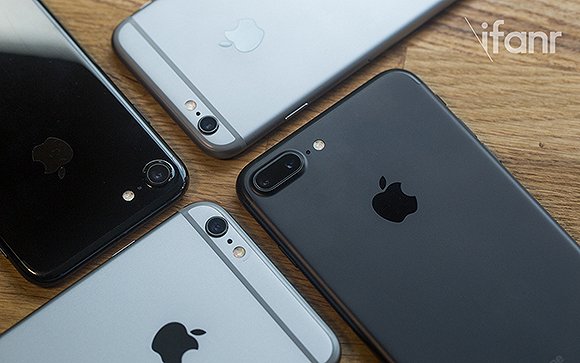
“This is the way to create a work of art.” A relevant practitioner commented on the manufacturing process of the new iPhone.
From the ABS plastic back shell that is almost directly usable after the initial injection molding, to die-casting or even a single piece of aluminum ingot CNC, and finally to the mirror back shell that has undergone complex polishing this time, this is an evolution from "seconds" and "minutes" to "hours", and it is also the "limit" that the current machining industry can achieve in mass production.
Of course, the price of manufacturing "handicrafts" is that the processing time of the back shell is greatly lengthened. This also means that the cost of the iPhone 7’s back case has increased significantly. Industry insiders estimate that the cost of a single back case will reach about 200 yuan.
On a mobile phone with quarterly shipments of tens of millions, using such a time-consuming process does go against "logic", but given Apple's current control over the supply chain, this is a "surpass" for other mobile phone manufacturers.
Despite its superior technology, the practical value of the glossy black iPhone 7 may not match its gorgeous appearance. After a week without using a protective case, the iPhone 7 in our hands has already developed a very obvious scratch. Apple also reminds on its official website that the surface of the glossy black version may show slight wear and tear with daily use, and it is recommended that "perfect parties" use protective cases.
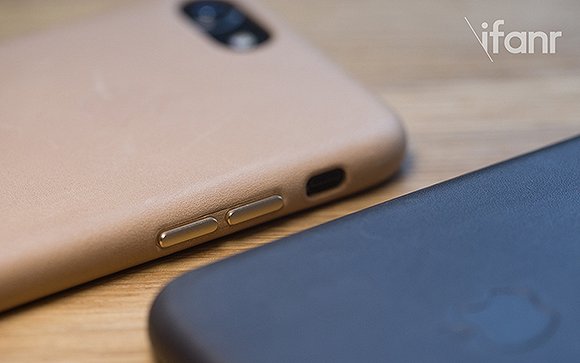
Wide color gamut screen, the look and feel is not so obvious
The iPhone 7 series still maintains the screen resolution of the previous two generations and adds support for wide color gamut technology. Simply put, it allows you to see images with richer details.
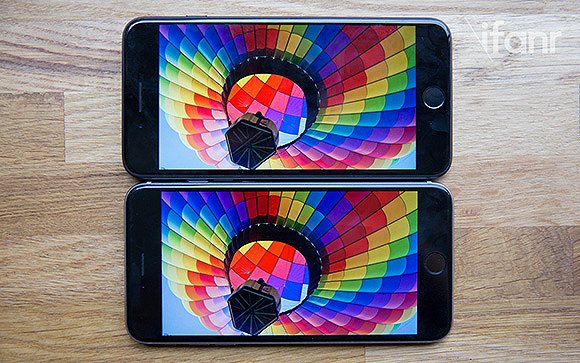
If you don’t put two mobile phones togetherComparing the same bright photo, you may not be able to feel the improvement of the screen.
The color temperature of the screens of these two iPhone 7s is obviously lower than that of the iPhone 6s Plus I have.
The iPhone 7 takes photos as well as the iPhone 7 Plus, but the Plus is a long-range weapon
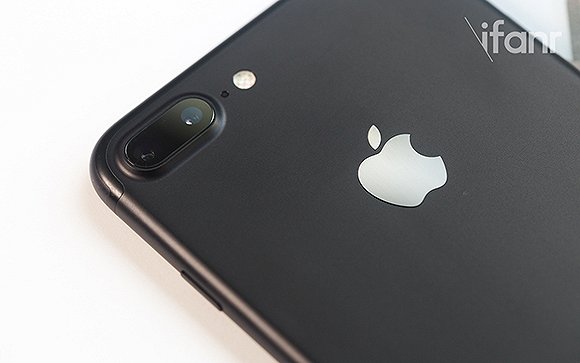
If you criticize the protruding camera on iPhone 6/6s, then the larger camera on iPhone 7 will probably not make you more satisfied.
The camera is the highlight of the iPhone 7 series. When explaining the top ten innovations of iPhone 7, Apple spent almost half of the time on the camera.
In terms of parameters, the improvements of both phones are obvious: the aperture of the lens has been increased from f/2.2 to f/1.8, and the 4.7-inch iPhone 7 is also equipped with optical image stabilization. iPhone 7 Plus is also equipped with dual cameras that provide two times the optical zoom without loss of image quality.
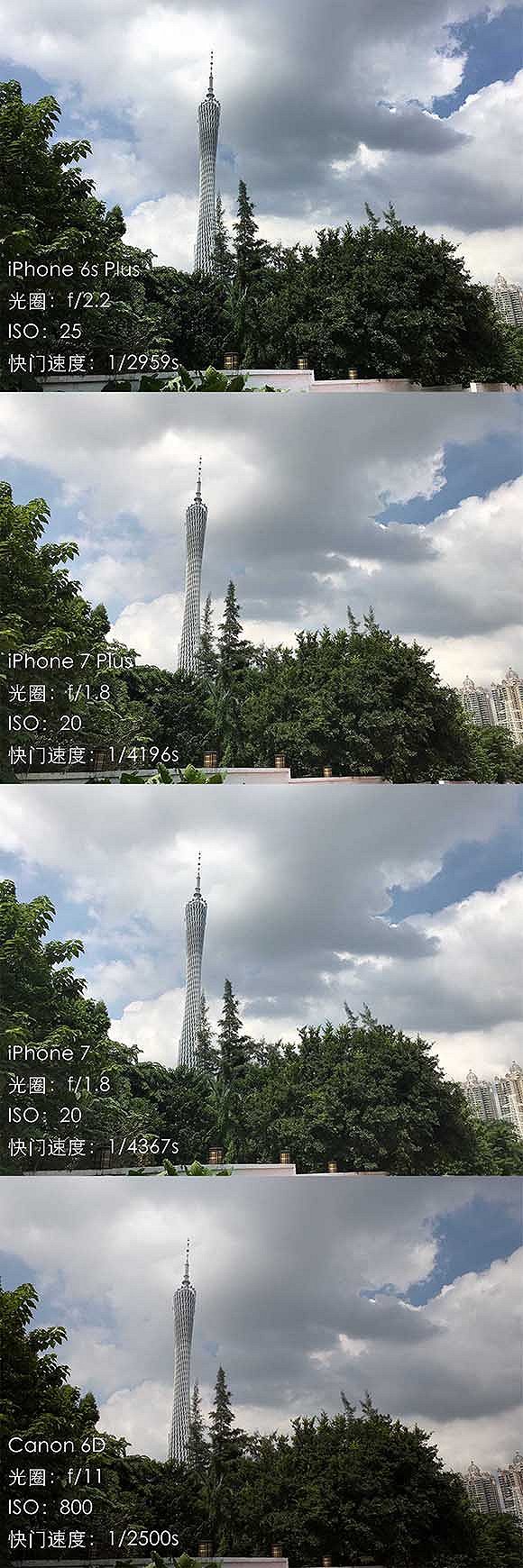
In the first set of samples, most of the iPhone 6s Plus can only see the outline of the leaves, while the iPhone 7 and 7 Plus can retain more details. Referring to the footage produced by Canon 6D, the white balance of iPhone 7/7 Plus is more accurate than that of iPhone 6s Plus, and is closer to the effect seen by the naked eye. However, the colors of iPhone 6s Plus are more vivid and eye-catching.
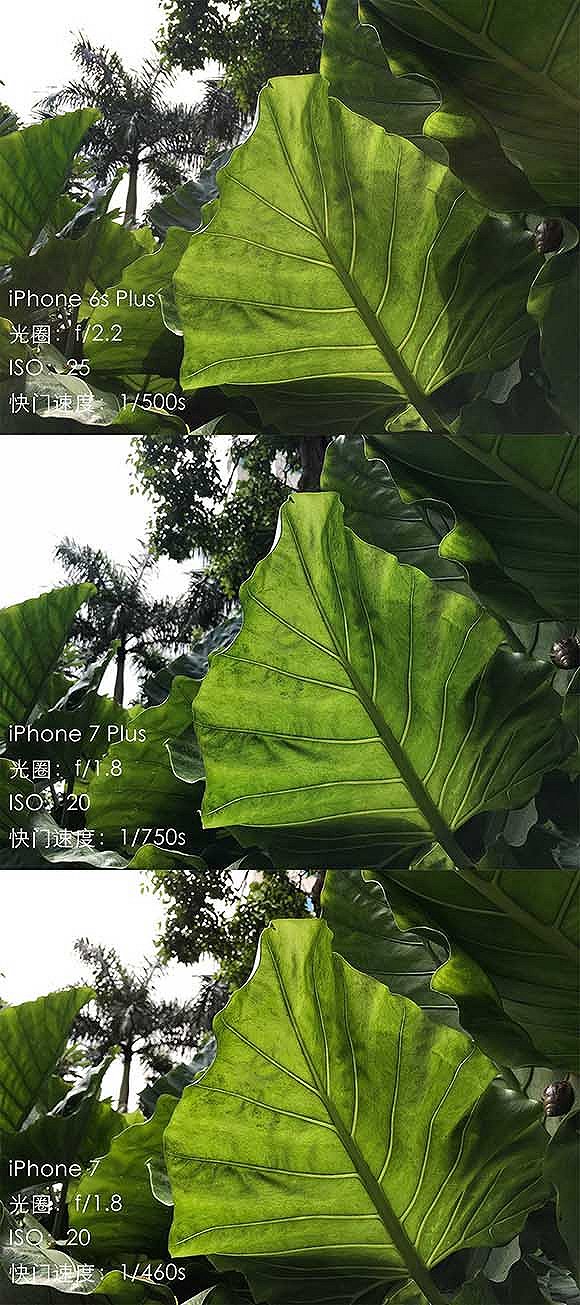
The second set of samples. It can be seen from the texture of the green leaves that the resolution and imaging contrast of the iPhone 7 Plus are more than half a step higher than the iPhone 6s Plus. The larger aperture allows the iPhone 7 Plus to effectively compress the exposure time and reduce the impact of hand shake on imaging. This is also good news for users who are accustomed to using mobile phones to take still life pictures.
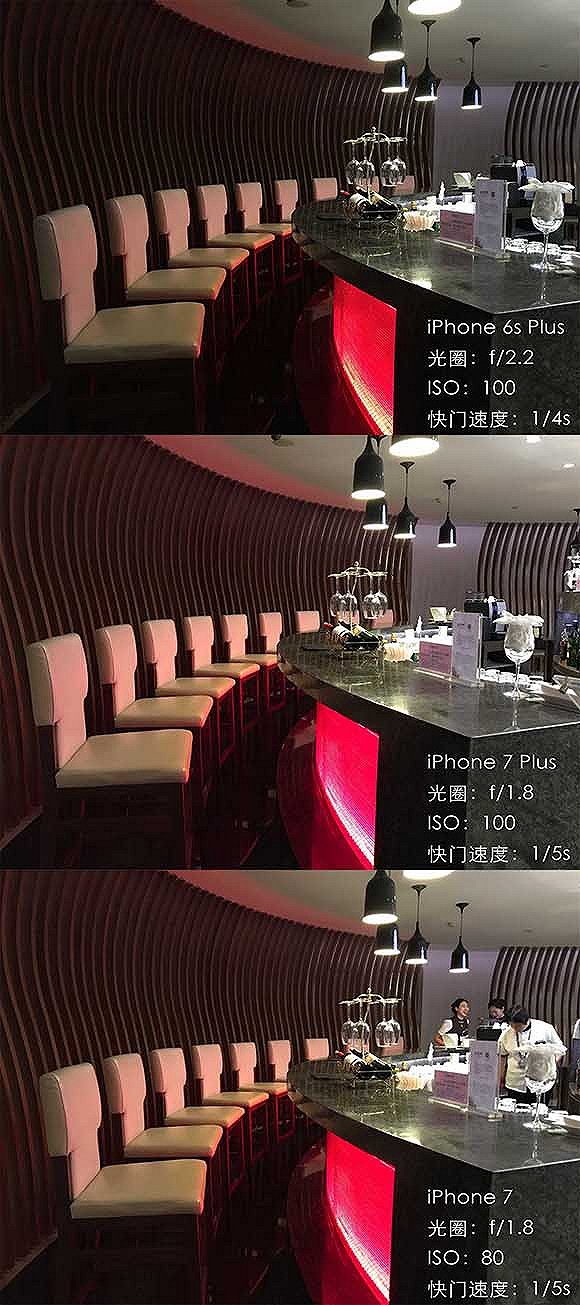
Thanks to the larger aperture and optical image stabilization, iPhone 7 shows considerable advantages in imaging in dark light conditions. In the comparison of the following set of samples, the iPhone 6s Plus bar background is close to black, while the iPhone 7 and 7 Plus can still see the curve of the background clearly. It is worth mentioning that the performance of the iPhone 7 is equivalent to that of the 7 Plus.
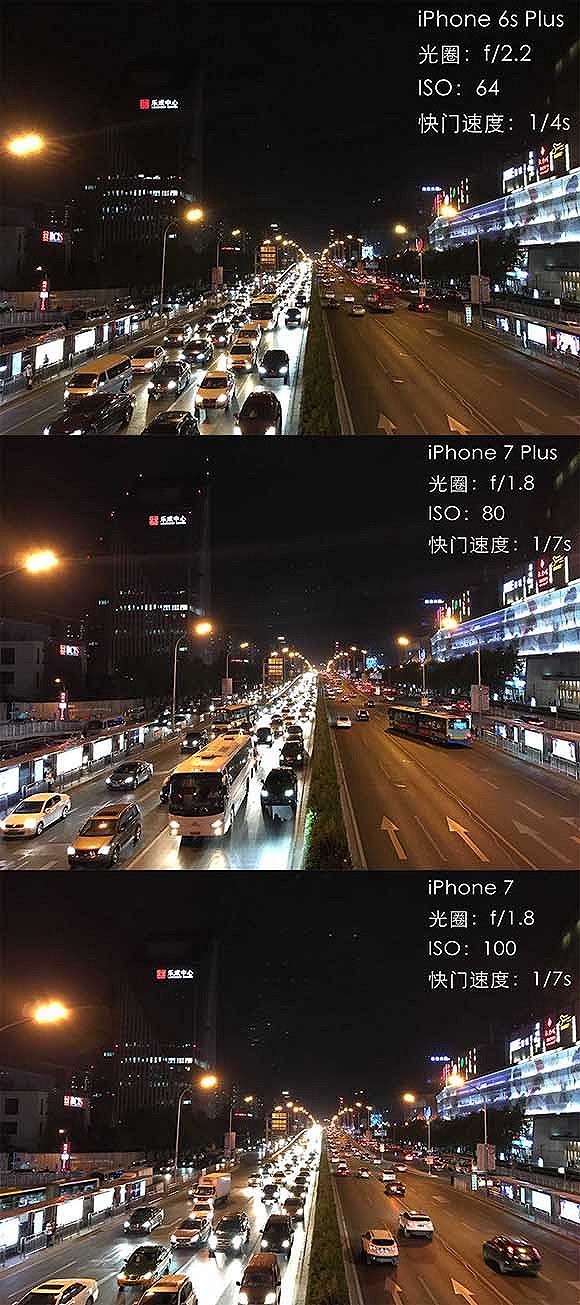
In the comparison of night scenes with complex lighting, iPhone 7 PlThe us retains more dark details than the iPhone 6s Plus, which can be seen from the buildings in the distance of the screen. In addition, the green belt captured by the iPhone 6s Plus has been severely smeared, while the iPhone 7/7 Plus can still retain the outline of the leaves.
Since the pixels of the front-facing FaceTime camera have been increased from 5 million to 7 million, the picture quality of selfies is better. In FaceTime video chat, you can also feel the clear picture quality.
Compared with these improvements, what I like most is the zoom function of iPhone 7 Plus. Due to size limitations, most smartphones are equipped with wide-angle cameras, which means that you can easily use your iPhone to take pictures of vast mid-range and long-range shots, but you cannot bring the scenery in front of you.
There are basically two ways for previous mobile phones to achieve this goal: one is to add an optical zoom component to the mobile phone lens, such as the Nokia N93i or the Asus Zenfone Zoom. Another approach is to make the pixels of the mobile phone sensor very high and simulate a telephoto effect by cropping the screen, such as the 41-megapixel camera monsters Nokia 808 Pureview and Lumia 1020.
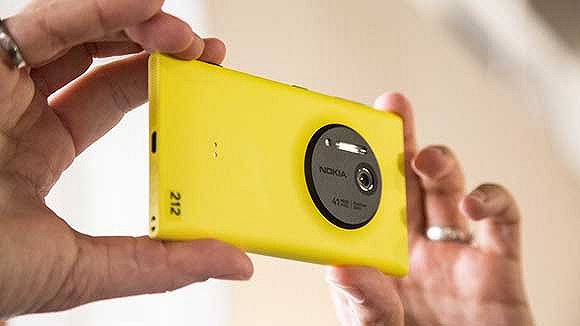
But the above two designs will make the phone very thick. The iPhone 7 Plus’ solution is to equip two cameras with different focal lengths.
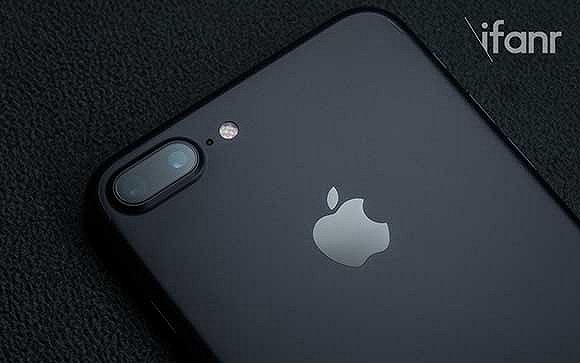
In addition to the same 28mm 12-megapixel wide-angle lens as the iPhone 7, it also has a 56mm telephoto lens on the right side.
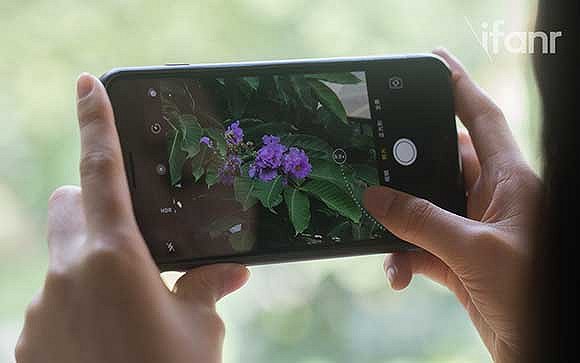
In the default photo shooting situation, the iPhone uses a wide-angle lens to shoot. When you click 1x on the photo interface, the lens will switch to the telephoto lens to achieve 2x optical zoom. Since the focal length of 56mm is closer to what the human eye actually sees, this can be a very practical feature in daily photography.
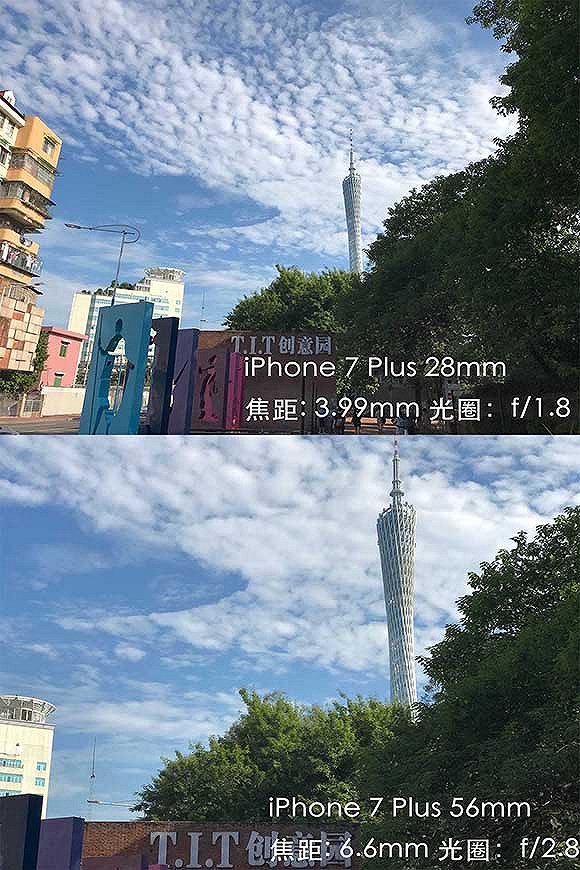
Continue to turn the zoom ring to zoom in to 10x and 6x in video shooting. In comparison, the iPhone 6s Plus’s viewfinder can only be magnified up to 5 times. The resolution of the iPhone 7 Plus is much higher than that of the iPhone 6s Plus. Although the iPhone 7 is not as good as the iPhone 7 Plus, it is still much better than the iPhone 6s Plus.

Telephoto support is an important step in allowing mobile phones to achieve true background blur, because in addition to the larger the aperture, the shallower the depth of field, the longer the focal length, the shallower the depth of field.
Unfortunately, the bokeh function of iPhone 7 Plus cannot be experienced on iPhone 7 Plus for the time being. When it is officially launched at the end of this year, ifanr (WeChat ID: ifanr) will provide a separate review.
All in all, the image quality of iPhone 7/7 Plus is still excellent, but the improvements compared to the previous generation mainly focus on white balance and low-light imaging, and the addition of optical image stabilization allows iPhone 7 to reach the same image level as iPhone 7 Plus. As for the dual cameras of the iPhone 7 Plus, in addition to its good zoom function, we are also looking forward to a breakthrough in the bokeh function.
This Home button failed to fool me
On iPhone 7, Apple replaced the 9-year-old physical push-button Home button with a solid-state button design. To put it simply, the Home button cannot be pressed.
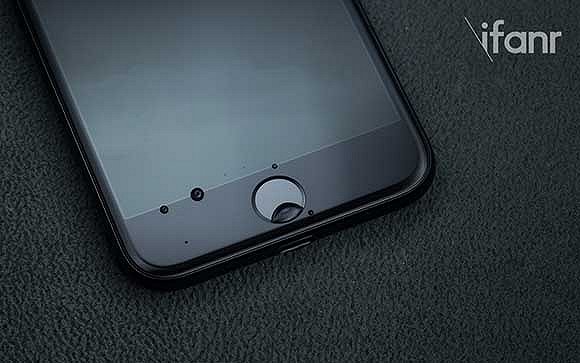
Apple hopes to use the Taptic Engine’s tactile feedback to give you the feeling of pressing down. The harder you press, the stronger the Taptic Engine vibration will be.
Even so, the pressing feel of this Home button is still quite different from the previous iPhone Home button, and it will not give you the illusion of pressing it.
In fact, the first time I used the Force Touch touchpad on the MacBook Pro, the "clicky" feel made me completely believe that I pressed the touchpad. So why doesn’t an iPhone using the same technology fool me?
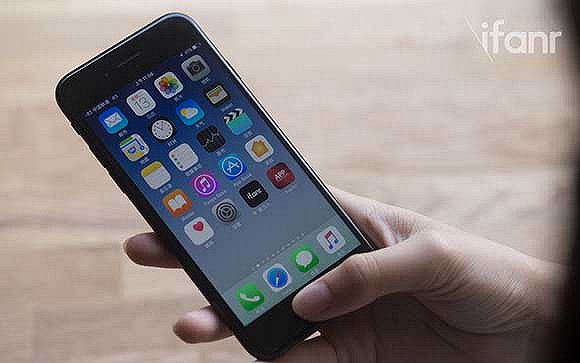
The reason is not the technology itself, but the different gestures you use to touch the device: when the MacBook is placed on the table, you only press the touchpad with your fingers, so only a few fingers feel the vibration feedback, while the iPhone's vibration feedback acts on your entire palm, so the thumb's vibration is relatively not that strong.
But even so, the pressing feel of this Home button is still better than the virtual buttons of all Android devices. In my opinion, the function of the vibration feedback of the virtual button is just to remind you that you pressed successfully.

In the iPhone 7 startup boot, you can set three different vibrations based on the pressure of the press. But if you are used to crisp physical buttons, it may take you some time to get used to the pressing feel of the iPhone 7 Home button.
The benefits of using a solid-state button for the home button are obvious. Because it is more sensitive and durable, it is expected to improve the strange situation that a large number of able-bodied people use AssistiveTouch (commonly known as the "little dot") because they are worried about damaging the home button. In addition, due to the open API, the Home button may have more personalized gameplay in the future.
In a week of use, we found that the vibration feedback of this Taptic Engine has been applied to more scenes. For example, when it comes to the scroll wheel list menu, when you slide the screen, the Taptic Engine will make continuous vibrations along with the sound of gears, just like the feeling of gears grinding.
As for fingerprint recognition, its recognition speed is almost the same as that of iPhone 6s.
Chopping off the headphone jack didn’t make the phone thinner, but it was worth it
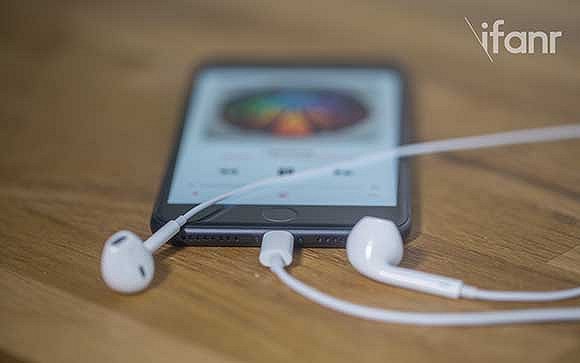
The removal of the 3.5mm audio interface is indeed a "courageous" attempt. It is not like the previous removal of the network cable interface on the MacBook Air and the removal of the USB interface on the New MacBook. After all, they exchanged for the thinness and lightness of the device, while the thickness of the iPhone 7 has not been thinner.
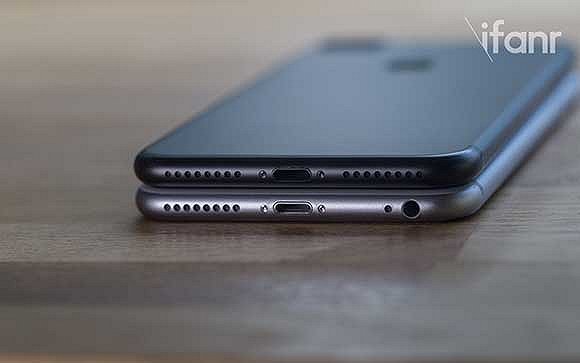
The most direct feeling this gives consumers is that there is only deprivation but no satisfaction - it is not a selling point.
Removing the audio interface may seem to many to be just a small 3.5 mm hole missing, but in fact the internal audio interface occupies quite a lot of space. In addition to the cylinder of the plug itself, there are also a series of other components and circuits: the elastic metal piece responsible for contact with the plug, the circuit board used to fix the plug socket, the external audio chip and the audio circuitroad.
After using Lightning, these can be removed. The only thing that needs to be added is to add an audio module to the main chip and transmit the audio information through the Lightning interface, which saves a lot of trouble.
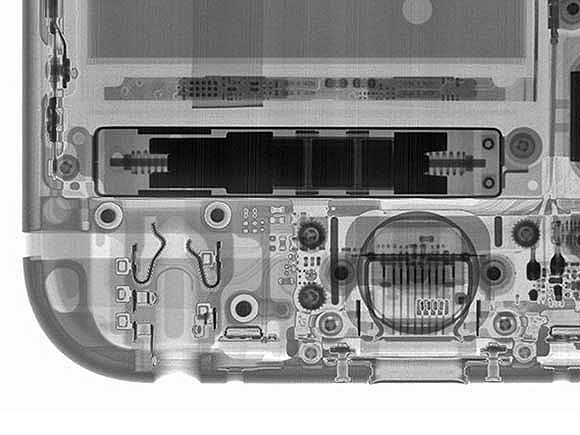
In fact, it is precisely because of the limitations of mobile phone space that the iPhone 6/6s is not equipped with the optical image stabilization camera on the Plus. Apple employees told iFaner (WeChat ID: ifanr) that the optical image stabilization camera module is almost twice the size.
The 3.5mm headphone jack was cut off. Although the iPhone 7 did not become thinner and lighter, Apple was able to optimize the integration of internal components. Taking the 4.7-inch iPhone 7 as an example, it lost the 3.5mm headphone jack in exchange for a stereo speaker with twice the volume and an optical image stabilization camera that greatly improved low-light imaging.

For example, the added speaker is located at the earpiece, which directly doubles the external volume of the mobile phone.
In addition to saving space, Apple has a more important reason for removing the audio interface - as an interface standard for more than 100 years, 3.5mm and other size TRS interfaces have a single purpose and can only transmit analog signals.
This trend has actually become a reality in the field of video data transmission. The two major standards of HDMI and DisplayPort have completely replaced the VGA interface that previously used analog signals. At the same time, in the latest plans of the two standards, it is mentioned without exception to provide transmission support for power supply, network, audio and other types of data based on existing cables. This is also because the key to different application scenarios of pure digital transmission standards lies in the definition of interfaces and the encoding and decoding of data.
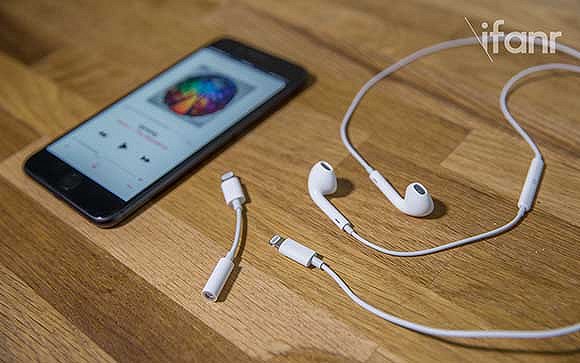
Behind the disappearance of the 3.5mm audio interface is the replacement of "analog signals" by "digital signals" in transmission interface technology. Even if Apple doesn't do it, someone else will. As for who comes first and who comes last, it doesn't matter.
iPhone 7/7 Plus comes withEarPods headphones with Lightning plug, and comes with a Lightning to 3.5mm converter. However, compared to the 3.5mm EarPods, the sound of this Lightning EarPods is not significantly improved.
AirPods is a benchmark for Bluetooth headphones
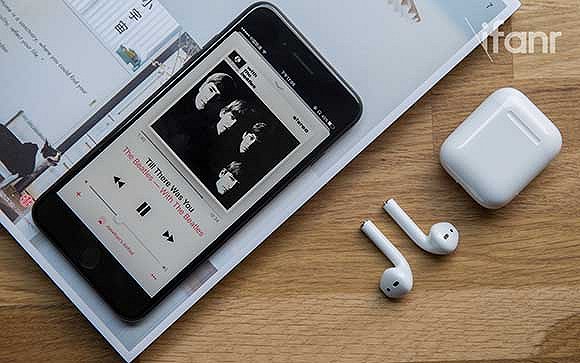
Lightning headphones are not the only audio solution. Apple prefers wireless methods. This is the Bluetooth headset AirPods. These headphones, which are like EarPods without cables, can solve your problem of listening to music while charging.
After using iPhone 7 for a week, AirPods almost became another "wearable device" on my body. It is always connected to iPhone, but it is as light as nothing.
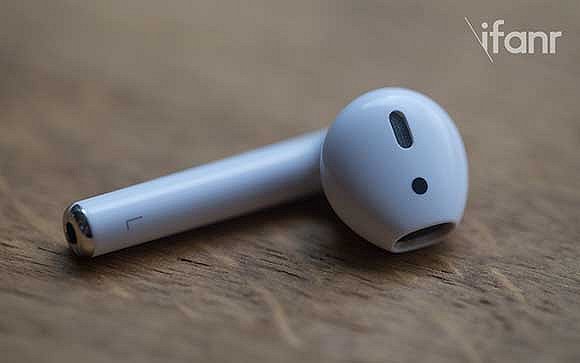
Thanks to the built-in W1 chip and various sensors, AirPods does have some smart attributes of wearable devices: when you take off one of the earphones, the built-in infrared sensor will detect it and stop music playback; the accelerometer sensor can sense the touch and double-tap the earphone to activate Siri; when making a voice call, the voice accelerator sensor can identify the vibration and direction of the sound and reduce noise.

These operations are so natural that you feel that Bluetooth headsets are born this way.
However, AirPods can currently only answer calls, play the next song, and adjust the volume by activating Siri. It would be more convenient if it could be directly controlled by customized touch actions.
Limited by the size of the earphones, the battery of AirPods can only sustain 5 hours of audio playback. Apple has designed a box that can be used to store AirPods and charge the earphones, extending the battery life to 24 hours. The box is smaller than the EarPods box, but still a lot heavier.
From the Jawbone ERA to the Bose QC series, the various Bluetooth headsets I have used have had trouble pairing and connecting. First, find the button on the headset to turn on the Bluetooth pairing mode, then search and connect. For some personalized settings, you have to download the app.
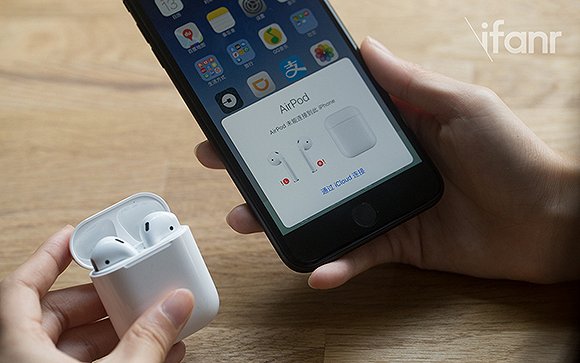
Apple, which has always been good at combining software and hardware, has integrated the troublesome process of pairing into the usage scenario-when you are about to open the box and take out the headphones, the phoneA pop-up will automatically pop up waiting for you to pair. This process usually takes less than 5 seconds.
As for sound quality, it's no different than the wired EarPods. However, the price of 1,288 yuan is comparable to that of a music player.
With stable connectivity, elegant pairing methods, and intelligent interactive experience, Ai Faner (WeChat ID: ifanr) believes that AirPods is a benchmark for Bluetooth headsets.
Purchase advice: If you are still using an iPhone 5, consider changing to one
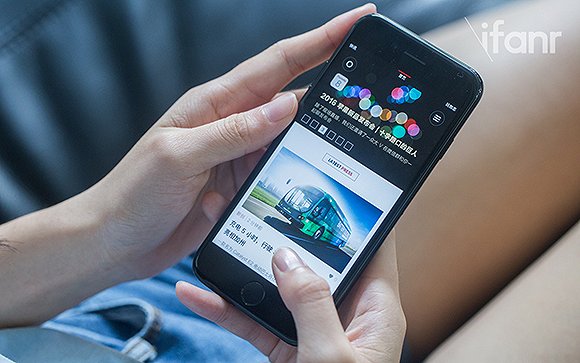
In the past few days of using the iPhone 7 Plus, except for the unique feel of the Home button, I don’t feel that it has changed much from the iPhone 6s Plus. In most cases, the similar shape and the same grip made me mistakenly think that I was still using an old phone.
Although the screen, sound, and camera of iPhone 7 are better, it is only better-the performance of iPhone 6s Plus is already good enough.
If you use iPhone 6s Plus and don’t have too many requirements for mobile photography, there is no need to upgrade to iPhone 7 Plus.
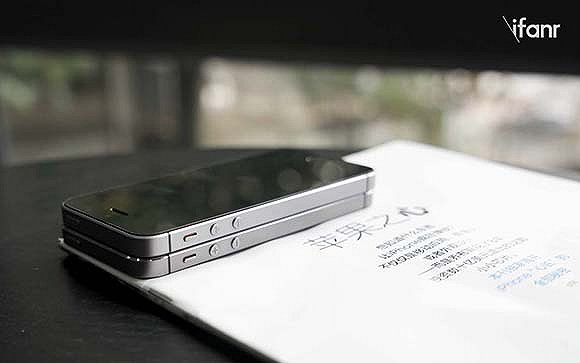
If you are still using a phone older than iPhone 6, iPhone 7 will give you a comprehensive leap in experience.
As for the dilemma between iPhone 7 and iPhone 7 Plus, in addition to battery life and size considerations, one important thing you need to consider is whether you have a need for zoom.
In terms of color, ifanr (WeChat ID: ifanr) recommends the new black and glossy black versions, a more concealed antenna line design, and a more complex new process, which at least makes it look more like a new mobile phone.
The iPhone will have less and less "surprises"
Since its birth in 2007, the iPhone is now entering its 10th year.
From the iPhone 3G, which greatly improved the speed with the help of 3G, from the iPhone 4’s comprehensive progress in design, resolution and photography, to the metal unibody iPhone 5, to the large-screen iPhone 6. Every two years, the iPhone will undergo an appearance improvement, a technical upgrade the following year, and a feature selling point, and these features are either unprecedented or unparalleled.
iPhone 7 did not bring major changes in appearance, nor did it come up with an explosive innovation. Each of its iterations is based on the improvement of existing functions or existing technologies.
But iPhone 7 is better in every aspect, but it may not inspire your desire to change.
A survey by market research firm Consumer Intelligence Research Partners shows that the frequency of iPhone user replacements is becoming longer, and most users will wait at least two years before considering replacing their phones.
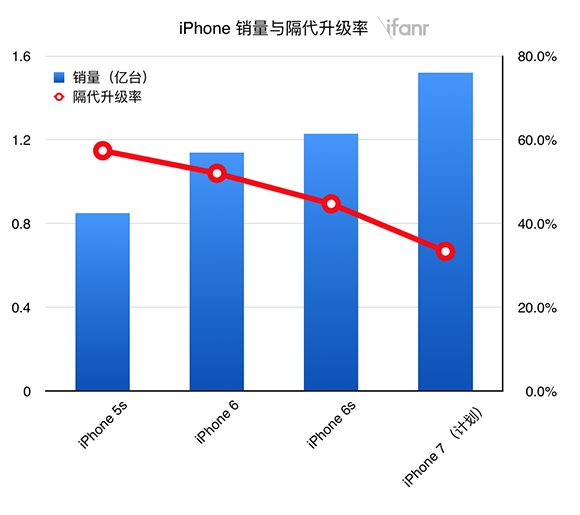
The cancellation of the two-year contract policy by US operators has indeed slowed down the frequency of phone replacements, but the bigger problem is that breakthroughs in mobile technology are encountering bottlenecks.
One manifestation of bottlenecks is that the maturity of new technologies is slowing down. The bokeh function is one of the biggest selling points of the iPhone 7 Plus, but it failed to catch up with the release of the new phone. Apple rarely released a temporarily unavailable feature at a hardware conference.
Samsung’s curved screens were criticized for being useless at first. The curvature of each screen is different. However, two years later, curved screens gradually became popular on Android. And Apple can't be as aggressive as Samsung in trying new technologies on different product lines - it only releases two or three iPhones every year.
The second-generation Apple Watch has been gestating for 18 months. Although Apple hopes that this wrist device can do more things independently, it has always been unable to compete with the pressure of performance on the battery.
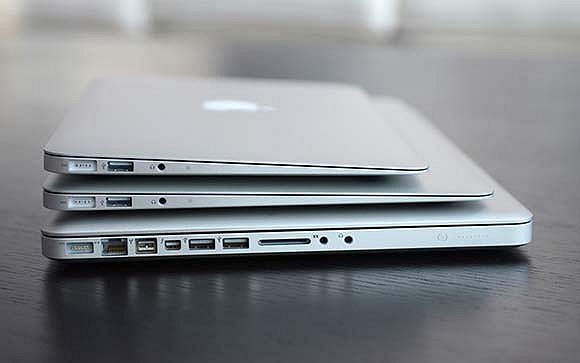
In the aging portable computer industry, the latest MacBook Air remains the same as it was when it was launched 8 years ago. The design of the Retina MacBook Pro has continued for 4 years unknowingly.
The incremental improvement of the Mac is inevitably happening on the iPhone. In the future, iPhone iterations will mostly focus on predictable updates of core components: a more powerful SoC, a camera that allows you to take better photos, a screen that looks better and more delicate...
The iPhone will have less and less "surprises", and people will become more and more sensible when it comes to switching phones - you will not only study every feature, but also consider whether these features are helpful to life.
Cook previously mentioned in the financial report meeting that 60% of iPhone users are using models before iPhone 6. This isThe opportunity for iPhone 7 - it needs to attract Apple fans who have iPhone 5 or even older phones, and Android users who are interested in iPhone, rather than counting on loyal and picky old users to continue spending money to upgrade.
There is never an absolute "surprise", only whether expectations are met or not. There is a group of consumers who don’t care whether the iPhone 7 can surprise them. They just want a better-use phone, that’s all.
On this point, iPhone 7 does it.
