
According to FT reports, as Obama actively pushes Congress to approve the TPP before the end of this year, China has become the most important target. The Obama administration is trying to convince Congress that the TPP is one of the important strategies for the United States to respond to China's economic rise.
In order to prove the necessity of the TPP, the U.S. government filed a lawsuit with the WTO on Tuesday against China for "illegal" subsidies for staple grains. In order to prove to Congress the need to pass the TPP and use "new rules" to check China's rise, the U.S. government has taken frequent actions in recent months, including initiating anti-dumping duties on Chinese steel and trying to prevent the recognition of China's market economy status through WTO rules.
Tuesday’s WTO case on staple food subsidies is the 14th trade “complaint” against China initiated by Obama during his term in office.
Obama said that as the global economy develops, we must ensure the leadership of the United States and set the highest standards for other countries in the world to follow. This is the TPP.
Although the next presidential candidates Trump and Hillary have both clearly stated their opposition to the TPP, the Obama administration believes that no matter who is elected after November 8, because of the support of the Republican leaders in Congress and the powerful business and agricultural political lobby behind the TPP, Congress can successfully pass the TPP. One of the most important supporting forces is the members of Congress from agricultural states.
So there was the "farce" staged at the WTO on Tuesday. The United States accuses China of providing $100 billion in staple grain subsidies to Chinese farmers by setting minimum purchase prices.
The United States is the world's largest exporter of agricultural products, exporting $20 billion worth of agricultural products to China last year. However, the "accusations" made by the United States against China this time are actually based on "a hundred steps, a hundred steps, a fifty steps".
The price of the staple grain wheat grown in the United States has fallen for four consecutive years. To some extent, the price of wheat is now lower than the cost of production. However, the production volume of staple grains in the United States has remained near the highest level in history in recent years, and there has been no "market adjustment" due to falling prices.
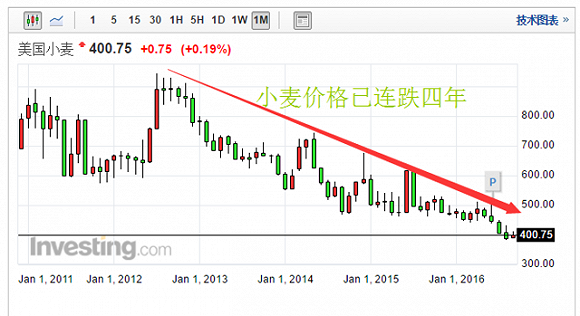
This is mainly because the United States Department of Agriculture has an implicit subsidy policy to protect staple food production. Subsidies are mainly provided in two ways: one is to provide ultra-low-interest loans to American farmers when the price is below a certain price. Farmers can apply for loans and purchase seeds, fertilizers and other elements to continue to maintain staple food production, while storing the harvested wheat and selling it after the price recovers. The other is to set a "minimum price" based on the specific conditions of each state. After selling wheat at a price lower than the "minimum price," farmers can apply to the U.S. Department of Agriculture for a "price difference subsidy."
