
The downturn in oil prices that has lasted for nearly two years has made life difficult for members of both camps of the Organization of the Petroleum Exporting Countries (OPEC, referred to as OPEC). This seems to have increased the possibility of reaching an agreement to freeze oil production to some extent.
OPEC oil production remained at a record high in August. According to a report released by OPEC on Monday, the organization's oil production fell by 23,000 barrels per day in August to 33.2 million barrels. Among them, the output of Saudi Arabia and Iran increased, while the output of Nigeria, Libya, Venezuela, and Iraq decreased.
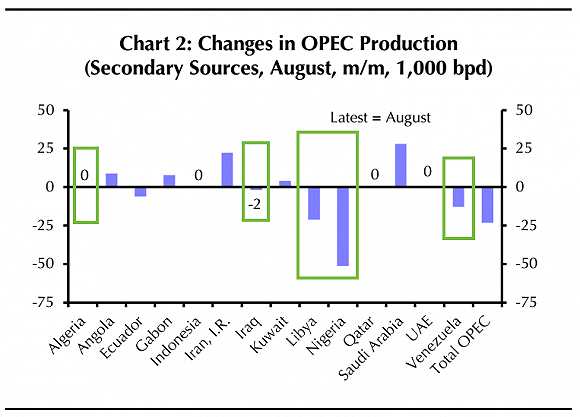
Business Insider reported that this is consistent with the "split" of the two camps within OPEC: one camp has so far successfully withstood low oil prices, including Saudi Arabia, Qatar, Kuwait, the United Arab Emirates, and Iran; while the other camp composed of the "Fragile Five" of Libya, Iraq, Nigeria, Algeria, and Venezuela has reached a life-or-death moment.
Affected by the continued impact of low oil prices, the "Fragile Five" have all fallen into economic and political chaos. Due to its heavy reliance on oil exports, Venezuela's economic situation has become very serious, with food shortages, medicine shortages, energy shortages, robbery and soaring prices. At the beginning of this month, large-scale demonstrations broke out in Venezuela, with millions of people calling for the president to step down.
Nigeria is also slipping into a full-blown economic crisis due to low oil prices and the government's controversial foreign exchange policy and price controls. The country's armed organization, the Niger Delta Avengers, sabotaged oil production equipment in the Niger Delta, the main oil producing area, seriously affecting Nigeria's oil production. Similarly, the domestic political and security situations in Libya, Iraq, and Algeria are also affecting their oil production.
The situation of Saudi Arabia and Iran is much better than that of the "Fragile Five", but the wealth of these two countries has shrunk severely in the past two years. Saudi Arabia's foreign exchange reserves have fallen by nearly $190 billion since oil prices began to fall in mid-2014. According to forecasts by international rating agency Fitch, Saudi Arabia's fiscal deficit is expected to be as high as 11.2% and 6.8% of gross domestic product (GDP) in 2016 and 2017. Bloomberg reported last week that Saudi Arabia plans to cancel more than $20 billion in projects and cut the budgets of various ministerial agencies by a quarter. A poll by Iran's University of Tehran showed that 74% of respondents said they did not feel that Iran's living standards had improved since the nuclear deal was reached last year.
The commodities team of RBC Capital Markets believes that in the current oil price environment, no oil-producing country can be the winner. The only question is which oil-producing country that lacks funds will become the biggest loser. The agency believes that all oil-producing countries are having a difficult time, which seems to increase the possibility of reaching an oil production freeze agreement in Algeria on September 26.
“We believe that oil-producing countries may come to the conclusion in Algiers that limiting production will not bring any losses when the economic situation is close to the limit. ”Helima Croft, chief commodities strategist at RBC Capital Markets, said.
However, some analysts pointed out that the possibility of reaching an agreement to freeze production should not be overestimated. Based on historical probability analysis, the possibility of reaching an agreement this time is less than 50%. Moreover, even if the production freeze agreement is reached, it will not have much impact on the fundamentals of the oil market. The U.S. Energy Information Administration (EIA) forecast on Tuesday that oversupply in the crude oil market will continue into the second half of 2017.
