
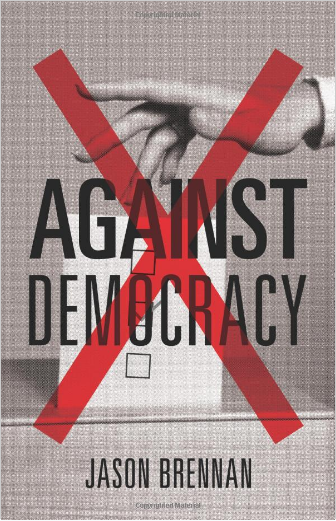
Political scientist Jason Brennan's new book "Against Democracy" was recently published, which does seem to be a bit timely. From the Brexit referendum to the rise of Trump, there has been no shortage of complaints from die-hard liberals or conservatives: If this is the people’s decision, it’s better not to let the people decide. If you feel this way, then Brennan's book is just for you.
In the book, Brennan jokingly divides citizens into three types: "hobbits" who just want to live their own lives and don't care much about politics; those who have a certain interest in politics, but have no partisan color and only tend to use local, small groupism colored eyes. The "hooligans" who see everything through the mirror; and finally the "vulcans" (originally referring to Vulcan, the god of fire in Roman mythology, and a slang term for a person who accepts death in a single glance and is not very emotionally sensitive - translator's note) who only want to present facts and reason. Brennan approves of "hobbit" type citizens, but believes that such citizens should not be deliberately encouraged to care about politics, because further citizen participation is likely to turn them into "rogue" type citizens. In many cases, political life is indeed like a battle between hooligans, filled with all kinds of noisy and irrational voices. The best way to make the world a safer place for hobbits is to give Vulcan citizens greater power. Therefore, Brennan recommended replacing or supplementing democracy with "epistocracy", that is, letting those with more knowledge rule (the English word democracy contains two roots derived from Greek, demo means people, cracy means rule, and episto and cracy are connected together, which is the so-called "rule of knowledge" - translator's note).
This set of statements may seem like some provocative voice coming from the academic world (Brennan now teaches at Georgetown University), but similar statements are not new, and they do not only come from the ivory tower. The book does nothing more than repeat truisms about how ignorant citizens are: they don’t understand how the U.S. government works, they don’t understand the political platforms of each party, and they don’t even know who the congressman is in their district. They don’t know the specific content of the Constitution, they don’t know basic economics, and they can’t understand the federal budget. Most citizens know next to nothing about politics other than the name of the current president – yes, you read that right, that’s the truth.
Brennan explains with a common political science analysisAnswering the question "Why are citizens ignorant?": The cost of remaining ignorant is very low, and the possibility of a single vote changing the outcome of the election is slim. Even if you cast a vote without thinking, the sun will still rise tomorrow, the earth will still rotate, and everything will be as normal. Brennan also contrasts environmental pollution with ignorant voting behavior: A little more emissions from your own chimney doesn't hurt, but if everyone does it, it will greatly increase environmental pollution. The same is true for politics. The sum of individual irrationality will worsen the situation of everyone.
Now we know why ignorant voters would do such a thing as "sacrificing a large-displacement car just to cross the street." But if every individual's vote has no real meaning, why should he go to all the trouble to participate in the election? Brennan acknowledged that most voters actually have a good intention to promote (what they understand) the public interest; they just don't have a good understanding of what the public interest is. In addition to reaffirming the common sense that good intentions do not necessarily lead to good results, Brennan also believes that political life often stimulates the negative elements of human nature: there is a deep "tribal" nature in our political arguments. We love to hate our opposites. This kind of "tribalism" (tribalism is often used in English political expressions to collectively refer to small-scale or small-scale positions of various loyal objects. Similar expressions in Chinese include sectarianism, localism, small groupism, etc., but taken alone are not enough to exhaust the full meaning of tribalism - translator's note), it further strengthens our ignorance. Most people who care about politics only accept arguments that support their existing views. New information often strengthens existing prejudices after being filtered through colored glasses.
Based on the phenomenon of "self-reinforcing ignorance," Brennan believes that using democratic elections to make major decisions is a crazy move. No one would agree to be operated on by a doctor who did not believe in scientific evidence, and no one would think that a jury that was highly partisan and unconcerned with the truth was qualified to send him or her to prison. Delegating life-and-death decisions to our fellow citizens resulted in wars, mass incarceration, and the brutal punishment of marijuana users and, to this day, gay people based on ignorance and prejudice.
Brennan claims that the reason why we reject the above conclusion is that we think of democracy too "specially": voting expresses our deep belief that everyone should be respected equally; the right to vote is an important part of personal freedom, and this importance may be intrinsic, or it may be because it restrains the government and protects your freedom. However, according to Brennan's discussion, these views are somewhat untenable. In his view, the belief that voting specifically reflects respect for citizens is an arbitrary and unreflective habitual view. We should go beyond this. Think about it: We don't feel disrespected when we refuse to have someone untrained operate on us, and we should feel the same way about voting. As for your freedom, since it is difficult to change anything with just one vote, "picking up five dollars on the street may have a greater empowering effect on you" than gaining the right to vote.
It can be seen from this, democracy doesn’t work that satisfactorily, and there’s nothing morally special about it. That being the case, why don't we try something new? Since some people—usually highly educated, high-income white men, as Brennan is not shy about telling us—do understand politics, economics, and public policy better than others, we might adopt the approach recommended 150 years ago by John Stuart Mill (a famous British philosopher, also accomplished in political and economic theory, and author of "On Liberty" and "Representative Government" - Translator's Note), which is "high-quality citizens have greater voting rights." Perhaps we could stipulate that no one should have the right to vote until he or she has passed some stringent civic-literary test. Perhaps we could also create a House of Lords composed of learned men to exercise veto power over democratic decisions. Brennan's writing is brimming with the hope that his (needless to say, highly educated) readers will appreciate the results of "intelligent masters": learned bureaucrats who, while not geographically or demographically representative, are highly suspicious of war, have a laissez-faire attitude toward personal morality, abhor lengthy prison sentences, and support free trade. Under the constraints of the veto power of the "intelligent master", farces such as Brexit or Trump's ascension will simply not happen.
At this point, Brennan’s thoughts are already clear. However, he may not have fully appreciated the ambiguities and contradictions in his own argument. After all, Trump’s image fits the requirements of an “intelligent master”: He has indeed claimed that he likes voters with less education, but don’t forget that he often attacks the Obama administration as being unqualified and not understanding how the real world works. This small omission not only seems ironic, but also reflects a larger problem: the "wisdom master" is not aloof from politics, and will still face various political entanglements within itself. Who sets the standards for knowledge levels? What aspect of economic life or the constitution would be considered uncontroversial? Unless the test covers only mathematics and the natural sciences (Brennan has mentioned this possibility, but he himself prefers to test "basic facts" and "widely accepted conclusions of the social sciences"), which are almost completely apolitical areas, the winners in such tests are likely to be those who have learned a lot. "Ruffian" citizens: These people care about politics, are well aware of the causes and consequences of various policies, are familiar with political and legal theories, and can be represented by an intelligent parliament... But this does not mean that they are less partisan and tribalistic; these people are just able to refine their positions. In other words, all the problems faced by democracy are also encountered by "intelligent masters", but they lack political virtues such as "treating people as self-legislating equal citizens" that can help limit these problems.
With this in mind, some of the other statements in Brennan's book may also be questionable. They may not be fully established. Voting is really nothingValue? When people believe that voting makes them the legislators of their own lives, they are not necessarily wrong. While Brennan is right to point out that it is difficult for an individual voter to make a difference in an election, there is also a good chance that your vote will make you part of a majority group. When people say, for example, "We chose Obama," that's what they mean, and there is no conclusive evidence that they are wrong.
Is our association of suffrage with equality between citizens or morality arbitrary? In a deeper sense that may be true, and allowing everyone to wear purple (which was once the preserve of the nobility) may be a better sign of equal respect than giving everyone the right to vote. However, the following "objectively sensible" argument has obviously had a greater impact in history: trying to persuade blacks, women, poor people or people with low education to accept a hierarchical right to vote by saying that "a vote is not as valuable as five dollars", believing that the symbolic meaning of voting rights is greater than the substance.
Brennan may think that such a conclusion is too hasty and not take his argument seriously. He's always trying to be rational; telling him how people actually feel is completely beside the point! Even so, the plan recommended by Brennan still faces many practical and symbolic difficulties that are not easy to overcome. The main purpose of this book is to defend the "Wise Lord" with a progressive reform attitude, but it fails to depict a sufficiently convincing blueprint for reform and prospects for change. On the contrary, the most likely consequence of this plan is to allow a small number of conspirators to undermine democratic decisions, at least by slandering "this people are not good" in the back room, at worst by ruining the results of referendums such as the Brexit referendum. In addition, Brennan’s argument is suspected of supporting those elites who support meritocracy and technocracy. These people will use this to describe their ignoring the will of the people as some kind of heroic feat, claiming to have saved democracy. According to Brennan, it means that democracy gets the treatment it deserves and avoids the abuse of democracy.
Although Brennan's book devotes much of his book to exposing how miserable and disappointing political life is, his entire argument also has economic implications. Brennan pointed out that market mechanisms should be used to make decisions instead of democratic processes whenever possible. He believes that in market transactions, we need to express true consent (genuine consent) and be responsible for all the consequences of our decisions. In contrast, in political life, we never "agree" to be bound by laws in any meaningful way. These laws are ultimately voted by ignorant citizens and parliamentarians full of narrow-minded prejudices. Economic life is often used by Brennan as an example of a "depoliticized field of expertise." All in all, the prospect promised by "Smart Master" is to let the market mechanism itself, rather than the political process, complete various decisions as much as possible.
Ultimately, Brennan's argument that "markets are better than politics" is a moral argument. He believes that supporting government regulations is supporting violence, and all state actions must ultimately be based onBacked by violence, whether to wage war or enforce laws that promote fair employment. This insight is certainly profound, but Brennan's mistake lies in his binary opposition between coercion in political life and informed consent in market transactions. In fact, the operation of the market itself will lead to state violence to some extent. Protecting private property rights means supporting the use of violence to punish unrepentant deviants. Supporting a market-based health insurance mechanism means using violence to prevent those who cannot afford medical treatment from accessing medical services - to put it bluntly, it means leaving these people to suffer or fend for themselves. Forcing public debt payments and ignoring political opposition, as the EU did with Greece, would mean supporting the use of force to stop parents begging for food for their children in a country with widespread malnutrition. The above discussions are not intended to be sensational; they are just another vivid and accurate way to confirm Brennan’s statement that “government regulation means violence.” We may have many good reasons to argue that market mechanisms play a positive role in many - or almost all - situations, but markets are also deeply affected by political and judicial decisions, including those of the legislative branch, the courts, and the police. In a word, the market is not a set of mechanisms completely external to the political process; it is itself a product of the political process.
To reiterate: Politics is indeed everywhere. The arguments used to defend democracy in the face of "intelligent masters" are solid and historically based, and are not simply conceptual games. Democracy has historically been instrumental in breaking down hierarchies that prevented minorities, workers, and women from fully participating in social life. For more than a century, social mobility and elections based on democracy have also been the main force against the continuous accumulation of economic power and various privileges under capitalism. At the moment, when considering supporting or opposing democracy, perhaps we should start by reflecting on the market mechanism itself - at least for now, it is far from fulfilling its promise of "decent, voluntary, and guaranteed freedom."
(Translation: Linda)
