
At the end of August, architect Feng Guochuan flew from Shenzhen to Zhifu District, Yantai, and gave an architecture class called "Children Build the Future." More than 20 children participated in the class, as well as many parents.
Feng Guochuan led students and parents to visit the old buildings on Guangren Road near the sea, explaining the characteristics and history of each building while walking. "The brown stone indicates that it contains iron," Feng Guochuan said, passing by a two-story stone house. "This is a place where Christian churches hold activities and is also the earliest public library. It was also a meeting point of the Communist Party in the 1920s. The decoration on the roof has a peak, which is a European practice."
Next to it is the former site of the Hair Net Company. "This company discovered that China had just had its Revolution of 1911 and everyone was cutting hair, so it was very cheap to buy hair. The craftsmanship of hair nets and fishing nets are basically the same, so they could hire female workers here, as they had hair and workers, so they came here to produce. It is said that it had a monopoly on the production of hair nets around the world, and most of them were made in Yantai."
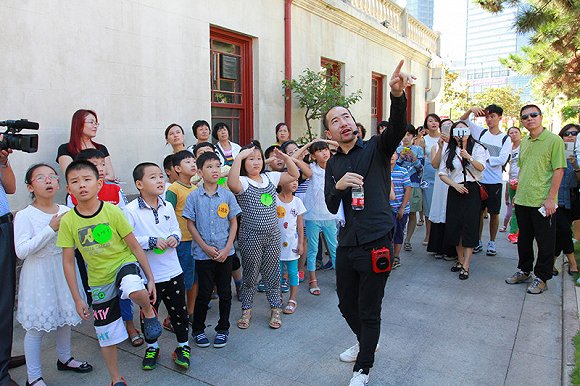
This road also has the former site of Shengming Electric Lighting Company, the former site of French Medicinal Materials Company and East Asia Cannery. There are more than 40 such old buildings with red slope roofs and stone walls. They have experienced hundreds of years of wind and rain, but they still look very intact and beautiful, and each one is unique.
After returning to the classroom after the visit, Feng Guochuan guided the students to assemble a model of the Guangren Road Historic District. Feng Guochuan hopes that "Children Build the Future" can cultivate children's perception and understanding of architecture. "Through learning architecture, children will have a pair of eyes for discovery and be good at discovering the beauty on the other side of life; participating in workshops will allow children to have smart brains and thinking hands, and they can express their ideas in more ways."
"Guangren Project"
Feng Guochuan's "Children Build the Future" class announced the official launch of the "Guangren Project". The core of the "Guangren Project" is Zhifu Academy. "Children Build the Future" is a fixed education project of Zhifu Academy.
Next autumn, a large bookstore will be born on the seaside of Guangren Road: two Western-style historical buildings are connected into one, with a row of book walls reaching the roof facing the sea. Every weekend, writers, scholars and artists from all over come here to give lectures and exhibit. This is the Zhifu Academy, and its designer is Dong Gong, the architect famous for the "Lonely Library" on the seaside of Qinhuangdao.
What is the "Guangren Plan"? Its operations team says it is a historic district revitalization plan. Through the re-planning of Guangren Street space, the renovation of historical buildings, the re-investment, the introduction of cultural and artistic creative forces, and the establishment of Zhifu Academy, it has been transformed into the "Guangren Art District”.
In a studio that was simply renovated from a two-story old building on Guangren Road, Tan Fang, the operations director of the "Guangren Project", described the current situation and prospects of the project to reporters, "I hope that Guangren Art District can become Yantai's urban living room and a cultural business card that attracts domestic and foreign attention."
Her studio consists of two small rooms, one upper and lower, plus a small yard. Inside the house, the floor is cement, painted with a layer of light gray floor paint; the windows deliberately retain the original style of lift windows. The upper and lower window leaves can be lifted up. When the window leaves are lifted up, the sea breeze can flow in.
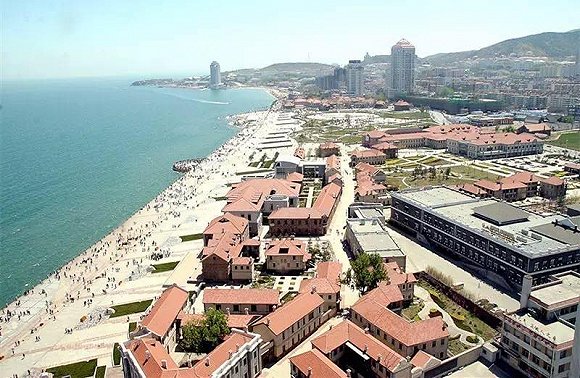
Next autumn, two of the old buildings on Guangren Road and Marina Square will be transformed into Zhifu Academy. You can read in the academy facing the sea.
Although the bookstore + cultural activity model has already produced many successful projects, they have basically appeared in first- and second-tier cities. Yantai is currently only a quieter and slower third-tier city. Is its urban heritage sufficient to support such an art district?
Tan Fang said, "This matter itself is very difficult. First-tier cities definitely have more foundation. Like Shenzhen, there are too many cultural and creative districts, too many art districts, two to three hundred, and Shanghai has even more. There is no shortage of such places. How meaningful will it be if you do it? Like Yantai, because there is no one, no one will do it, but it does not mean that this city does not need it. There are not many third-tier cities with history like Yantai."
So, she said, "To do this, you must have hometown feelings and a sense of mission to do it."
Old buildings in Yantai
Yantai has extremely rich historical architectural resources. It was opened as a commercial port as early as 1861 and was the second batch of treaty ports in modern China. Many countries have successively set up consulates in Yantai; under the background of industrial salvation, wine, hair nets, embroidery, foreign companies and other industries and businesses gathered on Guangren Road and Chaoyang Street. The spread of Western learning to the east led to the prosperity of foreign schools, foreign companies, foreign hospitals, libraries, churches and other cultural institutions; there are also post offices, banks, restaurants, clubs and other places.
Under the influence of foreign culture, Yantai created many firsts in China, such as Yantai Clocks, Cheng Mingsuo, Changyu Wine, and School for the Deaf. There are also apples, peanuts and big cherries, which were first introduced by Guo Xiande's grandfather in Yantai and promoted nationwide; Zhaoyuan Gold Mine was founded in the Westernization Movement and a general and open atmosphere, and its scale and equipment should be the first in the country.
Correspondingly, a large number of buildings with Western forms and a combination of Chinese and Western styles were built, with rich and colorful styles, leaving Yantai with valuable historical heritage. The British Consulate and the HSBC Bank, built in 1864, are the earliest examples of Western-style architecture in modern China. The Japanese Consulate built in 1882 is an early modernist style building.
Architecture that combines Chinese and Western styles is quite common in Yantai. Hu Shuzhi, an architect in Yantai, said, "You will often see Chinese-style sloped roofs and British-style sloped roofs, some Greek and Roman column styles, and the courtyard doors may be Chinese style. Or it is a Chinese-style house, and the courtyard door is Chinese style. There are often some imitation Baroque or even Rococo decorations on the ceiling and porch, and even some jade.The columns are obviously of various styles from various countries and periods," and these ideas are very lively. He said that modern buildings like Yantai that combine Chinese and Western elements are rare in other places.
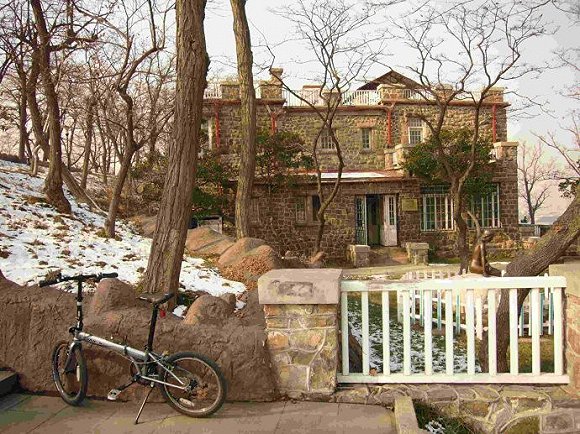
The former site of the Danish Consulate
Feng Guochuan was fascinated to see many old buildings during his two days in Yantai. He saw all 17 consulates in Yantai Mountain. He said that the consulates of the United States, Britain and Denmark were well preserved. "The Japanese Consulate is a modern building. There were few such exquisite early modernist buildings before 1920, but it was abandoned there, with broken windows, dust, wild animals, and long grass in the house. The damage to the building was very bad, and it took effort and money to repair it. It is under the control of the government, and it may not be able to do what it wants. In fact, it is this state that the construction industry is very worried about. ”
In contrast, the old buildings on Guangren Road a few hundred meters away are in much better condition because they have been in use and are not idle. "As for the buildings themselves, they are really good and have been preserved for a hundred years. They were basically built between 1910 and 1930. It is rare for them to be preserved to this day and in such good condition. The urban public space they presented at that time was quite dynamic." Feng Guochuan was full of praise for them.
But he also raised concerns about the "Guangren Project": "Seeing these old buildings, I feel that this city was once a very elegant city, but this temperament has not been passed down particularly well over the years. Walking on the street, watching these people chatting, and then going to restaurants and bars, this living atmosphere has no clear connection with that of the past. In fact, the temperament of this city is not obvious. Shanghai has a Shanghai-style culture, and Wuhan has many cultural places, such as Nanjing. But Yantai is less obvious. In Shanghai and Beijing, to build cultural communities, there will be soil, and the seeds can be sown. In this place, the soil has to be cultivated and re-cultivated by itself, and then the seeds can germinate, which is difficult. ”
Return Marina Square to the people
Tan Fang has had a complex about old houses for a long time. She grew up in Yantai. When she was a child, she lived in a traditional courtyard house in the city. There were six families living in the courtyard. At that time, there were more than 400 Western-style buildings in Guangren District, which was very crowded and felt a bit like Shanghai Shikumen. She has a good friend who lives on Guangren Road, and she often goes to her friend’s house. “It has very good wooden floors and wooden stairs. When you go up, you can open the window and face the sea directly. There are more than a dozen households living in the courtyard, which is very densely packed. It’s all gone now, it was demolished in 2001. ”
When she grew up, she went to Shenzhen, settled down there, and founded her own company. She did not return to Yantai for five or six years. In 2013, she came back to find an office for the branch. She saw that Yantai had changed a lot, and many old houses were gone. She found this small two-story building on Guangren Road as an office. A friend told her, "This house was actually the worst at the beginning. How could it stay? We feel very good now." After being away for so long, I feel more emotional when I look at these old houses than before.
The current situation of Guangren Road makes Tan Fang feel pity, "I grew up playing in this place. It is so good.The location has such good natural features and historical culture, but its current presentation is unsatisfactory. ”
She said that Yantai needs to slow down. The pace is very slow, the city is beautiful, and there are abundant seafood and fruits. It is suitable for people to calm down and experience the city. "Marina Square is very mobile, but there is no content and no participation. People can't sit down, just take a photo with the sea breeze and leave." ”
As for the 47 buildings that have been preserved from the more than 400 old buildings before demolition, except for a few that have closed down, the rest are high-end clubs, teahouses, and restaurants. Those restaurants, if you go in and have a meal, the price is four figures. These buildings are closed spaces that exclude ordinary citizens and tourists.
Tan Fang said that the "Guangren Plan" is to return Marina Square to the people and turn these closed buildings into public spaces that ordinary citizens can share. How to achieve this?
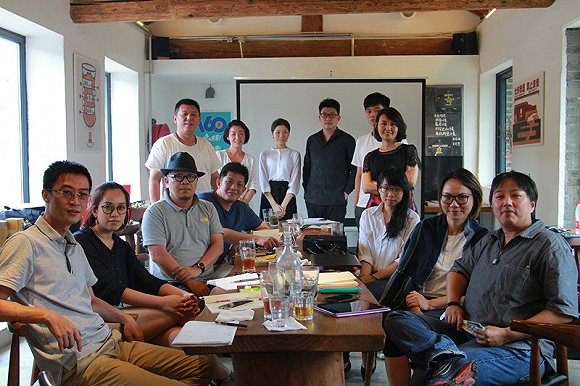
The "Guangren Project" has formed a strong international team, including Tan Fang, Ou Ning, Dong Gong, Xu Yijing, Xiao Ma + Chengzi, etc.
The first is Zhifu Academy, which is a space where people of all ages, regardless of social class, can enter. They can order a cup of coffee or sit down and read with a book. Zhifu Academy is not just a bookstore, it will be a combination of a college, a research institute and a bookstore, and a base for knowledge production and sharing. There are three guest rooms in the attic of the academy, which operates the "Zhifu Researcher Residency Project". Researchers come with topics and the results produced will be published in the name of the academy.
At the same time, they will also build a public welfare community library in the old city where the lower class of society gathers, and become a satellite institution of Zhifu Academy. After scholars and artists give lectures in Zhifu Academy, they will also give lectures in the community library.
The second is to re-engage investment operations and introduce new business formats. In two years, Tan Fang's Chuangyuan Company will obtain the operating rights of all the old buildings on Guangren Road. "Now the operating rights are in the hands of private companies. We cooperate with them. In two years, all the formats can be replaced. Now there are those that are being vacated and rented out one after another. We will keep them and not rent them out. After the format planning is completed, we will rent them out one after another." "The person responsible for the spatial transformation and business planning of the entire area is Xu Yijing's team who has participated in the "Dashilar" renovation project in Beijing.
Tan Fang said that Guangren Art District must still be an area for cultural consumption, and they will gradually introduce "some profitable and influential mature brands, as well as some top independent designer brands, so that rental income is guaranteed." It must be mid-to-high-end, targeting consumers who pursue quality of life. But this space is still public and requires interaction with tourists. It is very comfortable to walk around without buying anything. ”
She said that the driving force of the "Guangren Plan" is feelings, and feelings are very important. At the same time, professional operations can be used to ensure the quality and commercial benefits of the project.
NurtureCultural soil
Tan Fang also admitted that Yantai’s cultural soil is not that deep and cannot retain people. Although there is an art museum in Yantai, it is more official, and the larger bookstore is Xinhua Bookstore.
So since 2015, they have been organizing creative markets and beer drinking in the summer to cultivate the local cultural atmosphere. The creative market was held once a month at first and then every two weeks, bringing together Yantai's folk craftsmen, street talents, and intangible cultural heritage craftsmen. When the weather is warm, it is held at the beach, and when it is cold, it is held in the mall.
"At the beginning, everyone asked, is it possible to hold a creative market in Yantai? No one knew what a creative market was. But we started to do it little by little. Sugar Man is very popular, and one of their stalls is equivalent to half a month's income. At first, we thought Joy City would bring us a flow of people, but later Joy City told us that there is a 20% difference in sales between weekends with creative markets and those without," Tan Fang said.
In the process of doing the creative market, she discovered that local artists and cultural figures in Yantai have gone to larger cities. "It is difficult for artists to support themselves in Yantai, so the creative market may provide them with some opportunities." Zhifu Academy will attract these cultural figures after it opens.
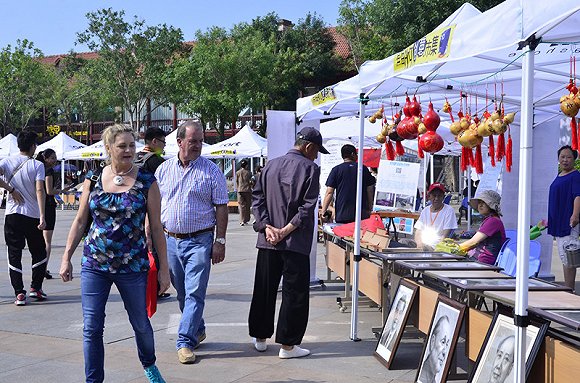
Creative Market
The introduction of the popular "Children Build the Future" course in Shenzhen is actually cultivating cultural soil for Yantai. Feng Guochuan said, "China's urbanization is a wonder in human history. The construction of houses in such a short period of time has basically reached an inflection point. There is a surplus and many architects are free. At the same time, the level of urban construction in China is relatively low. Ordinary people know too little about architecture. It is very difficult for us to communicate with the owners, so why not cultivate it."
"When we first started doing construction science popularization work with adults, the adults said that I was very busy and didn't have time to listen, but the children wanted to listen, and I could accompany them. So we found that teaching directly to adults was not effective. Speaking to children can involve adults a little bit," Feng Guochuan said, which sounded a bit like a curve to save the country.
Up to now, all the investment in the "Guangren Project" has come from Tan Fang himself, and the budget of Guangzhifu Academy is 30 million. The government is also studying policies to provide support. “I didn’t know how to cooperate with the government before. With support, progress will be greater.”
Next fall, Zhifu Academy will open. Tan Fang believes that by the year after next, the Guangren Art District will be established. "By then it will be completely perfect and there will be good commercial returns. Once our park is completed, it may attract many people like me who go out to make a living to come back to Yantai."
