
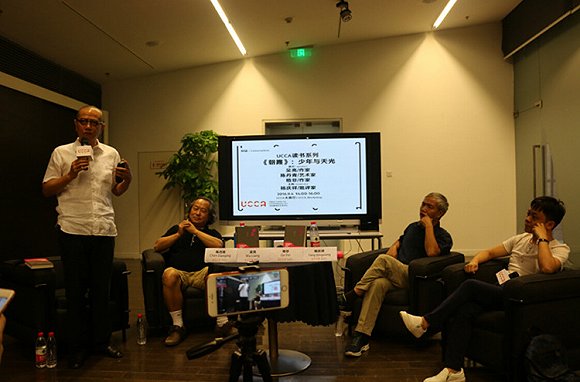
When Wu Liang is speaking, he must stand up and take off his sunglasses, "so that I can see the faces of the people behind me clearly." He has long hair, mixed with black and white. Although he is over sixty years old, he mockingly said that he "took a mental age test and was only 18 years old." His speaking style remains as sharp and forthright as his critical style.
In the Chinese literary world in the 1980s, Wu Liang can be said to be one of the most important critics. In 1986, he published an article called "Who are the Pioneer Writers" in the China Youth Daily, becoming the first critic in China to propose "avant-garde" writers. His evaluations of Ma Yuan, Sun Ganlu and others almost constitute a classic. Later he dabbled in essays and art criticism. At the age of 60, he finally completed his first novel - "Morning Glow". Yesterday, Chen Danqing, Ge Fei, and Yang Qingxiang came to the Ullens Center for Contemporary Art to discuss with Wu Liang the new possibilities of narrative in the novel and the "Youth and Skylight" in the 1970s described in the novel.
A seriously "derailed" novel
"Zhao Xia" can be regarded as a coming-of-age novel about the 1970s. A group of teenagers wandered in the gaps of Shanghai city, living in endless chats and incompatible gossip all day long. There is no linear story advancement, but a narrative maze constructed from fragmented paragraphs.
This form of breaking the conventional narrative method is surprising, but Wu Liang did not deliberately design anything in advance. Jin Yucheng, the author of "Flowers", a novel originally about Shanghai, said he had something in his stomach and wanted to "watch him write it out." He registered an account on the Nongtang.com under the name "Longbaye" and started writing this novel online. "I only know that I have something to write about, and I don't know what to write about." In the process of writing, the characters began to grow one by one.
He can be regarded as "spontaneous" writing. He starts writing as soon as a picture appears in his mind. "One or two hundred words short, five or six hundred words long, constant blank lines, all are a camera panning or a long shot, a point, a medium shot, a close shot. The narrative must stop somewhere, like a montage." Some can be picked up and written down, while others can be forgotten and not written down. Many of the dialogues in it were all written in the first draft, and the entire book of 250,000 words was written in only 5 months. "I just typed on the computer. That's how it came about."
Writing this novel completely changed Wu Liang's so-called eloquent, logical, argumentative, and clear-minded style. In these five months, the characters in the novel changed from ten to twenty, and finally to thirty. They all came alive and followed Wu Liang every day. "In fact, it is a spiritSplit." "When you have a lot of people in your body at the same time, I listen to everyone without judgment because I have a lot of brains at the same time. I want to make a statement. Someone may not think so. Does my statement make sense? I don't mean to express it anymore. "Wu Liang often goes blank when talking at the scene, because there are many people talking in his mind, so he often gives up the microphone to others in the middle of speaking.
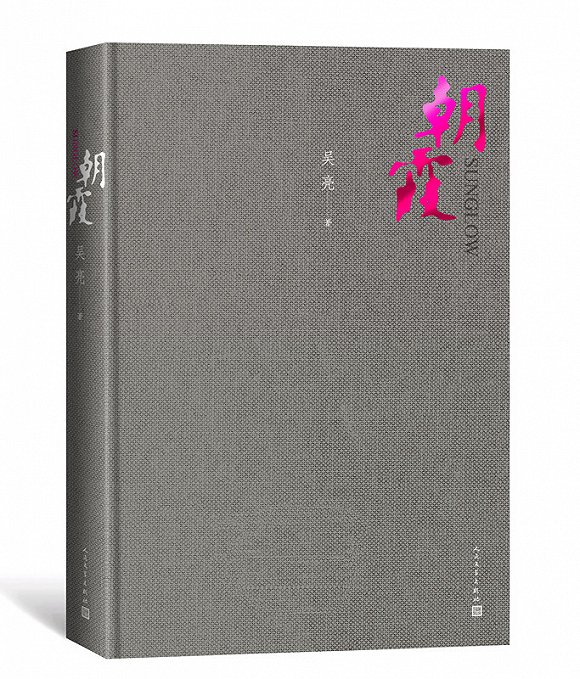
In Ge Fei's opinion, this novel has a "barbaric power". “I know Wu Liang doesn’t think highly of contemporary Chinese literature, and I don’t think highly of it myself either.”Ge Fei believes that contemporary Chinese literature becomes more beautiful and more refined as it is written, but it is not broad enough and lacks a sense of power. From Wu Liang’s novels, he saw a huge power that he had not seen for a long time.
"Zhaoxia retains a strong sense of turmoil, that is, it is filled with a large number of events, stories, affairs, passionate scenes and fragments. "It cannot be read as a traditional novel. The book is full of a lot of discussion. Like Proust's works, it is an "invasion of prose into novels," Gefei said. "He refuses to consume this novel as a general reading material. For example, it contains a lot of love stories. , when you feel like you want to consume it, he suddenly stops, and suddenly comes a piece of Hegel, and a piece of reading Marx's notes, which makes you stunned. There are a lot of clues in it that can form a series of interlocking dramatic events, but he did not do this.
Many aspects of this novel shocked Ge Fei. Regarding the transformation of the novel itself, he felt that this process must be completed in China. The sad thing is that he originally expected such a work to be written by a young writer, but he did not expect that it would be written by a 60-year-old old naughty boy. Wu Liang's novels are not summaries of social life, but descriptions of life itself. What he reminds people of is daily life itself. "Readers who pursue the ambiguity of Haruki Murakami will definitely be disappointed. He does not give you more emotions, but he is describing the disorder of real life itself, the excitement, the ultimate boredom, even meaninglessness, and nothingness. Of all the things in his works, only one thing is clear, and that is the morning glow, which is when the sun rises. The other buildings, streets, lanes, and children in Shanghai are all fragments, constantly changing like a kaleidoscope. ”
Yang Qingxiang also believes that this novel is the ultimate expression of ideals. “After the development of modern Chinese literature in the 1980s, the most important principle is free expression, saying what you want, and creating forms that don’t exist. But this spirit has been lost today. Everyone’s writing or life has become particularly disciplined and well-behaved.” And this novel’s “form and content are “off the rails” novels, challenging the aesthetic imagination we have inherited today. ”
A group of well-read wild children in the ruins
Wu Liang wrote about the life of young people in Shanghai in the 1970s. The original title of this novel was "Yesterday Never Comes Again" because its basic tone is retrospective, telling stories from the past. Later, he changed the title to "Nowhere to Hide." "One of my feelings at the time was that I liked that era very much. Although these people were sneaky and stayed in the same room, they had nowhere to hide."
Three people appear in the first section of the novel. One came back after being sent to Qinghai, one came out of prison, and one came back from Xinjiang. Critic Huang Ziping said that this is a theme of escape. "Escape" runs through the entire novel. The teenagers cheated on sick leave, wandered on the streets, and read taboo books in their rooms. "My thinking is that the story in the novel must be about characters who are idle and must escape from a period of time." Wu Liang said.
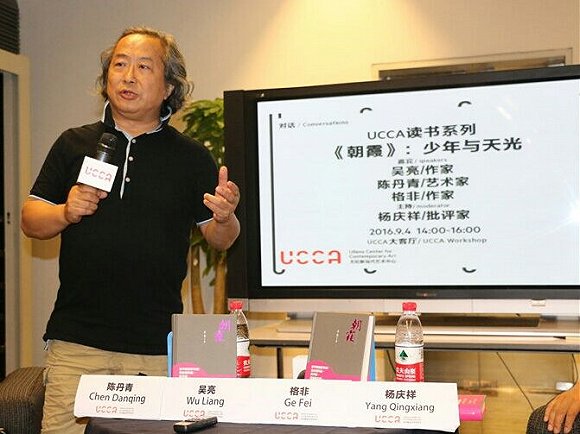
In Chen Danqing’s view, this novel describes a submerged Shanghai. When talking about Shanghai, everyone will think of the occupied Shanghai written by Zhang Ailing, Su Qing and others in the 1930s. In the 1980s, Wang Anyi, Sun Ganlu and others appeared to re-describe Shanghai. The narrative from the 1950s to the 1970s was completely interrupted. It was a Shanghai in the revolutionary period and the Shanghai of the Cultural Revolution. "As we people gradually enter middle age and old age, I believe that we will naturally become qualified to start talking about the Shanghai when we were young, the Shanghai that has not been spoken of." Chen Danqing said.
When the Cultural Revolution began, Chen Danqing was 13 years old and Wu Liang was 11 years old. The next ten years were when they were in junior high school, high school and college, and they happened to spend their time during the Cultural Revolution. These ten years were a disaster for their parents and ancestors, but they grew up in it. "There is only one movie that accurately describes that moment, and that is "Sunny Days." Whether we agree with its conclusion or not, if it did, children at that time were really happy. First, there was no need to go to school, second, there were no exams, and third, there was no competition. It was hard for us to go to the countryside, and it was hard for you to go to the factory, but everyone was just as poor." Compared with the huge difference between being a "diaosi" or a "rich second generation" today, he would rather be a young man who went to the countryside in the 1970s.
In addition, young people in the 1970s had a lot of time. They did not have to go to school or take exams, and they also had a lot of time to go to the countryside. But at that time, you couldn’t go to another place. Going from one place to another required a certificate from your employer. Everyone had a lot of time, but they were stuck there. Young people chose what books to read, what friends to make, and all kinds of dreams when they should go to school. "When we were young, we were all reading books, and our hands were full of world famous works. We had several idols. Fu Lei wrote "Philosophy of Art". I know there was a Ru Long in Beijing because he translated Chekhov. Between the ages of 13 and 18, we knew all the literature, and we knew all the names we could know at home and abroad. , although you may not necessarily see his books, there are no popular books, there is no TV, there is no Internet. Because of the emergence of today’s civilization, I look back and think about how our generation grew up. I don’t want to say that that era was good at all, but I was very lucky that I spent 13 to 18 years old in that era.”;
Chen Danqing said that he left Tsinghua University because he could not stand the school physically. "I have been a wild child since I was a child, and I think Wu Liang was also a wild child. But he was well-read, and a group of well-read wild children were talking about literature in the alley without any hope, and in the end they really became writers. This was an anarchic period, and most things were It was smashed, and a group of children grew up in this ruin." The lives of young people born in the 1980s and 1990s were all planned from kindergarten to college graduation, or they worked as "diaosi", and for them at that time, "we were very happy with a little pocket money."
In the end, the novel was named "Zhaoxia", and Wu Liang said that it might be related to his liking for the sky. In the process of writing, his ambitions have gone beyond Shanghai and even beyond the ground. He wrote about the earthquake in Tangshan and a flood in Henan. He originally wanted to write about locust plagues and mudslides. "The destruction caused by large weather events to human beings, in addition to political disasters, there are also struggles between a large number of people and animals, diseases, and geographical struggles." These are metaphorical, and more importantly, he is interested in retaining the information at that time. But in the end he used a bright name like "Zhaoxia", "In the end I had to use something positive. Being positive is not for publication. I am a very positive person myself. Because I believe in God." As a Christian, Wu Liang finally said this.
