
Most of the people who came to listen to Lin Xili's lecture were parents with their children. She came this time to promote her new book "Kingdom of Chinese Characters for Children". She spoke in English, and after a brief greeting, she apologized for not speaking Chinese because she hadn't been to China for a while.
Lin Xili speaks quickly and smiles from time to time. When she smiles, her eyes are filled with friendliness and enthusiasm, which makes it difficult for people to think that she is 84 years old. When she got up, she noticed that she had difficulty moving and needed the support of crutches. She had a second knee surgery six months ago. Later, when I was sitting across from her for an interview, she stretched out her hand - the hand that had been playing the guqin for decades was now swollen and stiff, and some of the fingers were bent and could not be straightened. They were severely deformed and looked weird and lifeless, hardly like a pair of hands anymore.
More than fifty years have passed since she first came to China. She wrote, as an outsider, "How did I go from viewing China as a scourge and loathing her in many ways, to understanding her better—and finally falling in love with her regardless of everything?"
Lin Xili was born in Lund, Sweden. She studied Chinese linguistics and Chinese art for many years when she was young. Her teacher was the famous sinologist Gao Benhan. In 1961, when her first husband came to work at the Swedish Embassy in China, she decided to go with him and study Chinese at Peking University.
At that time, it was very difficult to obtain a study visa in China. She received letters of recommendation from many people, including King Gustaf VI of Sweden. On January 2, 1961, they finally made the trip. When passing through Moscow, she went to meet a local music professor and said that she wanted to learn an instrument in China. The professor suggested that she should learn Guqin. Guqin is the instrument that best reflects the character of ancient Chinese literati, and recommended the Guqin Research Society to her.
For her, China in 1961 was a completely different world. When she was in Sweden, she read a lot of books about China in 1949, but the Swedes knew almost nothing about the situation in China after 1949.
She moved into the dormitory of Peking University. The classrooms and dormitories were very cold, and the students were all dressed in bulging clothes. When spring comes, students climb up the elm trees to pick leaves to eat. In order to catch the leaves, many branches are broken. Lin Xili ran to tell her teacher that someone was destroying trees, and the teacher told her that there was a famine across the country. Then she noticed the swollen faces and limbs of her classmates, and she didn't realize the seriousness of the problem until she began to lose strands of hair herself. The doctor diagnosed her with severe protein deficiency and asked her to go to Union Hospital twice a week for vitamin B injections.
My experience at Peking University was very unpleasant. There are very few everyday words in the text, and most of the text is full of political overtones. The teacher only taught mechanically, blindly memorizing the students without much explanation, and asking questions was seen as disturbing classroom discipline. She wrote in her diary: "I feel that the distance between me and this country is increasing uncomfortably. Life is so heavy, like trudging through muddy fields in rubber shoes... Teaching is not to create people with the ability to think independently, but to make people unconditionally obey the new social system... I feel that I am getting smaller, shriveled and hopelessly turning into a four-year-old child."
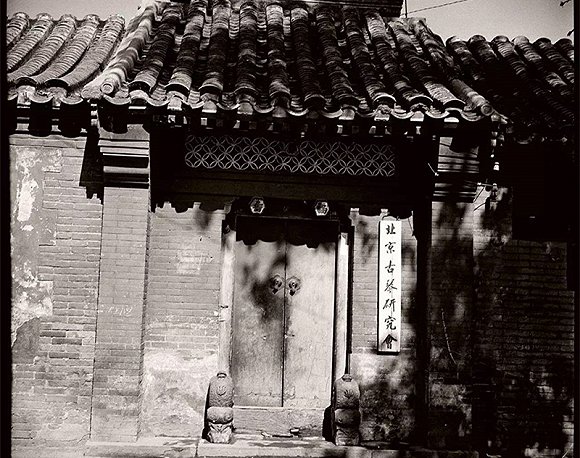
When Lin Xili entered the Guqin Research Association near Huguo Temple in Beijing to study Guqin, her attitude towards China completely changed. The Guqin Research Association (founded in 1952 and closed down during the Cultural Revolution) is located in an old courtyard house. There are 11 musicians and scholars in total. They are knowledgeable, friendly, and dedicated, and they never talk empty words or slogans. And she was the first and only student of the Guqin Research Association, and they were eager to teach her everything they knew, without reservation.
For her, this is a pure place isolated from the harsh political environment, where China's most elite traditional culture is still well preserved despite being doubted.
Her teacher is Wang Di. Wang Di plays a piano from the Tang Dynasty, and Lin Xili plays a piano from the Song Dynasty. Pu Xuezhai, a guqin player and painter who works next door, would sometimes come over to make comments. He was the cousin of the last emperor Pu Yi. Wang Di's teacher, the outstanding guqin player Guan Pinghu, is naturally also very concerned about it and comes to visit from time to time. In her impression, Guan Pinghu was “only 1.5 meters tall, thin and short, with a head full of gray hair. When he spread his huge, black and uneven hands on the strings, the contrast was huge. His playing was so powerful, it felt like the whole building was going to collapse." At that time, Zha Fuxi and Wu Jinglue were professors at the Conservatory of Music, and there were Wang Mengshu, Yang Baoyuan and others in the seminar. These people were all gentle and quiet. It took her a long time to understand who these old gentlemen were.
Every day she walked through the crowds holding the borrowed guqin from the Song Dynasty that was thousands of years old, and squeezed into the bus with great difficulty. She is obsessed with the beautiful sound of the guqin and the artistic conception and stories of the music. "Goose Falling on the Pingsha" is about the wild geese flying in, lingering and falling, and then flying away and disappearing. The tune is sad. "Eighteen Beats of Hujia" tells the true story of Cai Wenji who was kidnapped by the Huns. The even more legendary "Guangling San" describes the story of Nie Zheng's assassination of the King of Han during the Warring States Period. Ji Kang played this piece on the qin before his execution in the Wei and Jin Dynasties.
During the two years at the Guqin Research Association, "I developed a deep admiration for Chinese culture, although I did not realize it at the time." More than fifty years later, when she talks about the Guqin Research Association, she gets excited and speaks faster.
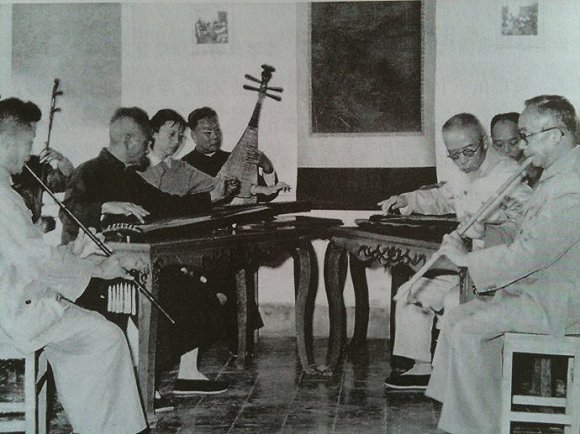
Sunday concert at the Guqin Research Association in 1961, the second from the left is Guan Pinghu, the third from the left is Wang Di, the middle right is Pu Xuezhai, and the one playing the flute on the right is Zha Fuxi.
Two years later, Lin Xili reluctantly left China due to family reasons. The Guqin Research Association not only gave her a Ming Dynasty Qin "Crane Ming Autumn Moon", but also recorded a tape for her that has become her final song.
When she returned to China for the first time in 1973, she could not find Wang Di. The Guqin Research Society was no longer at its old location, and no one knew where those Guqin players and the documents they collected had gone. (Pu Xuezhai and Guan Pinghu passed away in 1966 and 1967 respectively.) She inquired about their whereabouts year after year, but found nothing. In 1978, she finally got in touch with Wang Di, who had returned from being sent to the countryside, and they were reunited.
In the 1970s, Lin Xili began teaching Chinese in Sweden. Why did Chinese characters look like this? She explained the structure of Chinese characters.She narrates the whole story, from oracle bone inscriptions, bronze inscriptions, small seal script to today's Chinese characters. She also tries her best to use new archaeological discoveries in China and some pictures of cultural relics so that students can trace the origins of the shapes of Chinese characters. "I find that my students respond exactly as I have in the past - the more I teach about the structure and early forms of Chinese characters, the easier it is for them to understand and remember them. It works especially well when I also teach about the world from which these characters come, about the daily lives of the ancient Chinese - their houses, vehicles, clothes and the tools they used, and about the natural scenes - the countryside, mountains and rivers, animals and plants - that produced these characters."
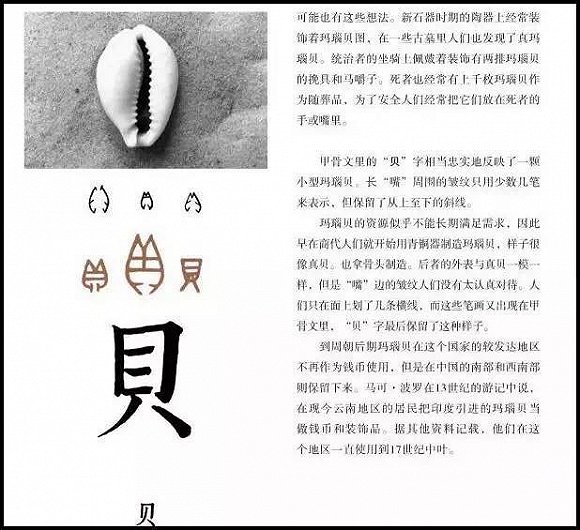
In 1973, she obtained a visa to China again. Since then, she has come once or twice a year to check information in libraries, visit experts and scholars, go to archaeological excavation sites to observe physical objects, and set up inspection sites in Shandong, Shaanxi, Henan and other places. She would be excited if she found a tool or artifact related to a certain glyph. Fifteen years later, in 1989, she completed "The Kingdom of Chinese Characters", which won the August Award, Sweden's highest literary book award, and was translated into more than a dozen languages.
After the completion of "The Kingdom of Chinese Characters", Lin Xili began to write "Guqin", telling her experience of learning the piano at the Beijing Guqin Research Association. “The piano ‘Crane Mings in Autumn Moon’ and the people I was fortunate enough to meet at the Beijing Guqin Research Association were the important reasons that prompted me to write this book.” It took another fifteen years to write “Guqin” and won the August Award again. She also invited Wang Di’s daughter, Deng Hong, a guqin player of the China National Traditional Orchestra, to perform more than 40 performances in Sweden, and the performance was very popular. Next week Deng Hong will go to Sweden to perform again, and Lin Xili is looking forward to it very much.
Interview with Lin Xili
Interface: Do you often play Guqin in your daily life?
Lin Xili:Yes. But my hands were swollen, I couldn't open them, and it was difficult to move them. So I only play it for myself and no longer play it for others. I like to play the piano for myself. It makes me calm and happy, and reminds me of Chinese culture and Chinese friends. Playing the piano is a bit like meditation.
During the two years when I studied in China, my teacher said, we know you want to buy a guqin, but it is basically impossible to buy it because there are no families selling guqin and no one plays the guqin. The next generation may be able to do it; so we provide you with a guqin from the Song Dynasty. I took the piano with me on the bus at that time. People were crowded around and it was dangerous. I was very worried that my piano would be damaged, but nothing happened.
Later they gave me a Ming Dynasty Qin "Crane Ming Autumn Moon", which is now at my home.
Interface: How important is the experience of learning piano to you?
Lin Xili: I still remember this experience very clearly. At that time, I found that these people who taught Guqin were very educated, very sincere, and very dedicated to Guqin. They are also very focused on passing on Guqin as a culture to foreign students like me. At that time, few people in China were so interested in ancient musical instruments. The guqin professor not only taught me the skills of playing the guqin, but also taught me a lot about the culture and knowledge behind the guqin. Through the professor’s explanations, I learned how the instrument, which has a history of thousands of years, makes sounds and how to tell the story behind the guqin.
It is no exaggeration to say that the two years of studying piano in China have been one of the best experiences in my life. These two years have changed my life. When I was studying, I didn’t really understand the instrument Guqin. Later, I regarded Guqin as a part of life and part of the meaning of life. I worked with my former Guqin professor to save this Chinese Guqin art that was about to disappear.
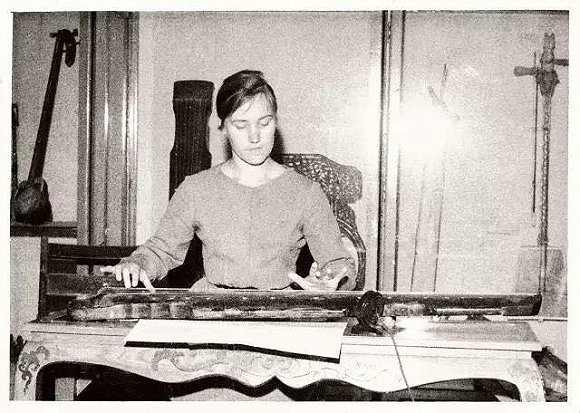
When Lin Xili was studying at the Guqin Research Association. "Later I regarded the guqin as a part of life and a part of the meaning of life."
Interface: Before you came to the Guqin Institute, you had a very unhappy time at Peking University. What was the worst thing about that time?
Lin Xili: It can be said that it is very unpleasant. The students are timid and fearful. If they do something wrong, they will be punished or sent to the countryside. Everyone is scared. I found that someone had touched my suitcase, clothes, medicines, everything. So I taped a string to my box so I could tell if they had opened it. When I returned to the dormitory, the thread was gone and the box had been rummaged through. I also glued a very small piece of paper, the kind of paper used for rolling cigarettes, under the door. When I came back, I found that the piece of paper was in pieces. By the end I felt like I was going crazy.
I complained about this to the International Students Office and asked why this was done to me. But they say we have never done this to our dear students. But they did. They wanted to know everything about me. There was a girl who was arranged as a tutor to help me study. She came three times a week for two hours each time. She is very nice, but she asks hundreds of questions every time, including who have you met since arriving in Beijing, what books have you read, etc. A Polish student found a notebook in his dormitory that his "counselor" had left there, in which he wrote all the details, who he had met, his political views, etc.
At that time, three Swedes were translating Mao Zedong’s works. I said, why should you listen to the authorities? One person said that there are people everywhere here, and anything you say may be heard by them. He was very aware of the situation, that we were all under surveillance, and it was terrible.
Interface: If you had not learned Guqin, would you have stayed in China for so long?
Lin Xili:Guqin is an important reason why I stay in China. If I had not participated in the Guqin Research Society, I would probably have left China at that time. As a foreign student, my personal freedom is very restricted, which makes me feel very uncomfortable.
Many people starved to death at that time, and the storeThere was nothing for sale inside, and there were no buses or taxis on the road, just some cyclists. I came to Peking University in the spring to study. I found some people lying on the trees and not knowing what they were doing. Those people were eating leaves, so I asked the teacher to stop them from eating leaves. The teacher said that they have had nothing to eat since September last year. I feel very sad and have no idea that the situation in China is like this. Foreign students and Chinese students lived in different places, and communication with each other was restricted. I did not fully understand the situation in China at the time.
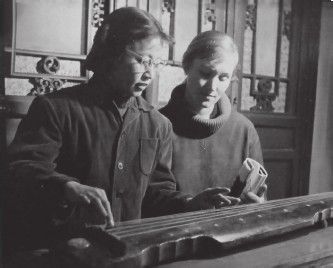
Wang Di instructs Lin Xili to play the piano
Interface: What happened to your teacher Wang Di?
Lin Xili: After the professor returned from labor reform on a farm outside Tianjin in 1978, we reconnected. The book "Guqin" is inseparable from her help. She helped me prepare a lot of materials. In 2005, one year before the book "Guqin" was published, the professor passed away.
I learned that the professor’s daughter Deng Hong is also a guqin player, so I invited her daughter to come to Sweden to perform and held many concerts, all of which were full. At that time, the piano and flute ensemble was unprecedented in Sweden, and many universities and organizations came to listen to musical instruments from China. They held it all over Sweden for almost three months, running from city to city, performing non-stop one after the other. Last year they performed in Iceland, and next week they will return to Sweden for the same performance. I am very happy to see these very famous guqin artists again.
