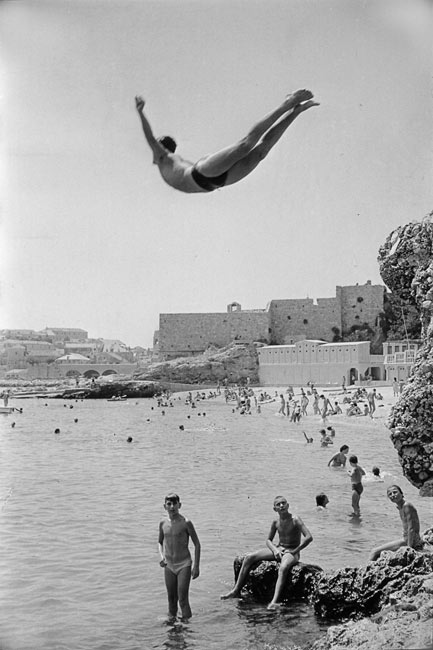
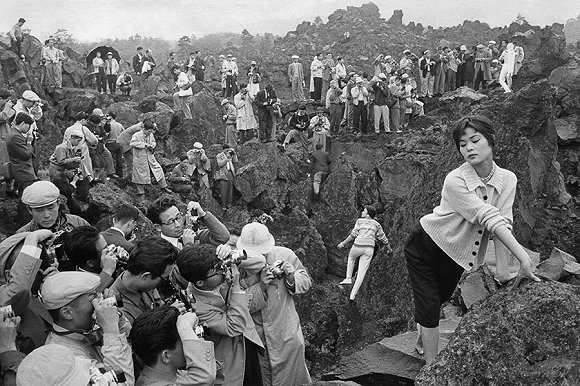
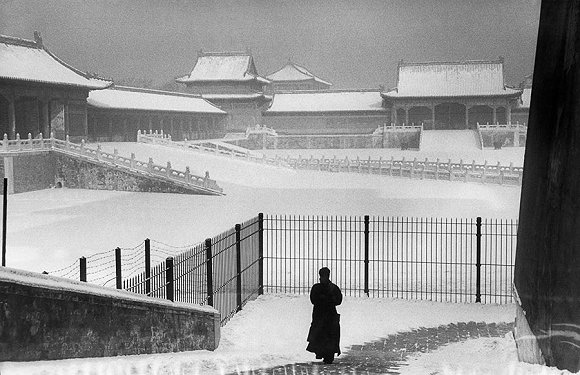
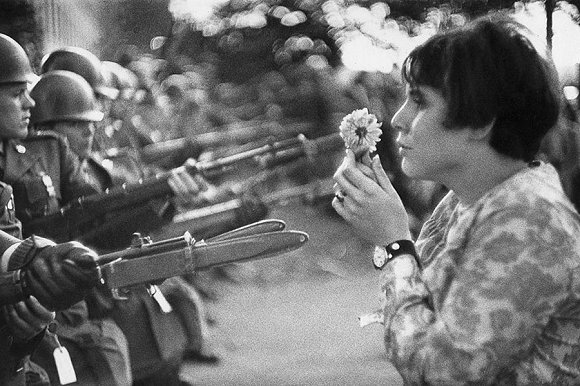
The process of Marc Ribu coming to China in 1957 is a bit legendary. He got a second-hand car in 1955 and drove it all the way from Paris to Calcutta, India. During the trip, Mark expressed his desire to go to Red China for photography through a friend he met - that friend happened to know Chinese Prime Minister Zhou Enlai. Two years later, with the help of Zhou Enlai, Mark was allowed to enter China and became the first Western photographer allowed to enter China to shoot.
He implemented a series of photography projects in China and traveled back and forth to China many times in the following decades. He photographed workers at the Anshan Iron and Steel Plant and Liulichang Street during the Cultural Revolution. These works won Mark Ribu a great reputation at a time when Europeans were mysterious about Red China.
With his expertise in Chinese subjects, Marc Riboud has become a master of documentary photography as famous as Cartier-Bresson, Rolf Gierhausen, and Brian Black. He has published photography collections such as "40 Years of Photographing China", "What I See in China", "Huangshan", and "Shanghai".
As early as when he was young, Mark Ribu formed a friendship with Cartier-Bresson. Marc Riboud took a trip to New York in 1951 and was struck by the photography in the museum. He had previously participated in the French anti-fascist guerrillas and graduated as a mechanical engineer from the Ecsle Centrale in Lyon after the war.
After returning to France from New York, Marc Riboud changed his career to become a freelance photographer and moved to Paris. It was during this period that he joined Magnum Photo Agency, founded by Cartier-Bresson and Robert Capa.
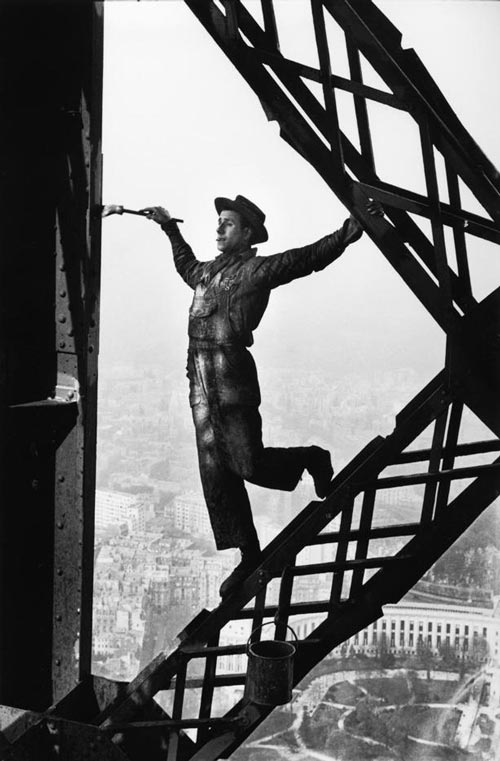
In 1953, Marc Riboud published his first work, titled "Eiffel Tower Painter". Marc Riboud's works are famous for their delicate beauty and exquisite composition. People who like him believe that this obsessive attitude towards lines is related to his past as an engineer.
In 1971, Mark Ribu came to China and photographed a ballet student. 39 years later, in 2010, Mark Ribu held a retrospective exhibition of his personal photography works in Shanghai. With the help of the Chinese side, the ballet student was finally found. It was Tang Xuejuan, who was already working as a dance teacher at the Shanghai Ballet. When meeting Mark Lu Bu, Tang Xuejuan admitted that she did not know that the photo was taken at that time.
Although his many shootings in China greatly increased Marc Riboud's popularity in the West, it was not until the late 1980s that his works were introduced to China. Since then, he has been regarded as a benchmark figure in documentary photography by Chinese photography enthusiasts.
Most of his works have been published in magazines such as "Life", "National Geographic", "Paris Match" and "Star Weekly". He has also won the Overseas Press Club Award twice, which is considered one of the highest honors in the photojournalism industry. In addition, he has also won the "Infinity Award" from the International Center of Photography in New York and the Sony World Photography Competition Lifetime Achievement Award.
On August 30, 2016, according to local French media reports, Marc Riboud passed away due to illness at the age of 93.