
"My dad is a firefly expert, and he promised to take me with him the next time I go hunting for fireflies in the wild. It's great! One weekend evening, we came to a large mountain far away from the city. Birds were jumping up and down in the forest, and the wind was dancing on the seedlings. 'Dad, it's so beautiful here!'"
"Let's collect some and raise them for observation. Most of them are male in the air, and most of them are female in the grass. You can see larvae in the rice fields. Look, here is one. Just suck it with a straw and put it in a bottle."...
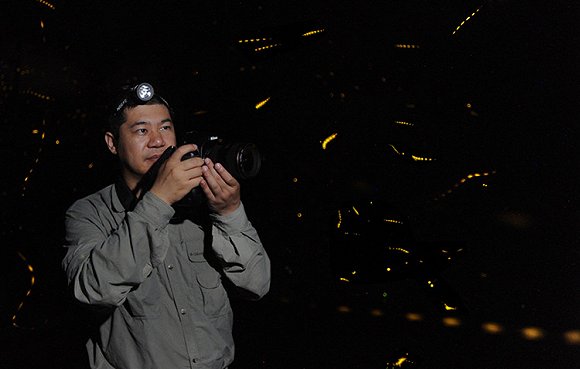
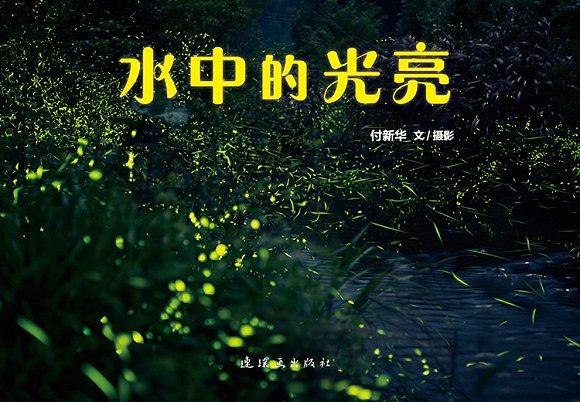
At the new book launch conference at the Beijing International Book Expo Children's Library, Fu Xinhua and his 9-year-old son Fu Yuheng recited excerpts from his just-published picture book "Light in the Water" on the stage. "Light in the Water" is a photographic picture book that combines photography, illustrations, and text to introduce the life of fireflies by telling the story of a child and his father searching, raising, and releasing fireflies together. The protagonists of the story are actually the author and his son, Fu Yuheng. "Yu" means flash, and flash is short-lived, so adding the word "heng" means "shining permanently."
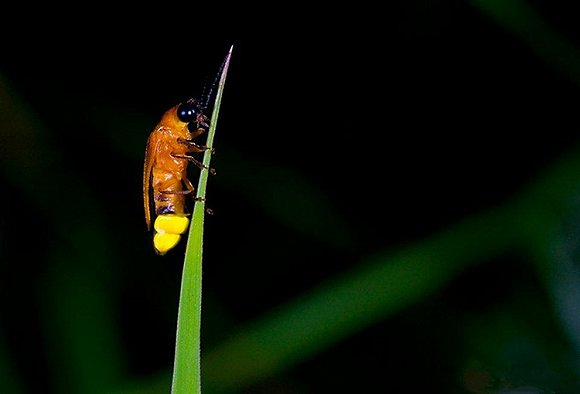
Fu Xinhua's identity here is a popular science writer, and his official occupation is an associate professor at the College of Plant Science and Technology of Huazhong Agricultural University. In 2000, he saw fireflies for the first time on the university campus, and he developed a strong curiosity about this beautiful and luminous creature. He started researching out of curiosity, and then got out of hand. He became China's first doctorate to study fireflies. He traveled to more than half of China for field research, and discovered and named new firefly species such as "Wuhan firefly", "Lei's firefly", and "Chinese firefly".
During the field investigation, he discovered that fireflies were disappearing rapidly. A year ago, there were thousands of fireflies flashing collectively in the mountains, but a year later, not a single one could be seen. Light pollution, pollution of rivers and soil, excessive deforestation or excessive landscape development have led to the destruction of firefly habitats. The population of fireflies is getting smaller and smaller, and many populations have become extinct before they are even discovered. After investigation, he found that 95% of urban children have never seen fireflies, and almost 99% of farmers believe that fireflies are pests. Most people do not care about the disappearance of fireflies. He felt that he could not just be a noble researcher in school, "I should do something. I should appeal to the public to keep the fireflies and leave such beautiful fireflies to our children."
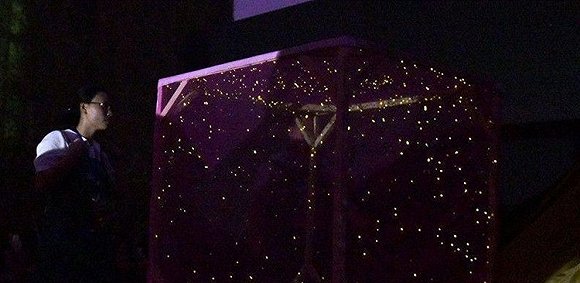
He began to do firefly protection and science popularization work. In particular, he was concerned about the "Firefly Theme Park" and "Firefly Release" activities that have become increasingly popular this year. After investigation, he found that all fireflies claimed to be artificially cultured were caught in the wild. The average mortality rate of the purchased fireflies was 22.52% after a few days of bumps on the road. The remaining ones could not adapt to the new environment and would die soon. The lifespan of adult fireflies is only about 7 days. During this period, they were captured on a large scale, which is likely to affect their courtship and reproduction, causing devastating harm to the firefly population in this area.
City people's desire to watch romantic fireflies has led to the mass extinction of fireflies. Fu Xinhua feels that in addition to calling on the public to reject such commercial practices, the most fundamental solution is to establish firefly habitats and allow fireflies to return to people. In 2015, he cooperated with the Xianning government of Hubei to establish the 22-square-kilometer Dali Mountain Firefly Conservation Park. The park cultivated and protected half a million fireflies, forming a glowing sea of fireflies at night. He hopes that after this model matures, it can be promoted to more places across the country, and even firefly sanctuaries can be established in cities. The 38-year-old will probably spend his whole life realizing his ideals. Currently, the Firefly Watch Research Center, the first firefly charity protection organization in China, he has established has a team of more than a dozen people. He hopes that more people can work with him.
In order to keep the figure of Firefly, he bought a SLR and practiced photography for many years. He also likes literature. He is very happy to use his hobbies to turn the photos he took and the words he wrote into books, so that more people, especially children, can see them. Through his books, he "inspires children's awareness of scientific innovation, scientific exploration, and environmental protection. Through understanding fireflies, children can fall in love with fireflies and sparkling little bugs."
Interview with Interface Culture on Xinhua
The most beautiful thing is the feeling of soaking in the sea of light in the grass
Interface Culture: How did you become interested in fireflies and start studying them?
Fu Xinhua:I never saw fireflies when I was a child. After I came to college in 2000, one night on my way back to my dormitory, I saw a bright spot in the grass. I dug it out with my hands and pulled out a glowing bug. I was very scared and threw it far away. Not willing to give in after that, I went to the dormitory to get tweezers and a petri dish, and clamped it inside. When I touched it, it glowed, then went out after a while, glowed again, and went out again after a while. This behavior made me feel very interesting, as if I was talking to me.Conversations are the same. I'm just curious, why does it glow like this? What is the purpose of its light? Later, I did a lot of experiments that seemed very naive now. The next day I asked the teacher what it was, and the teacher said it might be the larvae of fireflies. Later, when I was exploring the role of fireflies in luminescence, I became more and more fascinated, so I told my teacher that I wanted to use fireflies as a material for my research. The teacher agreed, and I have been studying it from master's degree to doctoral degree until now. It was a chance encounter.
Interface Culture: You are the first person in China to study fireflies. Why has no one studied fireflies before? When you first started researching, were there people around you who didn’t understand?
Fu Xinhua: The reason why no one has studied fireflies before is because they are neutral insects, neither pests nor beneficial insects. It is difficult to get funding for insect research. If there is no funding, no one will do it. When I first started researching, my teacher was quite encouraging. Do other teachers think this is useful? It has nothing to do with agricultural pest control. After I graduated and stayed in school, I became very stressed because it was difficult to get funding for scientific research. In my school, it was a niche and unpopular field. It was not the main battlefield. The main battlefield was agricultural pest control, killing pests and increasing production. Many colleagues, teachers, and school leaders said that you can’t do this well and can’t get funding. Can you do something like pest control? Some people still say this, including now. I think if I identify this thing, I will keep doing it. I like this thing, and I think it can be used as a theme of environmental protection, and it is also very interesting and beautiful. Generally speaking, I still stick to my own path, and when I do something, I have to do it thoroughly, either not doing it, or doing it well.
Interface culture: When you go hunting for fireflies, are you usually alone in the wild mountains at night? What would those times feel like?
Fu Xinhua: I feel a little more lonely. There will be a little bit of fear, but in fact, I have taken better precautions in the wild, so there is no big problem. Occasionally, when I hear a rustling sound, I will think, "What is this," and of course I will be afraid. But there is still more loneliness. I still feel that in the early stages of my career, although many people are now concerned about this matter, I still feel that my talents have not been fully utilized, because sometimes if you want to do something, it cannot be done by one person. It requires a lot of cooperation and the integration of many resources. Sometimes I still feel that this is not enough. Sometimes I still feel helpless and lonely, especially when I am alone at night. This emotion comes up and becomes amplified.
Interface culture: There are many beautiful things but also many dangers in the process of searching for fireflies, right? Can you tell me about the most beautiful and dangerous thing in your memory?
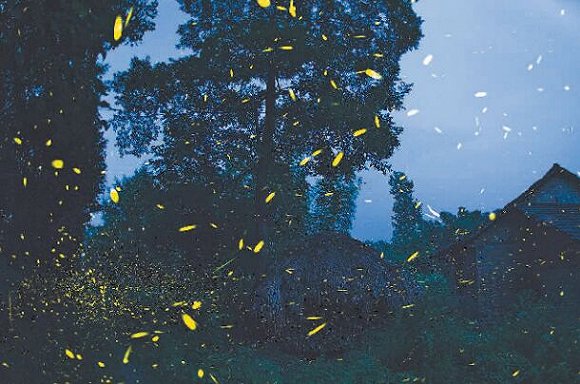
Fu Xinhua:The most beautiful thing is definitely when you see very beautiful large fireflies. For example, we saw so many fireflies in Dali Mountain. It feels like fireflies are surrounding you, it is the sea of fireflies, which is very spectacular. When I am in the grass, I feel like I am soaking in the sea of light. It is very good. This is the most beautiful time for me.
Poisonous snakes are generally the most common in the wild, but I have always been better protected and have never been bitten by a venomous snake. The most dangerous thing is that I almost drowned two days ago. When I was inspecting Jiugong Mountain in Hubei Province two days ago, I went down to the bottom of a valley to survey the terrain. I lost my footing and fell off a rock into a deep pool. The pool was two to three meters deep. I was not very good at swimming and almost drowned in it. Thanks to my colleagues who rescued me. When I came up, I thought, I won’t die here. It was extremely thrilling at the time, and this made me terrified for several days.
The so-called Firefly Park is a huge profit
Interface culture: Fireflies are a common image in ancient poetry, but fireflies are rarely seen in modern times. When did fireflies begin to disappear? When did you first become aware of the problem of disappearing fireflies?
Fu Xinhua: In my impression, when I started researching in 2000, there were still a lot of fireflies in the school, but starting from 2005 and 2006, the number dropped very quickly. When I went to Mount Emei, there were still many fireflies in 2005 and 2006, but they dropped sharply in 2007 and 2008. Maybe the real estate industry in China began to accelerate at that time, and when urbanization accelerated, the number of fireflies began to decline sharply. I have been particularly impressed since about 2008. I saw a large number of fireflies in 2007, but when I went to the same place in 2008, there were no fireflies at all. There was a big gap between that time and 2000. In 8 years, a large number of fireflies disappeared.
Interface Culture: How did you start to pay attention to the sale of live fireflies? What is the business chain behind this matter?
Fu Xinhua: Probably from 2009 to 2010, because the public began to slowly understand fireflies under my appeal, some people used their brains to catch fireflies and sell them to couples as courtship gifts. Then many newspapers will publicize that a certain university graduate is raising fireflies and starting a business, and they will report it like this. According to our investigation, it is all false. From then on, this matter became more and more intense, until it reached its peak last year, when 26 cities held firefly theme parks to catch fireflies and then release them in the city.
We have been doing live firefly trading investigation reports for the past three years and published them online. This year is the most solid year we have done so. Through collecting samples from small-batch sales on Taobao, conducting field visits and even biological verification, we have exposed all of this chain. The current chain is like this. Encouraged by insect dealers, farmers catch fireflies in their paddy fields, private plots, and mountains for 5 cents or 8 cents.The prices sold to insect dealers, which are more popular during Chinese Valentine's Day, are one yuan each. All Taobao sellers will deal with insect dealers. Taobao sellers will take orders and transfer the order to the insect dealer. The insect dealer will ship the goods according to the delivery address. The small batch will cost 5 yuan each, for example, 50 to 100. If there are thousands or tens of thousands of them, the wholesale price will be one yuan and fifty cents each. It will be very cheap. They will deliver it to you personally and give it to the so-called firefly park. Then Fireflies Park buys tens of thousands of them every week. They are very cheap. Ten thousand are only 15,000, and the most is two yuan each. Ten thousand are only 20,000 yuan. For a scenic spot, this is nothing. Then he built a net in the park and put it outside. Tickets cost 30 yuan to 50 yuan each. If 10,000 people could come, this would be an income of 500,000 yuan. After deducting the costs of various publicity, maintenance, and buying bugs, the total was only 100,000 yuan. He made a net profit of 400,000 yuan, which was a huge profit. So last year they were bought in many scenic spots.
Interface culture: Do people involved in the sale of Fireflies know the consequences of doing so to Fireflies?
Fu Xinhua: Insect dealers know this because the public opinion on the Internet is not good for them, so they are very careful even if they say they violate ethics and ecology. And in Ningdu County, Ganzhou, their government is also cracking down on those who catch fireflies, because this has caused great damage to the reputation of the county. When it comes to Ganzhou - the "Grave of Fireflies", they have to crack down too. Insect dealers hide relatively deeply. Farmers don't care. They think that if I catch a bug, it is no different than catching a fish, a shrimp, or a loach in the rice fields. This is not protecting animals, so it doesn't matter. But we city people think this is too cruel. Such a beautiful thing will die after being caught. The more we catch it, the fewer its descendants will be left. It is very cruel. It doesn't matter to farmers as long as they make money, but the level of economic development and consciousness are also different.
Interface Culture: Have any specific measures been taken to reduce this kind of business buying and selling behavior?
Fu Xinhua: After so many years of advocating against the sale and purchase of fireflies, we now feel that Taobao is just a platform, and it is of no use to visit Taobao. We even did some express delivery work the year before last. YTO, STO, and SF Express all promised on their official websites that they would no longer accept and send live fireflies, but after a year, it no longer mattered.
What is the real source of the problem? People, especially people in cities, are eager to see beautiful fireflies. The demand is huge, but no one can provide them. This kind of products and services has caused a great dislocation. If people and organizations like me are veryMany, we are building firefly protection areas or habitats in Beijing, Shanghai and surrounding areas in minutes. We can lead the public to see fireflies every year. I believe that this so-called firefly park will definitely disappear. Everyone knows that I go here to see only a few fireflies, and they die soon. He wouldn't go there to see them. I would rather spend more money to give the children a good education, instill the awareness of environmental protection, care for fireflies, and see large fireflies flying around freely. It is because of this huge disconnect between demand and service provision that some unscrupulous businessmen and bug dealers take advantage of it.
We feel that while we are making appeals, we should also speed up the pace and come up with good models. For example, we established the firefly protection area in Da Lei Mountain. We are now building a model, hoping to replicate it across the country and provide better products and services so that the public can appreciate the beautiful fireflies without causing much damage to the fireflies. From the perspective of conservation biology, the most fundamental thing to protect a certain species is to protect its habitat. Just like protecting tigers and pandas, we must protect the mountain. So we have taken many measures, the first is to establish a protected area, and the second is to do a lot of science popularization work. For example, our book "Light in the Water" is about the life of aquatic fireflies. We hope that children can understand the popular science knowledge, fall in love with fireflies, and then follow us to see fireflies, so that children can become the main force in protection. At the same time, this year we also released some reports on Taobao transactions with Guoke, China National Geographic, and The Paper, and appealed to the media and the public that the so-called firefly breeding bases were all fake and were all fake. Many people now understand.
Interface Culture: So has the phenomenon of buying and selling live fireflies decreased now?
Fu Xinhua: Our appeal this year is quite strong, and we have revealed all the truth. If we see that this phenomenon has decreased, there were 26 cities hosting Firefly theme parks last year, and this year there are 23, which is a slight decrease. I forgot the specific data. It seems that Beijing is no longer there, and Shanghai is no more. Big cities still have more advanced concepts. But I don’t know what the situation will be like next year. I will continue to monitor next year, because we are worried that as long as the insect dealers can make huge profits, as long as the theme park exists, the insect dealers will keep collecting fireflies. If they are attacked in Ningdu or Ganzhou, they may go to other places. There are many mountains with fireflies in Jiangxi and Hunan, so I will continue to monitor this behavior next year to see if there is a reduction.
Interface culture: Nowadays, people pay more attention to commercial interests. When establishing a firefly reserve, do the locals think, why should such a large cost be invested in protecting fireflies?
Fu Xinhua: I think the model is more important. The place in Dali Mountain used to be very poor, but the local villagers were able to get rid of poverty and become rich.Fireflies are a very good theme, and urban people are also very keen to see fireflies. Then I told them that we must first protect the fireflies and the environment. In this way, more and more people from the city will come to our Dali Mountain to see the fireflies, and we villagers will have the opportunity to make money. For example, you can make money by selling bottles of water or cooking for others, and carry out this so-called environmental education. This kind of education is actually permeating little by little. They are still very simple and all support this model. In addition, we have adopted a new model in Dali Mountain to protect the fireflies in the water, asking villagers to grow fireflies rice for us. We have transferred the land, and the villagers have grown rice according to our methods and techniques, without using pesticides, chemical fertilizers, or herbicides. The rice seeds we have chosen are very good. Although the yield of genetically modified conventional fragrant rice has decreased, and only 400 kilograms of rice can be produced per acre, the quality is very good, without any pollution, and the water is very clean, all from mountain springs. The rice grown is very valuable, and can be sold for 20 to 30 yuan per kilogram, and it tastes very good. So if we follow the original model, which not only destroys the environment but also kills fireflies, one acre of land sometimes cannot even earn 300 yuan. Our method not only protects the fireflies, but also significantly increases their income. Why not? Therefore, we have adopted such a unique new model of community development and agricultural production. As long as we adopt some very clever measures that can benefit the environment, communities, and farmers, everyone will support this matter.
Interface Culture: For people living in cities, especially in northern cities, do they have to go to firefly reserves far away to see fireflies? Will one day they can see fireflies around them?
Fu Xinhua: For cities, it is not impossible to bring fireflies back to the city. It requires the support of many forces, such as city managers, parks, and governments. Let's work together. Because pollution will be heavier in cities, such as light pollution and water pollution, a lot of efforts are needed. We are now communicating with the leaders of the Park Management Bureau of the East Lake High-tech Development Zone in Wuhan. They are very interested in this matter and hope to do it in a park in Wuhan. We are now moving forward. Once such a model is established, it can actually be replicated across the country. In comparison, this replication is relatively simple and has good social effects.
Interface Culture: Where can you see fireflies in Beijing?
Fu Xinhua: Xiangshan Botanical Garden is expected to have several species in June and July, but only a few dozen or a hundred.
The fireflies are back, and so are many creatures
Interface Culture: Compared with your previous popular science books and picture books, what are the new features of this new book?
Fu Xinhua:This book has very strong emotions in it. It is actually about me taking my son to the mountains.I searched for fireflies inside, found fireflies in the water, brought them back to the laboratory for breeding and observation, and finally put the raised fireflies back into Da Lei Mountain. The whole story is based on a true story. What is different from other picture books here is that it is a completely original photographic picture book, and this emotional color is used as an extension to create this book. The previous picture book was purely popular science, without much humanistic emotion in it. This book has a lot of deep love between father and son throughout the book. If you observe it with your child, you will tell him a lot of knowledge, feelings, and love for the environment. These will be reflected in the book, which is the biggest feature.
Interface culture: This book is about children observing fireflies with their father. Do you usually spend time with your children? Do you often take your children to look for fireflies together?
Fu Xinhua: I usually spend a lot of time with my child. I often take him out to hunt for fireflies, do scientific research, take him to the mountains, and we even go on picnics and fishing together. I think the father is very important for the independent growth of the child. The mother gives more of a kind of care in life, while the father gives more of a kind of courage and independent personality. There is an old Chinese saying that "if the son does not teach, it is the father's fault." It does not say "if the son does not teach, it is the mother's fault." Therefore, the father should have more time and responsibility in the education of the child. , this is what I hope to use this book to tell our parents, especially the fathers of their children, to spend more time with their children, temporarily put down some of their work and entertainment on weekends, take their children deep into nature, and reconnect the children with their father through nature and through fireflies. This is one of my original intentions in creating.
Interface Culture: What is the current situation of firefly research and protection abroad? Which countries pay more attention to the research and protection of fireflies?
Fu Xinhua: Foreign countries have done a good job in researching and protecting fireflies. For example, the United States and Japan have studied fireflies for many years. These two countries are the best in research. Japan will pay more attention to protection. There are more than a thousand firefly protection associations and organizations in Japan, leading children to conduct popular science education and nature education, to watch fireflies, raise fireflies, clean streams, etc. The government also purchases some services from these protection organizations to provide environmental education to children, which is very good.
Interface culture: Why does Japan attach so much importance to the protection of fireflies? Is it related to their culture?
Fu Xinhua:RelatedBecause Japan is an island country, volcanoes and earthquakes often occur, and they may die one day. They feel that fireflies are the same as cherry blossoms. The most beautiful time is the shortest, which is about seven days. Therefore, viewing cherry blossoms and fireflies in Japan have the same status. The people of the island country like fireflies very much. It is very sad and beautiful, and it is in line with the psychological characteristics of the people of the island country.
Interface culture: What does firefly mean in Chinese culture?
Fu Xinhua: There are many fireflies in Chinese culture, but the descriptions of fireflies in ancient Chinese poems are more poignant and lonely. There was a war, and fireflies were flying around on the rubble. It was very desolate and lonely. Of course, it also described some beautiful scenes. In fact, we have a lot of firefly culture, but due to poor research and protection, these have not been well explored.
Interface Culture: Now in China, what ideals do you hope to achieve regarding Firefly?
Fu Xinhua:I hope to establish many protected areas like Da Lei Mountain to protect fireflies to a greater extent and on a larger scale. Secondly,I also very much hope that fireflies can come back to the city, and children in the city can You don’t have to travel far. You can see the sky full of fireflies in the community or in the park. Children lie on the ground and look up into the sky, counting fireflies and stars. The night sky is so bright, there is not so much light pollution, and there is not so much smog. I think this feeling is great. This is my ideal.
Interface culture: This is no longer an ideal about fireflies, but an ideal about the entire ecological environment, right?
Fu Xinhua: Yes, because fireflies represent an environmental indicator creature. Fireflies are back, and many creatures are back. The key is that our love is also back. I have seen such reports in many foreign cities, and I feel very envious. When I see the public going to Malaysia, Thailand, Taiwan, and Japan to see fireflies, I feel uncomfortable. I wonder why the Chinese people travel so far to see fireflies. One day I will build many firefly habitats in China so that our citizens and children can see fireflies without having to travel so far, even at their doorsteps. How happy I am. This is my dream.
