
This article is reprinted with permission from SocialBeta.
Forty years ago, on April 1, 1976, three young men—Steve Jobs, Steve Wozniak, and Ronald Wayne—founded a company. However, they must have never thought that the "Apple Computer Company" originally established would now become one of the most valuable companies in contemporary times. This company is now "Apple Company".
Tomorrow, September 8th at 1 am Beijing time, Apple will hold its 2016 autumn new product launch event at the Bill Graham Municipal Auditorium in San Francisco. This time Apple will bring many new products. In addition to launching innovative products year after year, Apple has also been a pioneer in the advertising industry. They have many classic advertisements that can be called legends in the advertising industry. Looking back at history, we might as well review what classic advertisements Apple has had in the past 40 years? Also see what lessons these ads have for today.
Apple I: The first Apple ad
Published: 1976
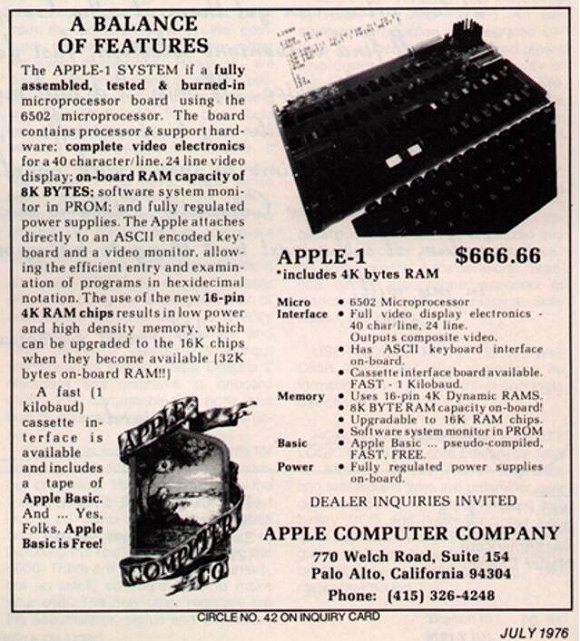
After Apple was born in 1976, it launched the Apple I computer and its first advertisement. But this ad looks more like a leaflet, with dense information and rough production, which is completely different from Apple’s current minimalist style.
Apple II: an advertisement that convinces consumers
Published: June 1977
The Apple II, born in 1977, was Apple's first mass-produced model. This product laid the foundation of the Apple empire, and its ease of use is still talked about by fans today. With a life cycle of an astonishing 17 years, the Apple II was widely hailed in the computer industry as the product that created the home computer market. By the 1980s, it had sold millions of units and was introduced to China in large numbers.
In this commercial, we can see people from all walks of life from Singapore, Mexico, Germany, Jamaica, Japan, the United States and other countries proudly saying that they use Apple II computers. The advertisement also shows that Apple II plays a very important role in people's home and work lives. Those daily scenarios that are closely related to consumers, as well as intuitive and clear words, let consumers know that Apple II is a personal computer suitable for mass consumption. It is suitable for use at home and even small children without any programming background can use it.
Apple Lisa: Ads featuring celebrities from the entertainment industry
Published: 1983
In 1983, the Apple Lisa, led by Jobs, was launched and named after Jobs’ illegitimate daughter. However, when the Apple Lisa was launched in 1983, Apple did not consider consumers' affordability of computers. The price at the time was US$9,935, which would be as high as US$20,807.06 in current prices. It is precisely because of this that many corporate users were more willing to purchase relatively low-priced IBM PCs. The Apple Lisa officially retired from history in August 1986.
The highlight of this commercial that deserves attention is that the male protagonist in the film is Kevin Costner, the star of famous movies such as "Dances with Wolves", "JFK", "A Perfect World", and "Mr. Brooks". In its early years, Apple often used the influence of entertainment celebrities to gain attention. In 1996, Apple placed its products in the first Mission: Impossible movie starring Tom Cruise.
At the end of the Apple Lisa commercial, you will hear the narrator say: "Soon, there will be just two kinds of people, those who use computers and those who use apples..." Apple had such confidence decades ago.
1984: Subvert tradition with a rebellious spirit
Published: January 1984
Apple Macintosh featured one of Apple's most famous commercials, "1984," during the 1984 Super Bowl.
Apple's "1984" advertisement is based on the fictional and prophetic novel "1984" by the famous British political satirist George Orwell. The protagonist in the novel, Winston Smith, lives in a totalitarian autocratic country called Oceania in the fictional year of 1984. His world is controlled by the "Party" and its leader "Big Brother". andIn this "1984" commercial, in a large, dark room, a group of people ran in and sat down in a row. Their expressions were dull. On the big screen in front, a solidified head kept telling the people sitting there what a PC was. Suddenly, a girl in a white shirt and red pants rushed in and threw the hammer in her hand at the screen.
The narrator slowly said: "On January 24th, Apple Computer will introduce Macintosh. And you'll see why 1984 won't be like "1984"."
The reason why Apple chose Orwell's "1984" as the background for its advertisements is because at that time, the Apple II series of computers were declining after several years of hot sales, while the IBM PC, which came out in 1981, was in a booming market and was constantly flooding into businesses and households. In the summer of 1981, IBM hit hard with the IBM PC, which promoted the rapid growth of the PC market. In Apple's eyes, there was no doubt that IBM, the "big brother" in the computer industry, wanted to control the emerging personal computer market. The ideological content reflected in Orwell's "1984" can fully express the pattern of the PC world in 1984 and Apple's mentality.
Ridley Scott, the director who was responsible for producing Apple's "1984" advertising creative, recalled: "'1984' expressed Apple's philosophy and goals: to let the people, not the government or big companies, control control technology, and make computers accessible to ordinary people instead of controlling people's lives." This 60-second long advertisement was only broadcast once during the telecast of the US Super Bowl on January 22, 1984, but it caused an unprecedented sensation. The three major television networks in the United States and nearly Fifty local television stations reported and replayed "1984" after the Super Bowl, and hundreds of newspapers and magazines commented on the phenomenon and impact of "1984," which earned Apple and the Macintosh free advertising and lasting applause.
In addition, Ridley Scott, the director of "1984", is still a famous director today. "The Martian" and "JFK" that you are familiar with are his masterpieces.
Think Different: The soul that saved Apple from dire straits
Published: 1997
In 1997, Apple was in turmoil. IBM was firmly on the throne of the personal computer market, while manufacturers such as Dell, Compaq, Epson and Hitachi were engaged in a price war. Apple computers had almost no place in the market. After Jobs returned to Apple, he found that the company he foundedSi is on the verge of despair. At that time, he only had 90 days to change the company's fate, because Apple's working capital only had enough to pay employees for 90 days. Since then, a series of "Think different" advertising works launched by Apple have also become the work that saves Apple's soul.
The "Think different" marketing campaign lasted from 1997 to 2002, when it was represented by TBWA/Chiat/Day. Advertisements include "Think different" celebrity posters and the "To the Crazy Ones" video. Celebrity posters are displayed in the form of black and white photos. Each advertisement features an iconic historical figure such as Einstein, Chaplin, Martin Luther King, etc., as well as some less well-known figures who are pioneers of the spirit of innovation, such as Bill Bernbach, one of the three founders of DDB, Amelia Earhart, the protagonist of "A Bug's Life", and Ant Flying, the protagonist of "A Bug's Life". Next to the poster is a short and powerful slogan "Think Different", and above the slogan is a brightly colored apple. Logo, the entire work is concise and full of strong visual contrast.
The characters in the "To the Crazy Ones" video advertisement include Einstein, Alfred Hitchcock, Bob Dylan, John Lennon, Yoko Ono, Martin Luther King, Thomas Edison, Gandhi, Picasso and other 17 characters. The copywriting in the advertisement was completed by Jobs and the agency. There is also a version of the narration voiced by Jobs himself:
Here's to the crazy ones. Pay tribute to those crazy guys,
The misfits. They are unique,
The rebels. They are unruly,
The troublemakers. They don’t stick to the rules,
The round pegs in the square holes. They don’t fit in.
The ones who see things differently. They don’t follow what others say,
They're not fond of rules.
And they have no respect for the status quo.
You can quote them, disagree with them, glorify or vilify them. You can quote them, disagree with them, glorify or vilify them,
About the only thing that you can't do is ignore them.
Because they changede things. Because they change things.
They push the human race forward.
While some may see them as the crazy ones, we see genius. Maybe they are crazy ones in the eyes of others, but they are geniuses in our eyes.
Because the people who are crazy enough to think that they can
change the world, are the ones who do. Because these people are crazy enough, they change the world
These copywritings also constantly remind future generations: respect those maverick geniuses who do unique things. Only those who believe that they can change the world can truly change the world. "Think Different" seems to be Jobs' declaration of returning to Apple: Apple is still so unique and cool. Put yourself in a relatively "niche" subculture, and gain insight into the commonality among your core user groups: what others see as madmen is actually a genius who changes the world. In this way, we can re-establish the image of Apple as unique and able to stimulate human creativity and ambition. And it is this niche interest that contains basic human nature that makes it popular among the masses.
Switch: Challenge again, but more tactfully
Published: 2002
After 1997, Apple successively launched products such as iMac, iBook and Power Mac, allowing it to quickly gain market share. The iPod, launched around 2001 and 2002, opened Apple to a broader mass market. At this time, Apple used the "Switch" series of advertisements to challenge Wintel, the "big brother" at the time, just like it used "1984" to challenge IBM.
Different from the intense and extreme "1984" or "Think Different", the Switch series of commercials directed by the famous American documentary director Errol Morris use a more peaceful and even joking way to allow celebrities who have switched from using PCs to using Macs to tell their own short stories. We see that in 2002, when Apple had a larger user base, the brand chose a more tactful way to tell its product story.
Wintel: Refers to the business alliance between Microsoft and Intel, which intended and succeeded in replacing IBM's dominant position in the personal computer market. PlaceAlso known as the Wintel Alliance.
PowerBook: Use characters and products to create cute contrasts
Published: Super Bowl 2003
The PowerBook was also a revolutionary product, the first 17-inch laptop. In this advertisement, Chinese basketball player Yao Ming also appeared and showed off his acting skills. In the advertisement, the tall basketball player Yao Ming uses the 12-inch version, while the short Wayne Troyer, the star of the movie "Mini Me", uses the 17-inch version. The contrast is very obvious. Troyer also happily watched the most popular blockbuster "Crouching Tiger, Hidden Dragon" on his big-screen PowerBook G4. Yao Ming, who was sitting next to him, looked at his smaller PowerBook G4 and then at Troyer's big screen, with envy and amusement in his eyes. At the end of the commercial, Troyer and Yao Ming looked at each other and smiled knowingly.
I fought the law: Make good use of current hot topics and join forces with PepsiCo to promote services
Published: Super Bowl 2004
In the 2004 Super Bowl commercial, Apple and Pepsi-Cola teamed up to make the best response and satire against the RIAA (Recording Industry Association of America) lawsuit against teenagers for online music sharing. The RIAA is notorious among music fans, especially teenagers, because it represents the interests of major record companies and has been waving the banner of law to block the exchange of music files online. In September 2003, the RIAA began prosecuting teenagers involved in online music file sharing. Among the first 261 people charged, the youngest was a 12-year-old girl. As of the end of January 2004, 914 individuals had been prosecuted by the RIAA.
The 16 boys and girls who starred in the ad were among the first to be sued by the RIAA. A 14-year-old girl named Annie Leith was the only one to speak in the ad. Sitting in front of a flat-screen iMac, Annie told the audience: "Hey everyone, I'm one of the kids being sued for downloading music for free online. I'm here to announce it in front of everyone.We still have to download music for free online. "At this time, Lace raised a bottle of Pepsi, and text appeared continuously on the screen: "Starting today, Pepsi and iTunes will legally give away 100 million songs to everyone for free," "Drink Pepsi, and you have a one-third chance of winning," "Download music on iTunes." Anne finally smiled and said, "How about no one can take it (free download music) now!" What's interesting is that the background music is still "I Fought the Law" by Green Day. The 100 million song giveaway event between Apple and Pepsi was announced in October 2013. According to this agreement, Pepsi will release 300 million bottles of Pepsi Cola, Diet Pepsi and Sierra Mist (Pepsi’s lemonade) into the North American market within two months. 100 million winning numbers are hidden in the bottle caps. The winners can use the winning numbers to download music for free from the iTunes online music store.
In April 2003, Apple launched the iTunes online music store, which obtained the music copyrights from the five largest record companies in the world. For the first time, Apple adopted a retail sales model of 99 cents per song, and gave consumers loose copying, recording and other rights for the music they purchased. Due to these consumer-focused services, the iTunes online music store became an instant success, selling 1 million songs in the first week, exceeding the sales volume of those record company music websites in 6 months.
iPhone 『How to』: The beginning of product introduction advertising
Published: January 2007
On January 9, 2007, Apple Computer Company officially launched its first smartphone iPhone and announced that it would be renamed Apple. Its biggest innovation at the time was the use of a home button and finger touch to operate the phone, a sliding browsing experience, an interface built with image icons, and a built-in iPod music playback system and a 2-megapixel camera. This commercial is also considered the first "How-to" type of advertisement in Apple's advertising history. It uses simple operations and narration to tell everyone how to operate the iPhone. This also established Apple's later advertising style of "clearly talking about products".
All kinds of fun: Pay attention to the value of vertical media and tap potential users
Published: September 2007
At the "The Beat Goes On" product launch event held on September 5, 2007, the iPod Touch was launched. The iPod Touch can be compared to a streamlined version of the iPhone - without functions such as phone calls and GPS (it was jokingly called "An iPhone without a Phone" at the time).
As part of the iPod series, Apple wants to highlight the product's significant features in music. At that time, Apple collaborated with Chicago music website Pitchfork Media to place a large wave of advertisements on the website. This is a very innovative attempt for Apple's advertising and marketing. It has begun to value the value of fans in the vertical media field, believing that this group of people who love music will become potential users of its products.
Pitchfork: A Chicago music website specializing in publishing music reviews, music news, and interviews with musicians. The content introduced on the website is mainly independent music, with a special focus on independent rock. It also reports some news about music types such as pop, hip-hop, folk songs, jazz, heavy metal, experimental music and electronic dance music.
Meet Her: Trying to combine technology with human emotions
Published: 2010
In 2010, Apple launched iPhone 4. The biggest highlight of the iPhone 4 this time is its free video chat function "Facetime", and Apple also lost no time in launching four video advertisements using this as a promotional point. They are "Smile": a teenage girl with braces who refuses to smile, and her father uses Facetime to make her happy; "Meet Her": a new father's first video conversation with his father; "Big News": a wife happily tells her husband on a video call that she is pregnant; "Haircut": about a girl showing off her new hairstyle to her boyfriend.
Slightly different from Apple’s previous fresh and creative advertising style, warm images have begun to become the focus of this advertisement. Apple began to try to combine technology with human emotions in its advertising. Since then, Apple has mostly followed this gentle path.
Misunderstood: emphasizing warmth and showing powerful functions
Published: Christmas 2013
Many people regard this "Happy Holidays" themed advertisement launched by Apple in 2013 as their favorite. This advertisement can resonate with every family. The family celebrated Christmas, and the boy was "playing with his iPhone" from the beginning until Christmas day. He seemed very cold and incompatible with the Christmas atmosphere. But in the end, when the family got together on Christmas Day, the boy used AirPlay to show the family videos that he had shot with his iPhone in the past few days and carefully edited with iMovie on the TV for everyone to watch. Only then did everyone realize that the boy was so thoughtful. It turned out that he wanted to use the video to express his Christmas blessings. Misunderstandings are eliminated and all that remains is mutual understanding. In such a warm holiday like Christmas, Apple hopes that everyone will not become a low-key person and spend more time with their families.
The advertisement "The Song" launched during the Christmas period of 2014 once again continued the warm line of 2013: when the granddaughter was sorting out her grandmother's old things, she found an old record that her grandmother had recorded for her grandfather. Then she used her MacBook, guitar and Apple software to re-record and cover the music, and put it on her iPad for her grandmother to listen to.
However, these two advertisements also reflect that Apple's products are so powerful.
Make a film with iPad: Apple products allow you to be creative
Published: February 2015
Last year during the 87th Academy Awards ceremony, Apple took advantage of the craze of the "Movie Extravaganza" to launch an advertisement "Make a film with iPad". Narrated by Academy Award-winning director Martin Scorsese, the ad tells the story of a group of students who tried to use iPads as their main shooting equipment to make short films with full personality based on the topic given by their teacher: "Make a film with iPad. Due this Monday." What is admirable is that this advertisement was completed in collaboration between Apple and students from the Los Angeles County High School for the Arts. The script, filming, post-production, and soundtrack were all created using iPad Air 2, and Apple provided the students with the necessary equipment. After the ad went live, Apple also announced the apps featured in the film on its official website, including the script drafting app Final Draft Writer, the auxiliary shooting app FiLMiC Pro, and the simultaneous recording app GarageBan.d. Apogee MiC, post-production application VideoGrade, etc.
During the Grammy Awards in February last year, Apple also launched the commercial "Make Music with iPad". The content of the commercial "Make Music with iPad" is similar to the above-mentioned "Make a film with iPad" advertisement. It tells the story of teenagers using iPad Air 2 to make music. The background music of the same advertisement was produced by iPad Air 2.
These two advertisements let us see that Apple wants to tell young people: the smart devices you have in your hands have unlimited potential, and Apple's products can allow you to unleash your unlimited creativity. At the same time, releasing corresponding advertisements based on the hot spots of important international awards also allows people to see Apple's ability to pursue hot spots, which is very different from the way ordinary brands chase hot spots.
40 years in 40 seconds: Apple’s cultural symbol over the past 40 years
Published: March 2016
Apple, founded on April 1, 1976, celebrated their 40th anniversary on April 1, 2016. To celebrate this milestone, Apple created a 40-second video. There are no bells and whistles in this video, just about 80 words that would make Apple proud. This time the words include Apple’s representative products, services and even historic advertisements in its 40-year history. From another perspective, these products or words are no longer just simple objects, but cultural symbols of Apple over the past 40 years.
Conclusion
Apple has launched nearly a thousand advertisements in the past 40 years. This list of so-called "classic Apple advertisements" will definitely vary depending on personal preferences. When we review these classic advertisements, we feel more about the rise and fall of a brand and how the way of telling stories to consumers has changed. Jobs said in a 1994 interview:
「When you grow up you tend to get told the world is the way it is and your life is just to live your life inside the world. Try not to bash into the walls too much. Try to have a nice family life, have fun, save a little money. That’s a very limited life.
Life can be much broader once you discover one simple fact, and that is - everything around you that you call life, was made up by people that were no smarter than you. And you can change it, you can influence it, you can build your own things that other people can use."
The "you can change it" he mentioned in this passage is also the core idea of "Think Different" three years later, and what he once said, "Try to have a nice family life, have fun, save a little money. That’s a very limited life." has gradually become the main line of advertising in recent years, whether it is Christmas ads or "Photos" Everyday" commercial, this series of advertisements has completely subverted the maverick spiritual core of Jobs in 1994.
From "1984" to "Think Different" to recent advertisements that reflect touching moments in ordinary life, we see that Apple is no longer as strong and rebellious as it was back then, and is becoming a gentler and more humane brand. For a brand that has a history of 40 years and has a large number of users, perhaps these warm advertisements that touch human nature are more likely to resonate with consumers.
