
Bilibili, which has always been known for its lack of advertisements, has recently quietly launched a new channel area - the advertising area.
Although the advertising area is not a pre-roll advertisement, at present, the concept of "no advertising" has evolved into an important symbol that distinguishes Bilibili from other video websites. It is even a moral judgment standard for many two-dimensional users to measure whether Bilibili violates its original intention.
Just in May this year, Station B caused a strong backlash from core users in the circle because of five new episodes. It was finally calmed down by chairman Chen Rui's timely crisis public relations. Nowadays, the number of online advertisements in the advertising area of Station B exceeds 1,000, which has once again brought Station B to the forefront because of the topic of advertising.

Currently, there are many doubts about why Bilibili chose to set up a separate advertising area. What changes will the birth of the advertising area bring to Bilibili and the advertising market? Will this be the prelude and clarion call for the commercialization of advertising at Bilibili?
Station B officially stated that the content carried in the advertising area is creative advertisements that were originally scattered in various areas and uploaded spontaneously by users. They are essentially the UGC short videos that Station B is good at. The advertising area is the same as the ghost area. It is open to all up owners and brand owners on the site, but it is currently not included in the charging plan.
Yang Liang, the public relations director of Bilibili, responded to Digital Entertainment DreamWorks that there is no direct logical connection between the advertising area and the advertising business. The integration of advertising areas is more based on content segmentation. It is still unclear whether new commercial value can be derived in the future.

1. Can the advertising area take on the important task of exploring new advertising models for Station B?
For Bilibili, which has always been known for its creativity and subculture, even when it comes to advertising, the approach is hugely different from other video websites. Through observation, Digital Entertainment DreamWorks found that the advertising area of Station B mainly has the following characteristics:
The carriers are different. Video advertisements on general video websites often adopt two forms: stickers and implants. The former is forced to watch before the video is broadcast, and the latter is to set up special plots in the series to expose the brand. The advertising content in the advertising area of station B is self-contained, using on-demand instead of forced viewing, and using subject play instead of object placement.
The content is different. Traditional video advertising often uses slogan-style promotion techniques to leave a strong product/brand impression on the audience in a short period of time. The advertisements in the advertising area of Station B are mainly creative advertisements, covering various forms such as funny, surprising, satirical, etc., and win with imagination, grooves and imagination.

For the vast majority of video websites, advertising is the most direct and effective monetization model for converting traffic. Will the advertising area be operated commercially in the future? Stand B is not in a hurry to give an answer at the moment.
In fact, Station B is not completely free of advertisements. In fact, in the early years, the advertising business played an important role in the development of Bilibili.The advertising model of this segment is the sale of advertising space and adopts a monthly billing model. After 2014, as the profit focus of Bilibili shifted to game intermodal operations, this part of the business was greatly reduced. Currently, only two advertising spaces are retained in the upper left corner of the video and the barrage pool (the remaining two are for self-use).
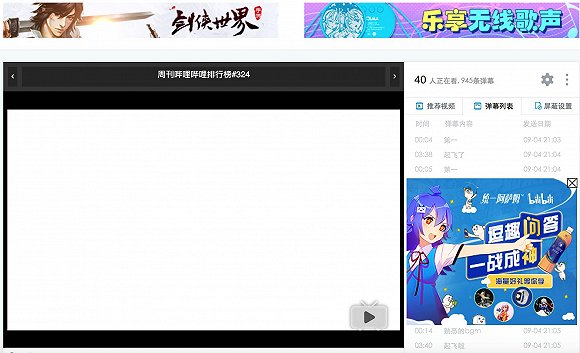
(The two advertising spaces in the upper left corner of the video and the barrage pool are currently the only advertising spaces reserved by Station B for external investment)
In fact, the core appeal of site B users is not whether there are ads in site B, but whether there are pre-roll ads. The crisis that occurred in May this year also revolved around patch advertising.
After understanding the user’s destiny, it is not difficult to understand why Station B dares to boldly launch an advertising area.
Up to now, the work with the highest click-through rate in the advertising area, "The Underwear Advertisement I Dare Not Finish As a Child," has exceeded 100,000, with 369 comments and 1,212 comments, and has even been shared 95 times. Many users of Bilibili left messages saying, "I never thought that ads could be so good-looking.", "I watched ads for an hour without realizing it."
If the above data and comments are from real user feedback and not from trolls. This may mean that the advertising area of Bilibili may one day bring a new advertising business model to Bilibili.
A person from Tencent Technology believes that at this stage, the conceptual value of station B’s advertising area is far greater than its commercial value, and it is unrealistic to shake the mature CPM model in the short term (CPM model refers to an advertising delivery mechanism that charges based on 1,000 times an ad is played). At present, the impact of the advertising area is still more at the content level.
"The establishment of advertising areas at Station B is due to the need to further split the living and entertainment areas. Even the pan-two dimension itself is a subcultural trait, and there is a strong isolation between various subcultures. The existing large area system is no longer enough to carry the subcultural conflicts in small areas. Returning to the establishment of the advertising area itself, advertising as a content carrier, some people like it and some people dislike it. By forming separate areas, user traffic can be further verticalized." said the person above.
2. If the advertising area is to be commercialized, how to break through the ceiling?
As mentioned above, the main advertising models broadcast on video platforms are pre-roll advertising and product placement. Since product placement requires cooperation with content producers, in addition to the share of self-made dramas, the rest of the revenue from product placement belongs to the producer. Therefore, the main advertising model that platforms really enjoy is pre-roll advertising.
The billing method for pre-roll ads is the CPM model, which is based on the 1,000 times the ad is played. This ensures that the advertiser's payment is directly linked to the number of viewers. On this basis, if video platforms want to achieve growth in advertising revenue, they need to increase the unit price of advertising on the one hand, and increase the number of ads on the other.
To date, the CPM model has become a very mature video advertising billing model. Click sharing not only ensures the advertiser's reach rate and display volume. According to the "2016-2021 China Online Advertising Industry Market Foresight and Investment Strategic Planning Analysis Report" released by the Qianzhan Industry Research Institute, the online video advertising market in the third quarter of 2015The scale is 6.490 billion yuan.
For the advertising area of Bilibili, if you want to achieve commercialization, how to set the price is a big problem. Judging from the current situation of the advertising area of station B: if the thousand-click algorithm of the CPM model is used, the traffic attenuation in the process from forced passive viewing to active viewing determines that the commercial ceiling of the advertising area will not be too high.
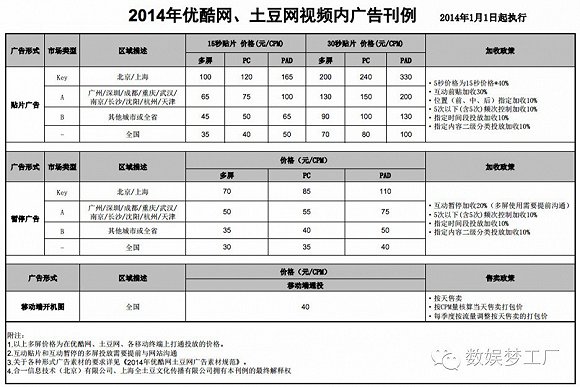
If compared with Youku Tudou in 2014, the number of daily active users of Youku Tudou that year was 140 million. In January 2016, Chen Rui, chairman of Bilibili, revealed in a speech at the China Internet Culture Industry Annual Conference that the average daily activity of Bilibili reached more than 10 million, which was still far behind Youtu’s 140 million at the time.
Even if the gap in user base is forcibly bridged, based on the 15-second advertisement in Youku Tudou's advertising example in 2014 under the CPM model (the highest price is Beijing/Shanghai pad version, 165 yuan/1,000 times; the lowest price is national multi-screen, 35 yuan/1,000 times), the advertising revenue of the most played advertisement "The Underwear Advertisement I Didn't Dare to Watch When I was a Child" (the playback data is 100,000 clicks) is only 3,500 to 16,500 yuan.

And this will also involve the issue of traffic allocation for the header advertising slots. Due to the limited number of head recommendation positions, there are 4 recommendation positions on the app side and the top ten list on the PC side, sharing 5 banner positions. Thesefactors will greatly limit the space for commercial development of advertising areas.
If calculated according to the traditional CPM model, the advertising area cannot bring much direct monetization to Station B. Some insiders believe that the influence of station B’s advertising area may be reflected at the content level, such as establishing the first creative advertising content community for C-sides.
In fact, creative advertising as a carrier has proven its penetration among young people in many ways. For example, Snickers in the food category and Durex in the adult products category.
In 2011, Snickers proposed the functional feature of "suppressing and replenishing energy" and cleverly used Lin Daiyu's elements. The click-through rate of the commercial exceeded 1.6 million within two weeks of its launch. In 2014, Snickers invited Mr. Bean to star in an advertisement, and the Weibo topic #Doudouhenhen# reached over 100 million views in two days.
The successful penetration of creative advertising has also brought huge commercial benefits to Snickers. At the beginning of 2016, Amazon China released the 2015 "Eating and Drinking White Paper", in which Snickers peanut-filled chocolate ranked among the top ten most popular delicacies in 2015.
The opening of the advertising area of Bilibili may provide a new platform for the promotion of creative advertising, which may become a testing ground for advertising companies' creative advertising competition. "Childhood's Queer Advertisement" has received more than 63,000 clicks on the advertising area, with 385 comments and 835 comments, and it has even been shared 317 times.
In this process, Station B is expected to gradually develop its own new advertising model. For advertisers, it may also be a wise choice to consider increasing the proportion of creative advertising.
