
Apple has created some of the most popular products of this era, and many people have fallen in love with the company. For these people, "Join Apple and join us in making the world a better place." is an invitation they can't refuse. But for some of them, working in an Apple retail store is not so Apple.
Chen, who graduated in computer science, was a software engineer before joining Apple. In 2011, Chen received a call from a headhunting company asking if he was interested in traveling to Shanghai to interview for a retail store job. He was a fan of Apple in high school, and he longed to "work under the Apple culture, develop his professional skills, and then strive to develop into management", so he decided to seize this opportunity.
Neil used to work in the IT industry and joined the company because he liked Apple's products. He said that he didn't have much ambition and just wanted to come in and take a look. He thought that even if it was just a branch, he could experience the atmosphere of a large, well-regulated international company. He said: "Even if it is a retail industry, it is one of the top retail industries in the world."
On Apple's recruitment homepage, there are three types of job opportunities: company, Apple Store, and work-from-home technical consultant. Earlier, applicants had only two choices: company or retail. Chen and Neil each worked in two different Apple retail stores in Shanghai - which determined what they saw of Apple.
A retail store with a difference
As for the working environment of Apple's retail stores, the official website says, "We have created a unique retail store that is creative, collaborative, and full of fun."
When Steve Jobs unveiled the first Apple Stores in 2001, industry experts thought it was a costly mistake, and they asserted that the retail stores would close within a year. However, 15 years later, Apple has established 478 physical retail stores in 18 countries and regions around the world. Each retail store brings Apple approximately US$49 million in revenue every year.
Ron Johnson, Apple’s former head of retail, is the biggest behind-the-scenes figure in the Apple Store. His goal is to restructure all aspects of the retail store. "The store you create should be more than just a store for people," he said in an interview with Harvard Business Review in 2011. "People come to the Apple Store for the experience, and they don't hesitate to pay for it."
May 19, 2016 marks the 15th anniversary of the opening of Apple’s first two retail stores. That same weekend, Apple unveiled its "second generation store" in San Francisco. The main entrance of this store faces Union Square, with a two-story giant glass door replacing the classic white Apple logo; the Genius Bar has been expanded into the Genius Grove, which is no longer a counter but integrated into seats; a long display wall is used to display ancillary products in a street-like form (The Avenue); a more open multi-faceted conversation area (The Forum) is set up on the second floor, with hundreds of wooden stools made of building blocks facing the 6k TV wall.It is used for community activities; there is an area similar to a small square (The Plaza) behind the store, which is open 24 hours a day and provides free Wi-Fi.
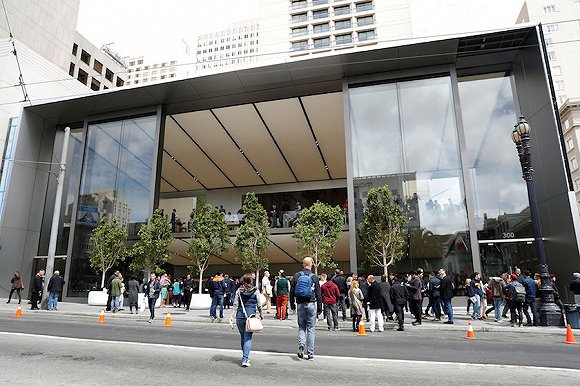
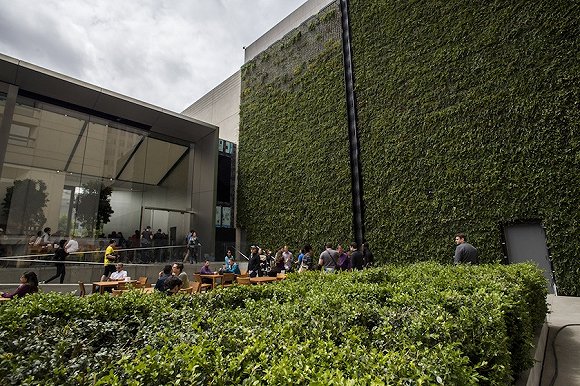
This is the first big job for Angela Ahrendts, senior vice president of retail and online business, who was hired by Tim Cook from Burberry, after joining the company for more than two years. She stressed that she hopes Apple retail stores can become places where people gather, like small town squares. In an interview with the Associated Press, Ahrendts said: "This is a company manifesto, not a retail store." Apple also plans to renovate existing retail stores at a rate of 5-10 per year in the future.
On August 19, Apple changed the name of its highly recognized retail store, Apple Store, to Apple, making a more direct statement that "this is more than just a store." "Forbes" contributor Carmine Gallo believes that as a dream business that has no cashiers, is customer education-oriented, and provides five-star hotel-style services, "there are ten reasons why Apple retail stores have never been just a store."
This non-store retailer generates $4,978.82 in sales per square foot. This result is about 1.5 times that of luxury jewelry brand Tiffany & Co. and 25 times that of mid- to low-end department stores in the United States. But cash doesn't just open the door and fly into Apple's account with a smile on its face.
Mysterious sales forecasting system
Along with the concept of "more than just a store" is the goal of providing customers with an outstanding service experience. Johnson said this in 2004: "Our employees will say, my job is to enrich the experience for people in the store. This is not a boring, laborious, I have to move the goods, solve customer problems type of work. But I am suddenly enriching people's lives. This is how we select, motivate and train employees."
Apple retail stores offer three types of positions, sales, support and management. However, employees on the sales team are not called sales, but called "Specialists" or "Senior Experts" (Expert).
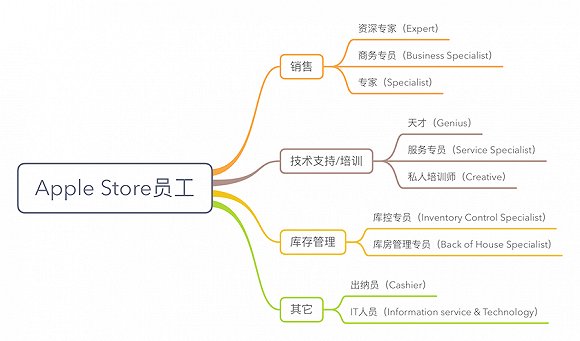
From the moment Neil and Chen became experts, the phrase that kept echoing in their ears was “enriching people’s lives.” The training specialist repeatedly emphasized that Apple does not care about personal performance at all, but only wants to help more customers, create more users, and solve more problems. Companies want employees to believe they are doing something much greater than selling products or repairing products.
But many times salespeople and customers may be too busy to care about product education or service experience, let alone how to enrich people's lives. The Apple Store on Nanjing East Road in Shanghai has the largest traffic volume among the six stores in the city, with about 20,000 people visiting every day. Neil said: "There is no way to have a good conversation there. You can't even reach the level of service because there are too many people. And even if you are very patient and spare 10 minutes to talk to the customer, he will not be patient."
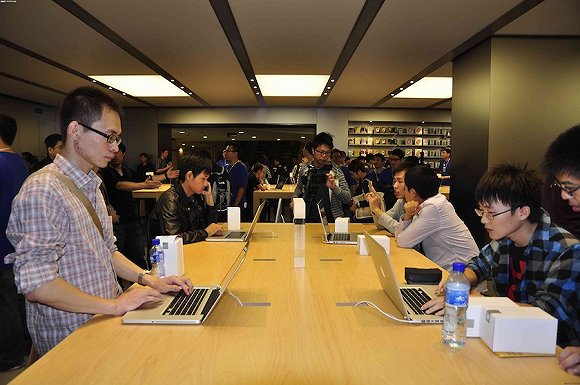
Neil and Chen may feel regretful that they are unable to meet the service standards due to the large flow of people, but what really consumes their enthusiasm is the need to face the game between the Apple Store concept and reality every day.
“Our in-store training and daily download every morning (similar to a simple review and a small outlook on the day) will emphasize that the goal of Apple’s retail stores is customer satisfaction, not sales numbers. However, the names and numbers of employees who sell the most products are announced every day, and the internal application threshold for some positions is limited by the number of certain products,” Chen said. “So if you naively believe that sales numbers are not important, but customer satisfaction is important, the result is that you will never be promoted or further developed.”
TradeGecko, a Singapore-based inventory management software company, once wrote an analysis saying that Apple’s complete supply chain and rapid inventory turnover rate (Apple reportedly shortened the inventory turnover rate to 5 days in 2012) largely depend on Apple’s ability to accurately predict sales. 9to5mac once exposed a screenshot of Apple's retail inventory system when reporting on Apple's 2011 Black Friday retail sales. The system not only had product sales forecasts for the day, but also counted the actual sales and "binding rates" for the day.
For retail store managers, thisA system can most intuitively reflect store performance and employee personal performance, and is also an important tool for motivating employees. Neil told Jiemian News that this retail inventory system is similar to a stock trading system. It updates the real-time sales data of each sales employee every 15 minutes, and the average data will be accurate to one digit after the decimal point. Chen also confirmed the existence of this system. Neil said that managers can see real-time sales data on the iPad, as well as the total sales, averages and national trends of each store in the same market. This is also one of the sources of pressure for managers, because every day after opening a store and logging in, the system will calculate how many sales a store will complete that day in order to reach the expected target.
An anonymous Apple Store employee also revealed in an interview with Popular Mechanics: "Each of us has a set of sales data lists, and you can see everyone else's. It tells you how much money each person makes for the company. If you are not performing well, you will be called to talk to the manager, and they will sit you down and discuss with you why you can't sell more products."
He only got a backpack
Horace Dediu is an industry analyst who has long been paying attention to the mobile phone field, especially Apple products. According to his statistics, each Apple Store employee (including non-sales technicians and inventory personnel) brought in an average of $473,000 to the company in 2011. According to the National Retail Federation, the average annual sales performance per employee at an appliance store that year was $206,000. "This is the sales level of consulting firms," Dediu said.
However, unlike consulting company employees, Apple Store employees do not receive bonuses.
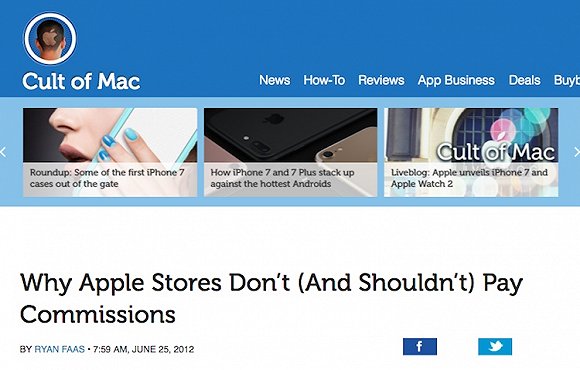
Before the Apple Store opened, Apple decided not to pay commissions to retail store employees. According to the New York Times, the reasoning is that Apple believes that this system of bonus sales will fundamentally undermine the company's main goal, which is to help customers find the right product rather than the most expensive product and help them build a long-term emotional connection with Apple's brand. Another flaw of the commission system is that it intensifies competition among colleagues and destroys the atmosphere of unity and cooperation.
Another technology company also from Silicon Valley also adopts a retail employee incentive strategy similar to Apple. Tesla Senior Public Relations Manager Duan Zhengzheng told Jiemian News that the basic salary of Tesla store sales staff is very high, but the commission is very small. "The reason for this is so that they are not so eager to sell the car, but to clearly explain the concept of electric vehicles."
Neil thinks the zero commission system is a bit weird sometimes. He gave an extreme example: There is a store in the Shanghai market that has ranked first in the world in sales to large customers for two consecutive quarters. The commercial specialist of this store took the lead in signing two contracts with a well-known Japanese company to provide overall Apple solutions for the company. One of the contracts totaled 4.5 million yuan. According to his estimation, if the project continues with the follow-up services, the total sales will be nearly doubled. "The leading colleague only got a backpack," Neil said a little helplessly.
"You will find that after your efforts, countless emails and phone calls, you get a package or a handshake. Anyway, I thought it was very ridiculous at the time. I couldn't tell that the colleague was really happy." Neil laughed and added.
When its performance is booming, Apple does not need to use material rewards to encourage sales. But with the overall global smartphone slowdown, Apple needs to start thinking about its response strategy. According to data from research firm Gartner Inc., Apple's mobile phone sales fell by 14% in the first quarter of 2016, and its 15% market share lagged behind Samsung (23%).
9to5mac obtained reports from Apple insiders that in order to encourage Apple Store employees to sell more iPhones, Apple held a global iPhone sales competition between February 21 and March 26. The winning reference indicators include iPhone weekly sales, customer satisfaction, iPhone accessories sales, and the frequency of iPhone recycling projects. The top-performing stores in each market were outfitted with Apple gift shops and hosted store-wide celebration parties, while the top-performing employees in each market received free vacations to Cupertino, home of Apple's headquarters.
Chen did not feel disappointed that there was no commission. He felt that the original intention of doing so was very good, using a salary higher than the industry average and working in a commission-free model to ensure customers' customer experience. However, he went on to say, "The value orientation of some key data makes this original intention almost gone."
Selling 100 iPhones is worse than selling one AppleCare
In the annual performance appraisal of Apple retail stores, employees are divided into three categories: needing improvement, meeting expectations, and exceeding expectations. Only employees in the latter two categories can receive salary increases or manager attention. Individual Sales Performance (ISP) is the key to measuring annual performance, and the "binding rate" that management attaches great importance to is the top priority. AppleCare extended warranty and former One to One services are listed separately in ISP. Chen believes that it is policies like this that clearly undermine the experience Apple wants to create.
The Wall Street Journal once reported that although Apple does not give sales quotas to retail employees, the company does require employees to achieve a certain binding rate, that is, the frequency with which employees persuade customers to purchase AppleCare (Apple's product warranty service), One to One (Apple computer one-to-one tutorial service, now replaced by theme lectures) and other service products in addition to Apple products. Employees who cannot meet the binding rate target will receive additional sales training or be transferred to other positions.
Sean, who was promoted from a junior employee to a senior manager at the Apple Store and has now moved to work for Apple, believes that it is right to advocate that services should be attached when selling a product. "Apple's most competitive advantage is the ecosystem we provide to customers, which makes customers more loyal and makes them have a greater opportunity cost of switching to other brands. This is correct for the company, but whether you believe this determines your performance."
But Chen and Neil are more inclined to believe that there is a lot of randomness in what products the customers encountered by the sales staff choose and whether they are bundled with additional services.
Chen used a story that happened to him as an example: "A foreigner brought a Chinese girl into the store. The foreigner was interested in the iPhone, so I introduced it to him and answered his questions. The girl wanted to buy a computer, so the colleague next to me stepped in, settled the bill, and persuaded her to buy the One to One. As a result, I sold a mobile phone, and he sold a Mac computer plus the One to One. In terms of benefits for his own development, he was much more 'cost-effective' than me."
Neil has also encountered customers who rushed into the store and said, "I have thought of everything, but I also want to add an extended warranty and so on. A salesperson may complete the transaction in 5 minutes, and other colleagues may need to spend an hour to explain endlessly. In the end, the customer still said sorry, but I don't need it." "It's very possible that you just have bad luck when you work very hard. Your Apple Care and your contract phones just don't sell as many as others."
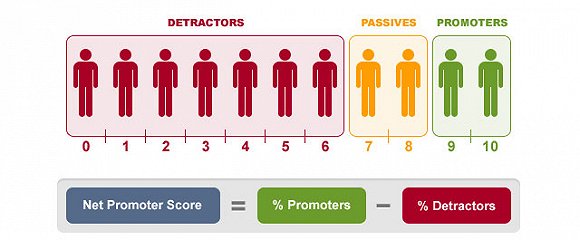
In addition to the binding rate, the "Net Promoter Score" is also a data that is referenced during sales staff performance appraisals and quarterly reviews. The Net Promoter System is a questionnaire for Apple Store customers. After purchasing a product, customers can choose to receive an electronic receipt. There is a link to the questionnaire below the receipt, inviting customers to rate the employee's service. "Generally, the response rate is about 5-8%, because not everyone will click on the email to read it, and it is also a very big pain point when you are promoted," Neil said. "It is very likely that you are very good at many things, but your net promoter score is one point less than others. Even if you are good at everything, you have 3 recommendations, but one is passing or negative, your performance appraisal will be greatly affected."
After speaking, Neil added another sentence: "Of course this is based on the manager's mood."
Enter management
A girl who worked at an Apple Store in the UK for 4 years complained about the lack of internal control at the Apple Store in an interview with Business InsiderAs for the promotion mechanism, the company would rather poach managers from other companies than promote its own low-level employees. It is almost an "impossible task" to be promoted from an ordinary store clerk to a manager.
In China, things are a little different.
In 2008, Apple opened its first store in China in Sanlitun, Beijing. On June 18, 2016, the 40th Apple Store in Greater China opened in Wujiaochang, Shanghai, covering 18 cities in mainland China. This speed of expansion requires Apple to train or introduce a large number of sales and management personnel in a short period of time.
Promotions in Apple retail stores can be divided into two situations. One is the promotion of grassroots employees, such as from Specialist to Expert, Creative or Genius; the other is to enter management through internal selection.
For the first situation, the store will conduct a selection for vacant positions roughly every six months to one year. After obtaining the manager's permission, anyone can sign up to participate. The list will be announced after the written examination and interview. Chen applied twice, and each time he passed the written test easily but failed in the interview. "The interview is too subjective. To put it bluntly, it's, 'Does the manager like you enough?'" Neil also has the same understanding of the importance of building a good relationship with managers.
Enter management through internal selection is the more difficult of the two promotion situations and takes longer. For internal employees, companies also appear to be more willing to bring in managers from the outside. According to Chen and Neil's observation, most of the Apple Store management comes from managers or veterans of other brands in the retail industry, such as Metro, Auchan, IKEA and Decathlon. According to public information on the LinkedIn platform, Joy Li, the first Store Leader of the Apple Store Sanlitun store, was the store general manager of Carrefour.
A senior headhunter in the retail industry who did not want to be named told Jiemian News that Apple will entrust headhunters to recruit management positions such as Store Manager, Senior Manager, Store Leader, and Market Leader. Although applicants are not required to have a retail background, the actual recruitment situation is to give priority to those with a retail background.
The headhunter pointed out that Apple’s demand for retail talents has been increasing in recent years, especially for senior managers and store managers. But at the same time, Apple is reducing its cooperation with headhunters. "Now Apple also attaches great importance to internal promotion, and the reduction of cooperation with headhunters is also because this aspect is strengthening." Chen believes that Apple Store’s strong demand for retail talents is not only an objective reason for its rapid expansion in China in recent years, but also because competitors such as Tesla and Microsoft have come to poach, leaving many job slots vacant.
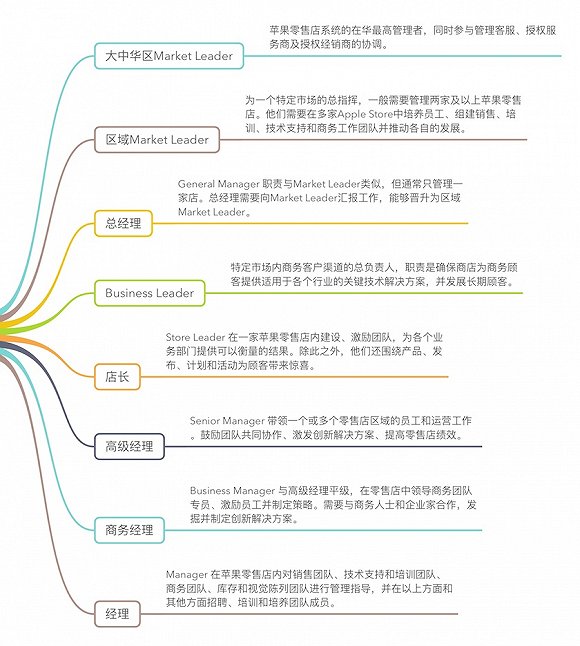
It’s not that Apple doesn’t haveThere is an internal leadership training system. In order to directly cultivate management talents, it launched the "Apple Store Leader Program (ASLP)" in 2010. This two-year program is dedicated to unlocking the potential of trainees through rotational training, practical work and mentorship. Trainees who perform well during the two-year training period will also have the opportunity to rotate to overseas Apple stores. After the two-year training period, trainees can apply for Apple Store management positions.
The ASLP project is open to the public, and both fresh graduates and people with work experience can sign up. Chen told Jiemian News that due to the strict selection conditions, the overall quality of employees entering the Apple Store through the ASLP program is relatively high, and they can basically serve as managers after the two-year training period. Internal employees can also sign up to participate, but the requirements are very high. "Basically, they must be able to converse with foreigners fluently in English, have a university GPA of no less than 3.5/4, and have good overall performance."
For internal employees, Apple launched the "Lead and Learn Program" (LLP) at the end of 2013, which is another way for grassroots employees to enter management. Neil analyzed: "Because we need to open a lot of stores in China, there is a huge demand for managers. What I cannot agree with the former British employee is that other countries are very mature markets. She may feel aggrieved, but here, if you want to perform well and have good data, you have a certain chance of moving to management through LLP."
But for Apple Store employees who are aspiring to climb up the promotion channel, how to "perform well" is the key.
If you can play around with these rules, "becoming a winner in life with a promotion and salary increase" is no longer a dream. Sean feels that Apple is a company that dares to employ people, and promotions are determined entirely based on individual performance rather than industry qualifications. He found that many managers at the same level as him at that time had more than 15 years of work experience. "For me, I have only worked for a few years, but what our Store Leader sees is your sense of recognition and hard work, so I see a lot of promotions around me."
He also believes that the Apple Store’s emphasis on professionalism in jobs and the high requirements for managers in the retail industry are obstacles for many people to be promoted from junior employees to managers:
Apple requires employees to take advanced courses in different positions and does not want you to change positions frequently, so it is normal for a person to stay in a certain position for a long time. The retail industry demands different things from leaders than it does from rank-and-file employees. For example, retail leaders need to have the ability to face uncertain situations - your product release information, supply sources - many times you need to make decisions at the last minute, and not everyone has this ability. It also requires full dedication. Retail leaders don’t have days off. As long as the retail store is open, you will be busy. So not everyone can adapt.
Leave Apple
Both Neil and Chen emphasized that from the perspective of employees in the retail industry, Apple Store’s salary is competitive and the benefits are complete. Yet they resigned.
Chen believes that the job opening experience in retail stores is just a formality and you cannot learn much. And after realizing that his chances of promotion were slim, he felt there was even less reason to stay. "I feel that retail cannot learn anything, nor can it give me the development I want, because my interest is not actually retail itself."
Neil knew from the beginning that he would not be able to work in a retail store for the rest of his life. "Even after being promoted, the nature of the job still hasn't changed much. The job content is just that you don't have to pay the bills," he said. "When I left my job, I kept thinking that you can't be stuck here for the rest of your life, because it's really hard to imagine that when you are 30 or 40 years old, you are still just standing on the floor with an iPad."
After realizing that their career development in the Apple Store had hit a bottleneck, they chose to leave.
The New York Times once summarized the reasons for the success of the Apple Store. It said that Apple's success has been proven to be based on a set of intangible concepts: the most important of which is Apple's own fan base that determines Apple's ability to continuously obtain passionate job applicants, and then there is an employee culture that elevates every job to a noble mission.
However, in the actual work of some Apple Store employees, performance pressure and conflicts between ideals and reality have counterproductively "disenchanted" their beliefs. "This is a (place) that relies on 'culture', 'sentiment', or 'quality' to attract people to work or spend money. At this point, if there is a conflict between the two parties, there will naturally be a sense of gap, which will evolve into hostility and conflict," an anonymous Zhihu netizen commented on the working experience at the Apple Store. Another netizen realized more calmly that although he was attracted by Apple’s logo at first, “but anyway, it’s just a job (no matter what, it’s just a job)”.
Sean remembers that he once said this while drinking and chatting with a retired colleague: "You have experienced utopia and the best time of (Apple). This is your luck. If you really believe in its values and believe that you can make changes, you can influence your leaders and the people around you, and you can prevent this culture from being diluted instead of escaping. What we need to provide is not a pleasant working environment, but a challenging working environment. We need to educate our employees and tell them that I want to be the game changer and hold the pirate flag to challenge authority and lead change. Only when Apple encounters challenges will we see who the true believers are.
Neil finds himself struggling to escape the fact that he once worked in a retail store. In the first six months after he left his job, he could not find a job at all, because the job opportunities he received were eitherGo to Tesla to sell cars, or go to a jewelry store to sell jewelry. Although he is unwilling to continue working in the retail industry, he admits that he has gained a lot in this industry that is "very training for people", especially the experience of looking at people.
Chen suffered some hardships in order to return to the IT field. Many companies questioned why he stayed in the retail industry for two years. Finally, a small company in the United States hired him, "because the big boss thought that my English was good and my thinking was clear, so I could give it a try."
"Apple is still a great company in my mind to this day," he said.
(At the request of the interviewee, Chen, Neil and Sean in the article are all pseudonyms.)
