Based on the talent data of LinkedIn and Chitu platforms, LinkedIn China released the "China Entrepreneurship Map" on September 13, 2016, which analyzes the characteristics of entrepreneurial groups. The map focuses on key factors such as the motivation and direction of entrepreneurs in the early stages of entrepreneurship, as well as changes in the workplace after entrepreneurship, and aims to provide useful reference for new entrants entering the entrepreneurial boom.
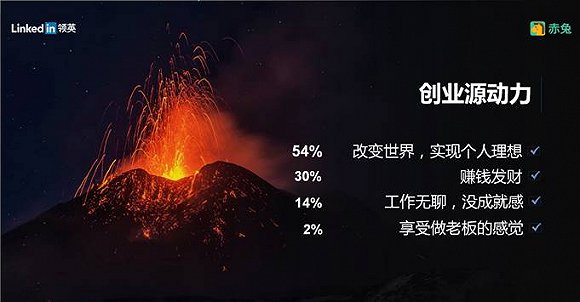
Entrepreneurs want to change the world
Through the Entrepreneurship Map, LinkedIn found that 54% of entrepreneurs have big dreams and hope to change the world through their own innovations; at the same time, 2% of entrepreneurs are very honest and believe that starting a business is about enjoying the feeling of being a boss. On the other hand, in terms of age structure, those born in the 1990s seem to be more enthusiastic about entrepreneurship than those born in the 1980s. They are very enthusiastic about entrepreneurship in catering, e-commerce, technology, clothing, and O2O related fields.
Scorpio has the highest entrepreneurial enthusiasm
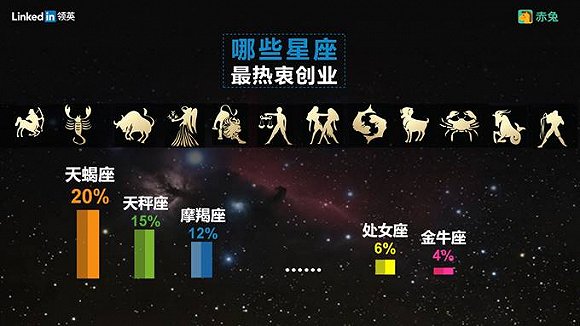
What is particularly eye-catching is that LinkedIn has launched a special report on the relationship between zodiac signs and entrepreneurs. Scorpio, Libra and Capricorn have become the top three zodiac signs that are most enthusiastic about entrepreneurship. In the databases of LinkedIn and Chitu, up to 20% of entrepreneurs are from Scorpio. Scorpios have excellent entrepreneurial genes, and their success stories are quite convincing. In BAT, Ma Huateng and Robin Li are both Scorpios. Scorpio's strong goal awareness and strong possessiveness, as well as the character of never giving up until the goal is achieved, have created the best potential for becoming a boss. On the other hand, among the zodiac signs that are most interested in entrepreneurship, Taurus is at the bottom of the list with 4%. Perhaps this has something to do with Taurus's preference for stability, reluctance to change, and slow enthusiasm.
Shenzhen has the strongest entrepreneurial impulse, and Shanghai has the highest net inflow growth rate of Internet talents
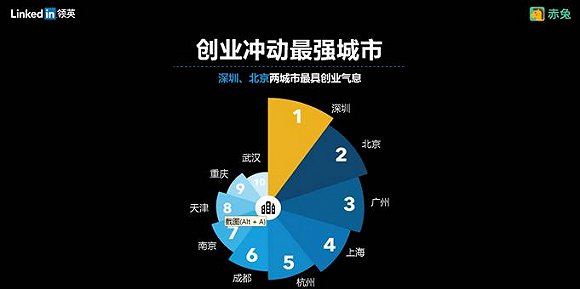
The top two cities with the strongest entrepreneurial impulse are Shenzhen and Beijing, Shanghai, Hangzhou, and Nanjing rank 4th, 5th, and 7th respectively, while Chengdu and Chongqing rank 6th and 9th respectively. It is not difficult to see from this that the Chengdu-Chongqing towns and the Yangtze River Delta region along the Yangtze River Economic Belt have strong entrepreneurial momentum. The craze for mass entrepreneurship and innovation is moving down the Yangtze River and sweeping across all regions along the Yangtze River Economic Belt. It is worth noting that Shanghai leads the list of Internet talent net inflows with a growth rate of 10.2%, surpassing some well-known Internet startup cities such as Beijing and Hangzhou.
High-tech practitioners are more willing to start a business
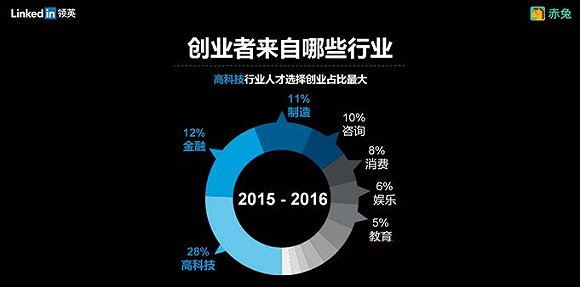
Another major finding of this map is that, judging from the industry distribution of entrepreneurs before starting a business, high-tech practitioners are more willing to start a business, accounting for 28% of all entrepreneurs; followed by finance and manufacturing. It can be seen that the unique technical advantages of the high-tech industry will allow professionals to embark on the path of entrepreneurship more calmly and quickly.
60% of failed entrepreneurs return to the enterprise
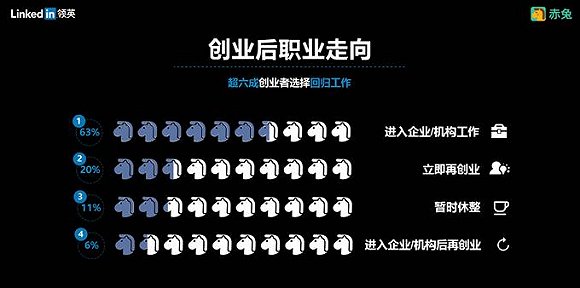
Although the prospects of starting a business are bright, the reality is still rough. Judging from the overall proportion, the chance of entrepreneurial success may be less than 1%. People often see those glorious success stories, but in fact, the vast majority of entrepreneurs have to accept failure. LinkedIn found that 63% of entrepreneurs chose to return to companies or government agencies to start working again, while 20% of entrepreneurs were very persistent and chose to start their own business again immediately, while 11% of frustrated entrepreneurs said they would wait and see again.
Even if you fail to start a business, you can gain career advancement
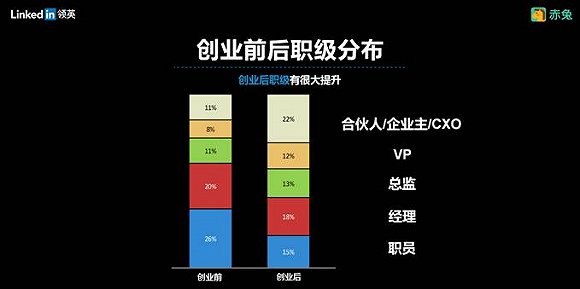
Despite the blow of entrepreneurial failure, entrepreneurship will still bring valuable experience and gains to professionals. In the comparison of ranks before and after starting a business, the entrepreneur's rank has been greatly improved after experiencing the baptism of starting a business. The proportion of corporate executives, including partners and corporate CXOs, increased from 11% before starting a business to 22% after starting a business. This data further verifies a truth in career development, that is: there are no losers in entrepreneurship. As long as you conscientiously persist in taking the entrepreneurial path, you will gain a lot of life experience regardless of success, which also lays a solid foundation for the next journey.