
There is an old saying in China that "the plan for the day begins in the morning", and its American version is "the early bird catches the worm" or "early to bed and early to rise, the wise, wealthy and healthy" - at all times and in all countries, the benefits of getting up early are a rare view that has gained global consensus.
We have also heard countless stories about successful people being morning people. Take former PepsiCo President and CEO Steve Reinemund. Laura Vanderkam wrote in the book "What the Most Successful People Do Before Breakfast" that he gets up at 5 a.m. every day, runs, prays, has breakfast with his family, and then starts to enter the work mode of running a Fortune 500 company. Anyone who reads this story will inevitably think that if you want to have a successful family and career, you have to sacrifice your morning sleep.
Opposite of early risers are late sleepers: they are more alert at night and prefer to stay up late. Scientists have done countless studies (and will continue to do so) on which of these two work and rest habits are better. We have found that this issue is much more complicated than the common sense of "getting up early is good".
Early risers VS late sleepers
How to determine whether you are a morning person or a night person? Biologist Christoph Randler told us that the method of judgment is simple: early risers usually wake up at the same time every day, while for late sleepers, the wake-up time on weekdays is completely different from the wake-up time on weekends, with an average time difference of two hours.
Researchers have even summarized the personality traits of people who get up early and people who go to bed late. Randler and his colleagues studied 346 experimental participants and found that morning people do have many excellent qualities compared to those who go to bed late: They are generally more persistent, more cooperative, more affable, more conscientious, and more proactive.
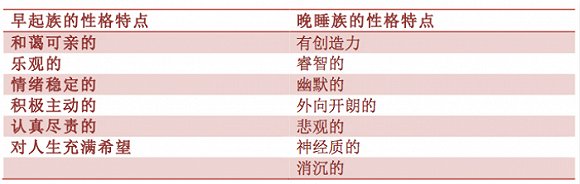
What’s even better is that some research shows that proactive early risers are less likely to procrastinate than late sleepers. One possible explanation for why late sleepers like to procrastinate is that late sleepers stay up late because they don’t do well during the day and have to wait until night to start work.
In 2012, two psychologists from the University of Toronto surveyed 435 young people aged 17 to 38 and 297 middle-aged and elderly people aged 59 to 79 and found that early risers have a more positive attitude and are happier than those who go to bed late.
But did you know that people who go to bed late are richer and smarter
After reading this, people who go to bed late should not be too desperate. People who go to bed late also have advantages.
The University of Southampton in the UK surveyed 356 morning people (by definition, they go to bed before 11pm and get up before 8am) and 318 morning people in 1998A late-sleeping person (who goes to bed after 11 p.m. and wakes up after 8 a.m.) discovered that the famous saying of Benjamin Franklin, the founding father of the United States, "Early to bed, early to rise, makes you wise, wealthy, and healthy." In fact, late-sleeping people have higher incomes, have higher car ownership rates, are slightly smarter, and there is no obvious health difference between them and early-rising people.
“Our experiments found no evidence for Franklin’s suggestion that going to bed early and getting up early is beneficial to physical health, socioeconomic benefits, and cognitive advantages. To say what we found, we saw that owls (late-sleeping people) are wealthier than larks (early-rising people), but there is no obvious difference in health and intelligence.” The researchers said.
In 1999, Richard D. Roberts, a psychologist at the University of Sydney, and Patrick C. Kyllonen, a member of the U.S. Air Force Research Laboratory, collaborated to conduct an experiment on "Who is smarter, whether early risers or late sleepers?" 420 participants were asked to take two intelligence tests, including mechanical engineering expertise, mathematics, reading comprehension, working memory and comprehension speed.
The result of the study is that people who go to bed late have higher scores on many intelligence test indicators than people who get up early, especially in working memory and comprehension speed. What's particularly interesting is that the intelligence test was conducted in the morning.
However, if we must talk about the shortcomings of people who go to bed late, it is that they are still more susceptible to addiction to tobacco and alcohol than people who get up early. A study of 676 adults found that people who go to bed later are more likely to become lifelong smokers than people who get up early, are less likely to quit smoking, and therefore face a higher risk of nicotine dependence. Another study of 537 adults found that those who went to bed late had higher alcohol intake than those who got up early.
The biggest advantage of early risers is that they fit in with the mainstream workplace culture
However, Randler said that although late-sleeping people are smart, creative, full of sense of humor and more outgoing, they are incompatible with the typical corporate schedule, which means that early-rising people have an advantage in achieving business success. A study by Randler found that early risers do better in school and go to better colleges, which can lead to better employment opportunities. The proactive nature of early risers means they are able to identify and solve problems early, and many studies have linked this trait to better workplace performance, greater career success and higher salaries.
As to why early risers tend to be more proactive, Randler’s explanation is that they usually have more time to think and prepare for the day.
Although people are now calling for the importance of flexible working systems, we have to admit that the mentality of "the day's work begins in the morning" is still deeply rooted. "Globally, people who wake up later are generally considered lazy. As a result, most school and workplace schedules favor early risers," Randler said.
As to whether working later will be accepted in the workplace in the near future, Randler believes that we need to have a deeper understanding of the human circadian cycle and confirm that going to bed late is indeed an inherent characteristic of a type of person. If that is the case, workplaces should consider adopting more flexible working arrangementsUse your time to maximize the potential of night owls, as their intelligence, creativity, sense of humor and extroversion can be a huge asset to employers.
