
Not long ago, Google's Beijing headquarters changed its location to a new location, and the lounge is still standard in the new office area of Beijing Raycom Information Center. People walk lightly when passing by the door of the break room. Occasionally, colleagues who have finished meetings across time zones will take a rest inside. Google employees have very little awareness of "region". Regardless of whether they are in Beijing or San Francisco, they believe that everyone's wisdom is concentrated together. For language product projects, the font team is mainly based in Silicon Valley, while the input method team is mainly based in Beijing. At present, Noto font supports more than 100 characters and more than 500 languages; Google keyboard supports input in more than 100 languages, and there are 11 different input methods for Indian language alone. Xiao Xiangye, a product manager in the United States, introduced her font research and development work through a video and said: "We are indeed using the power of ancient times to develop."
FontTeam: The ones who destroy the tofu blocks
The Google font research and development project that Xiao Xiangye participated in is called Noto, which was specially established five years ago to cooperate with Android and Chrome OS systems. When the system does not support text, it will display garbled squares, which is also nicknamed tofu, so the name Noto means NO Tofu.
"It is not technically difficult to have no tofu blocks, because the essence of fonts is encoding." Xiao Xiangye said, but the team spent a lot of energy on ensuring the beauty of a word and the harmony of multiple language combinations. Early PC fonts were designed for printing books. When people's usage habits gradually break away from computer screens and shift to mobile phones and tablets, how to make text suitable for reading on small screens? Personal aesthetics are different, and opinions among font team members are also inconsistent.
When designing a font for Bengali, a language spoken in Bangladesh and India, the font team created two alternative drafts. When it comes time to make a choice, something bad will happen. Both typeface designs had advocates at the time of the vote, and neither could convince the other. "We did some statistics and found that female salespeople prefer the traditional design above, while male engineers prefer the simple modern design below. For example, in the picture below, whether to add a small ending to the end of the very simple strokes, such a detail took a long time to finalize."
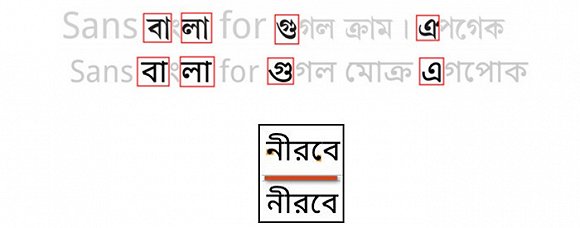
Although the dispute was fierce at the time, Xiao Xiangye couldn't help but laugh when recalling it. She enjoys the atmosphere of lively discussions in the team. She said: "We mobilized almost all the Bengali-speaking people in Google in India to review it." Chen Yongsheng also remembered the dispute, "it almost reached a fever pitch." He said: "Although I am a male science major, I support the font above." Chen Yongsheng is a Google engineering manager. In the past nine years, he has changed six or seven teams and participated in the development of enterprise search, Google Translate, knowledge graph and other projects. He said one of the reasons he likes Google is thatIt provides a platform for employees to find different experiences based on their personal interests.
When asked how to manage and encourage the team, Chen Yongsheng said: "Google has many departments and many projects. It is too difficult to think about how to inspire all employees on all projects." He felt that if he got close to employees and respected their interests to do projects he liked, he would get twice the result with half the effort. This year there was a French intern who was in his twenties and obsessed with font design. Chen Yongsheng thought, wouldn’t font design be boring in the eyes of young people? But since you have chosen to join, you are welcome. "I discovered recently that he is really famous for open source fonts. It would have been a pity if I had forced him to go to France to work on other projects."
Input method team: the iron triangle of product manager + designer + engineer
Chatting on WeChat and scrolling through Weibo are very common in daily life, but in fact, in many small-language countries in the world, people simply don’t know how to use their mobile phones to input their native language. For example, the combination of a consonant plus a primitive sound in Indian can look neither like the original consonant nor the original primitive sound, and the two letters are completely different. So there are many highly educated people in India who can write in their native language, but have no idea how to type. This feeling is similar to being unable to type Chinese characters and using pinyin instead. The team responsible for the research and development of the Indian input method from 0 to 1 is Lin Lin and Yang Fan.
Lin Lin is the product manager of the input method team. In April 2015, just after taking maternity leave, she participated in the development project of the Indian input method. Lin Lin does not speak Indian, and none of her teammates are proficient in Indian. At that time, her colleagues traveled frequently, and the experience designer landed directly in India. Heat is the first feeling. In the tropical monsoon climate, it is so hot whether it rains or not. When selecting test subjects, they focused on people who had never used a smartphone—most people in India fit the bill. When designers go to the streets, they often find a local, hand a mobile phone into his hand, observe how he types, and then ask them how to operate it more comfortably.
The real development began in June 2015. Lin Lin and her colleagues sat at a table and discussed continuously every day. "Preliminary communication is really important." Lin Lin said: "After discussing how the design should be changed, the engineer will immediately make a demo. We will then see if this design is feasible. If there are problems, we will continue to change it. Then we will have a new round of discussion."
What impressed Lin Lin the most was that when working on Malayalam, her fellow designers almost went crazy. The 26 English letters arranged on the touch screen are no longer spacious. There are more than fifty letters in this language! Lin Lin and others originally wanted to put only some commonly used letters on the main keyboard, so they asked their colleagues in India for confirmation. However, their colleagues said: "Every letter is commonly used, and they must be placed on the same input page at the same time."
More than fifty letters crammed together were a disaster, and designers struggled to allow this kind of interface to happen. They had a very difficult time during that time, and the conference room became a martial arts arena. Lin Lin said: "Later, we counted all the documents that can be found on Google's language website to see if we can find out which letters are not commonly used. But it turned out that really every one of them cannot be discarded." So the designers who accepted their fate every dayTian buried his head in front of his computer, revising - scrapping - revising again - team discussion - scrapping and starting again, repeating it more than a dozen times before finalizing it.
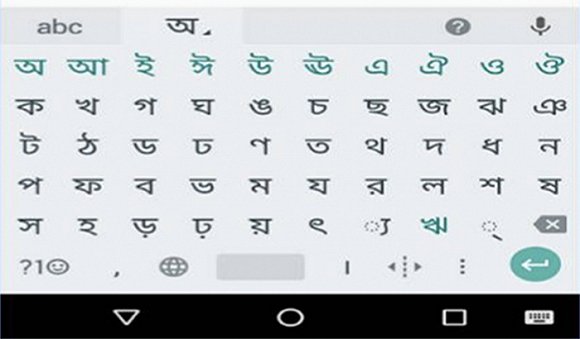
Yang Fan is the engineering manager of the input method team and also does not understand Indian. “Our team has senior engineers with nearly 20 years of experience in input method development. They have designed a framework that can adapt to all languages.” Simply put, it uses a fixed process, inputs data to derive a language model and transliteration model, and solves most development problems through machine learning. There was no psychological pressure at all when Yang Fan led the team to develop unfamiliar languages. His pressure came from time.
India’s import law was released in November 2015. Before the National Day holiday, several colleagues made an appointment in the chat group to work overtime at the company during the National Day holiday. Although Yang Fan had already booked a hotel, flight, and vacation, he canceled the trip and returned to the company after thinking about it. As soon as I walked in, I found that not only a few people were there, but everyone was there. Members of the input method team gathered around the table to discuss, try and make mistakes, and order takeout while arguing. This was how they spent the seven-day holiday. Yang Fan also joked: Don't you remember that you gave an order for everyone to work overtime?
Yang Fan joined Google's Beijing headquarters in 2007. Since 2010, he has accumulated rich experience in the research and development of input methods from the cloud to mobile phones. His team has slowly expanded from the first few people to now, and the main force of all Google input method projects is in Beijing. Yang Fan said: "Everyone is very enthusiastic, not just about pinyin development, but also interested in any language. Many countries' input methods are a brand new field that we need to explore. I think going from 0 to 1 is more meaningful than going from 99 to 100."
