
After reading Lai Ruihe's "Du Fu's Five Cities", I can't help but think of a question: What kind of reaction would you have had if you had read this travelogue written in the early 1990s more than 20 years ago?
Thinking about it for a while, the answer is that I probably wouldn’t like it too much. This is a book written at the same time as Luoyang Zhigui's "Cultural Journey". At that time, we obviously preferred to read the latter's articles: famous scenic spots, talking about the past and the present, beautiful writing, and more importantly, there was no revolutionary literary and artistic tone, and there were many personal subjective feelings of the author.
In fact, in our opinion, the articles in "Cultural Journey" at that time were already very "human", and the observation and discussion perspectives had a strong personal imprint of the author. For a long time, the author was nowhere to be found in China’s travel notes. The author was just a camera, a search engine, and a loudspeaker, telling us how wonderful the scenery was and how rich the historical anecdotes were, and then conveyed it in picturesque language and an announcer’s accent. As for the author's "private" feelings, they do not exist, and readers have no expectations of reading.
Therefore, compared with our reading habits at that time, the narrative posture of "Du Fu's Five Cities" was obviously too advanced: the travel location was too off-the-beaten-path, the perspective was too personal, what was seen and heard was too "trivial", and too "stingy". It was not the exciting and thought-provoking "scenic spot essay" we expected. Even though we later made further progress and became accustomed to the more personal travel notes of Wang Zengqi, Jia Pingwa and others, we were still not able to accept the presentation of somewhat unrefined information such as what we ate on the road, what melons we bought, what stores we stayed in, how much we spent, etc.
"Du Fu's Five Cities" continues the tradition of travel notes by literati in the Republic of China. Compared with the scenic spots that serve as targets, the importance of the city atmosphere, fireworks, and personal feelings and thoughts along the way seems to be no less important. It is precisely because of this that, in addition to the scenery, anecdotes and feelings, these travel notes have left us with a series of style paintings about the various aspects of people's livelihood. We can look at them repeatedly without feeling the oppression of grandeur, and we do not feel astonished at first sight and tired of them after a long time.
In addition, there is no arrogance and coquettishness common among overseas Chinese at that time in Lai Ruihe's writings. Often appearing in the travel notes of Hong Kong and Taiwan literati at the same time, they either condescend to tolerate the messiness of the mainland, or condescendingly "praise" for the ignorant and primitive local customs, or "sympathize" with the "loss" of scenic spots that have not restored their ecologically closed status. In "Du Fu's Five Cities", they all become an inevitable process of being calm. Although it cannot be said that it is a joy to eat, the author's comfort and calmness in taking things as they come, his laugh at all the inconveniences, absurdities and noises, his feelings of age in a simple environment, and his indifference in the face of the changes in history. His sadness, his detailed descriptions of various lights, the smell of vegetation, and the cold and hot temperatures all make people feel that he truly integrated into the land, people and history during his travels, although these big words rarely appear in his articles.
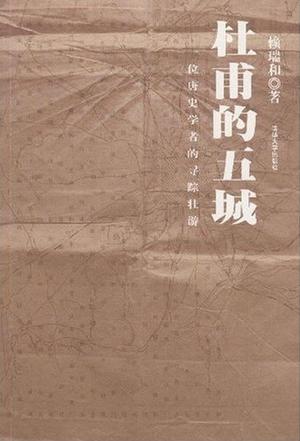
But if it is just these, it may inspire sympathy and empathy in readers when reading, but it is not enough to make people feel regretful and unsatisfactory after reading it, and they cannot bear to end the journey with the author. As a cultural traveler who studies the history of the Tang Dynasty and is especially proficient in the history of the frontier fortresses of the Tang Dynasty, Larry has his own unique knowledge structure and humanistic map, so he can outline the dusty historical context beyond the places people are accustomed to. Those places we are familiar with actually have richer meanings. Intentions, such as the huge underground granary in Luoyang City, places unknown to us that once occupied an important page in history, such as the "Five Cities are so far apart" important frontier town, such as the route of An Lushan's troops from Yuyang to march into Chang'an, etc.
What is even more rare is that the author does not make the journey full of book bag atmosphere and winter warmth. All these thrilling historical situations are quietly interwoven into current real life, allowing readers to unknowingly feel the "unspeakable sadness" about history and life more deeply.
Thus, I think that today's various private tours are not "private" enough, because they have already set up the posture of being watched, blindly seeking dangers, surprises, and likes, which is not a true "tour", but full of strategy and Baidu homework. Traveling is not for escape and comparison. If you cannot live your current life well, you will not become a traveler in the true sense. But in the final analysis, travel is a personal matter. Just like there is no fixed rule, just feel at ease.
