
Josef Stalin was once omnipotent, but on the night of March 1, 1953, he suffered a stroke, and he received perhaps less care than an ordinary office worker in the Soviet Union. He had the best security team, but he could not escape the fate of "collapsed on the ground for several hours after a stroke, unable to ask for help, and wet all over his body."
Although the servants and guards were disturbed by Stalin's long absence from the room, they did not dare to disturb him. When his colleagues called to inquire, the Guard hesitated and finally called a doctor - but not Stalin's personal doctor. In the previous "Kremlin Doctors Case", his personal doctor and a group of doctors who specialized in treating dignitaries had been arrested for treason. The horrified doctor recommended "absolute silence, eight medical leeches into his ears, an ice pack on his head, a milk of magnesia enema and the removal of his dentures". On the evening of March 5, Stalin passed away.
Stalin did not die at the hands of his closest colleagues, despite the rumors and speculations - Joshua Rubinstein was right to refute them. However, they did not try their best to save Stalin. In the last few years of his life, Stalin's health deteriorated, his workload was greatly reduced, and he was very suspicious of certain things. He launched an anti-Semitic campaign simply because he could not trust the Jews, and he may have been preparing for a new round of purges and deportations. Thanks to Stalin's cruelty and frugality, the Soviet economy returned to its previous level shortly after the war, but Stalin had no interest in improving the people's quality of life.
Stalin’s last days were dramatic, and Rubinstein tells them brilliantly, with a special focus on the anti-Semitic movement in the Soviet Union, on which he was an expert as the author of Stalin’s Secret Massacres (2001). What happened next is really interesting. Rubinstein places most of the new book in the year after Stalin's death - his old partners, members of the Politburo, including Vyacheslav Molotov, Georgy Malenkov, and Nikita Khrushchev, quickly launched a large-scale fundamental reform plan and tried to restore old relations with Western countries, which shocked almost everyone.
There are similarities between "Stalin's Team: A Dangerous Life in Soviet Politics" and "Stalin's Last Days", which I published last year. Of course, we didn’t know what each other was writing at the time. Although we tell stories from the same time, I focus on analyzing the domestic political situation of the Soviet Union, while Rubinstein pays more attention to the Soviet Union's foreign policy and international situation. If you were born in my generation and lived through the Cold War atmosphere created by John Foster Dulles, you may wonder whether things were really that bad. The impartial Rubinstein answered in the affirmative in his book.
The new leadership’s reform speed and boldness are quite astonishing. At Stalin's funeral, Malenkov, the new head of the government, talked about de-escalation, and Lavrenty Beria, the new head of the National Security Council, discussed legality and constitutional protection. Within a few weeks, the anti-Semitic campaign was halted and the (mainly Jewish) doctors involved in the “Kremlin Doctors Case” were acquitted.Subsequently, one million Gulag prisoners were pardoned, police powers were reduced, the government promised more consumer goods and public housing, cultural controls were relaxed, and relations with the West improved.
Although he was slightly reluctant, Rubinstein still made an objective evaluation. Although there is a lot of evidence that Stalin's close colleagues were not enthusiastic about anti-Semitic movements and took passive boycott actions in 1952, Rubinstein pointed out: "They did not stop the persecution of Jews out of conscience." When evaluating some policies, Rubinstein also made a similar analysis. He did not feel that the new leaders really wanted to change. "They were just reforming for the sake of reform." The nature of those policies was not clear, maybe it was just "a signal to move closer to the West"?
Although the Soviet Union expressed its attitude of seeking to ease Cold War relations, Americans did not want to hear this news. President Dwight Eisenhower and Secretary of State Dulles, who came to power in January 1953, continued to pursue Cold War policies and had an unfriendly attitude toward the Soviet Union. To them, the Soviets were disturbingly evil. Time magazine called this new change in the Soviet Union "puzzling, delightful, and sinister." Dulles insisted that the United States should not waver even if the Soviet Union made conciliatory gestures. AJ Liebling, a writer for The New Yorker, believes that for Dulles, changes in the Soviet Union were actually a threat to U.S. foreign policy.
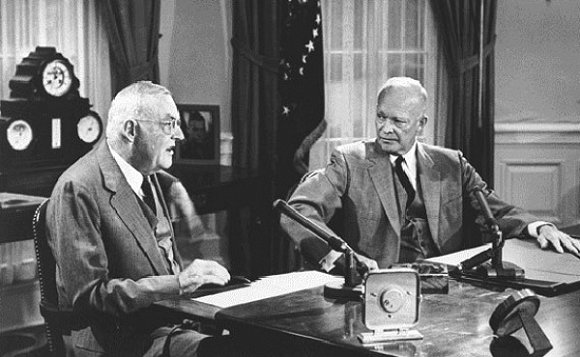
Of course, some Western countries responded positively to the Soviet move. In Britain, the astute and well-informed Soviet expert Edward Crean Kershaw told the Observer that big things were about to happen. At that time, the outgoing Churchill believed that this was a historic turn of events and wrote to Eisenhower. When Churchill convened a meeting of the House of Commons to discuss policy toward the Soviet Union in the post-Stalin era, Eisenhower was horrified. Dulles clearly opposed face-to-face negotiations with the Soviets, whether officially or privately. Dulles had an "almost superstitious fear". Perhaps to him, the Soviet Union was a horned devil, and he must not be given the opportunity to cause harm to the world.
In Rubenstein's view, from Stalin's death to the East Berlin uprising in June 1953, the United States missed opportunities to meet with the new Soviet leaders. Part of this was due to poor information and bad advice: Experts told Eisenhower that Stalin's successor was more dangerous and formidable than he was. Eisenhower himself also hoped to have peace talks with leaders who truly represented the Soviet people.
Rubinstein pointed out in his introduction that "for complex reasons, the Soviet Union and Western governments that have experienced many years of Cold War have never been able to trust each other." However, "both sides are at fault" is only a relatively safe statement. According to Rubinstein's analysis of relevant events in 1953, his conclusion seems to be different from this.
There is no doubt that Western countriesThe refusal to reconcile with the Soviet Union in 1953 was reasonable. After all, this was not the fault of one side, and there were also differences within the Soviet Union. However, according to Rubinstein, the Soviet Union had taken the first step toward peace talks, only to be rejected by the United States.
Secretary of State Dulles has always felt that the Soviet Union was a huge threat. On May 8, 1953, he stated that the Soviet Union was the "most terrifying and deadly threat" to Western civilization in the past 1,000 years, and categorically rejected the olive branch offered by the Soviet Union. Therefore, the fact that U.S.-Soviet relations did not ease after Stalin's death seems to have something to do with the United States.
(Translation: Shen Yirou)
